
Hammond Epoxy Flooring installs basement floor epoxy in Hammond, IN, serving surrounding cities including Griffith, Riverdale, Harvey, Dyer and Homewood. Basements are the hardest floors to coat well, because the slab sits against wet ground on its underside, and in more than 20 years on concrete we have learned that the moisture question has to be answered before anything else.
So every basement job starts with a test, not a color chart. We map cracks, efflorescence, paint and old patches, set a moisture test and write the result into the scope. The proposal then names the test, the reading the slab must meet, the primer and coating system, the coat count and the finished thickness.
We are just as clear about what a coating cannot do. It is not waterproofing, it is not flood protection, and it is not radon mitigation. When a basement needs a plumber, a drainage contractor or a licensed radon mitigator first, we tell you that before we quote a floor.
Moisture Comes First in a Basement
Vapor Moving Up Through the Slab
Concrete is porous, and a basement slab sits on soil that is often damp. Water vapor moves up through the slab constantly, and when a coating seals the top, that vapor pushes against the underside of the film. The result is blisters, bubbles and peeling, often within the first year.
Newer homes may have an under-slab vapor retarder meeting ASTM E1745, but many older basements were poured without one, or with one that has since been punctured. We do not assume either way, because the test is cheap and a failed floor is not.
The Moisture Tests We Use
The ASTM D4263 plastic sheet test is a quick first screen: a sheet is taped to the floor and checked for condensation. For a real number, we use the ASTM F1869 calcium chloride test, which measures vapor emission rate, or ASTM F2170 in-situ relative humidity probes set into drilled holes in the slab.
The result is compared with the coating manufacturer’s limit and with the moisture thresholds referenced in ASTM F710. If the floor passes, a standard system goes down. If it does not, the plan changes before you pay for it.
Moisture-Mitigation Primers and Their Limits
A moisture-mitigation primer is a dense epoxy designed to hold back vapor emission up to a rated level, so a coating can go over a slab that would otherwise fail. It adds cost, but on many basements it is what makes a coating possible at all.
It is not a cure for liquid water or hydrostatic pressure. A slab that takes water through cracks during heavy rain, or sits on a high water table pushing up from below, needs drainage or a sump system first. We use mitigation primers where the reading supports them and say plainly where they will not work.
Hammond Basements: Ground, Water and Sewers
Sandy Lake Plain, High Water and Slag Fill
Northern Lake County sits on sandy lake-plain ground, with a shallow aquifer under parts of Hammond and pockets of muck in old low areas. Groundwater can run close to the slab, especially in spring and after heavy rain, which raises vapor drive through basement floors.
Parts of north Hammond were also built over steel-mill slag fill, which can expand as it hydrates and has been known to lift floor slabs. We read cracks for fresh, widening or offset movement before coating, because a slab still being pushed up will crack through any coating.
Sewer Backups and Backflow Valves First
Hammond basements have taken sewer water in heavy storms: 74 confirmed backups after the July 5, 2023 storms, and at least 200 homes reported after an August 2025 storm. A floor coating does nothing to stop sewage coming up a floor drain.
A backflow valve installed by a licensed plumber, along with a working sump pump where there is one, is the protection that matters. The Hammond Sanitary District has offered homeowners a reimbursement toward backflow valves, so it is worth checking the current terms before a new floor goes in.
Sump Pits, Drain Tile and Floor Drains
Many basements have a sump pit fed by perimeter drain tile, plus one or more floor drains. A coating has to stop cleanly at the sump lid so the pit can still be opened and the pump serviced, and it has to meet a floor drain without changing the pitch that carries water to it.
We terminate the coating neatly at each fixture and keep it out of the drain body. Grinding dust is vacuumed at the machine rather than rinsed toward a drain, so nothing ends up in the sewer line.
Preparing an Older Basement Slab
Paint, Mastic and Old Patches
Most of Hammond’s homes were built before 1980, and close to a third before 1940, so basement floors often carry layers of paint, old tile mastic and patching. A new coating bonds no better than the weakest layer beneath it, so all of that comes off.
We diamond grind to sound concrete, remove failed patches and rebuild them with repair material compatible with the coating. Acid etching is never used, because it leaves residue and an uneven profile that hurts the bond.
Efflorescence and Salt Deposits
White, chalky deposits on a basement floor are efflorescence, salts left behind as water moves through the concrete and evaporates. They show where moisture is moving, and painting over them traps the salts under the coating, where they keep growing and push it off.
We grind the deposits away, test the slab and decide whether a mitigation primer is needed. If efflorescence is heavy and widespread, the moisture source usually needs attention before any coating.
Cracks and Hydrostatic Pressure
Hairline shrinkage cracks are opened, filled and ground flush before coating. A crack that leaks water during storms, or a floor that heaves or seeps across its surface, is a sign of hydrostatic pressure, water pushing up from below the slab.
No coating holds against that pressure. The fix is drainage, a sump system or foundation work, and we tell you that first rather than coating a floor that will lift.
Basement Floor Systems by Room
Laundry and Utility Rooms
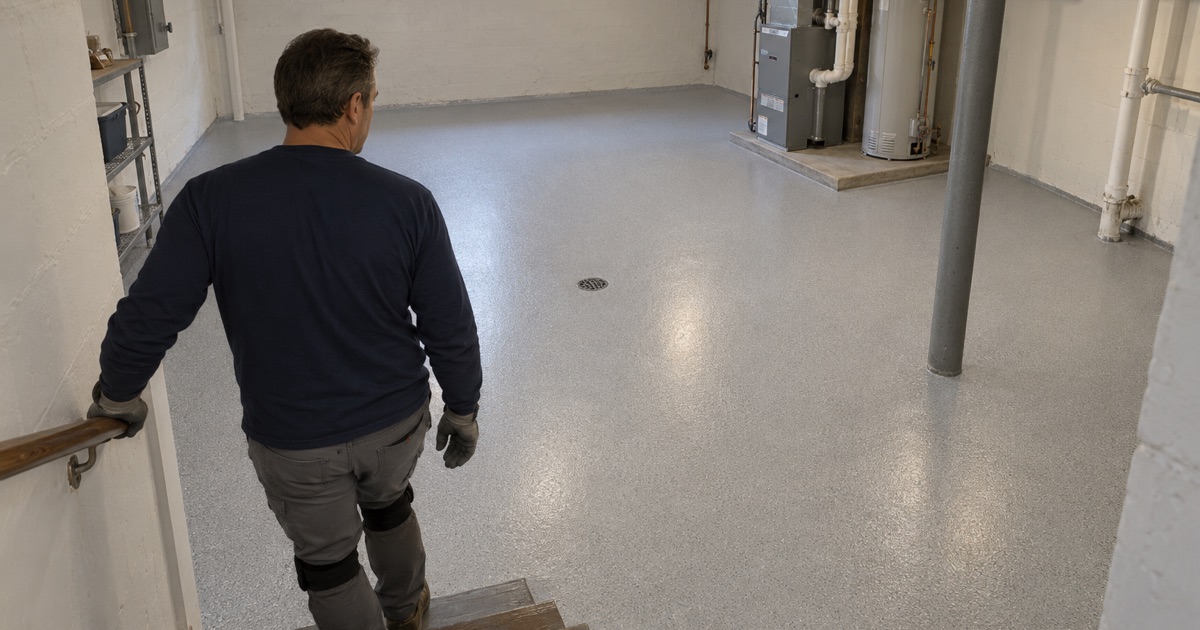
A coated laundry or utility room cleans easily under a washer, water heater or furnace and shows leaks clearly, which helps you catch a problem early. A solid color or light flake system with a satin topcoat is a common choice, and the coating stops neatly around equipment and drains.
Workshops and Home Gyms
A basement workshop needs a harder topcoat that resists dropped tools and solvents, plus a broadcast for grip. A home gym needs a floor that takes rubber mats and the occasional dropped weight. We match the topcoat and texture to how each room will actually be used.
Finished Living Space and Flood-Resistant Floors
In a basement that has flooded before, a coated slab is a practical floor because it can be cleaned and dried after water, unlike carpet over pad. FEMA Technical Bulletin 2 lists concrete and similar materials as flood damage-resistant, which is one reason many owners choose a coating over a soft floor below grade.
We are careful about the claim, though. A coating makes cleanup easier; it does not keep water out or protect the house in a flood. The floor is one part of the plan, not the plan.
- 20+ Years on Concrete
- Moisture Test in Every Scope
- Free Written Estimates