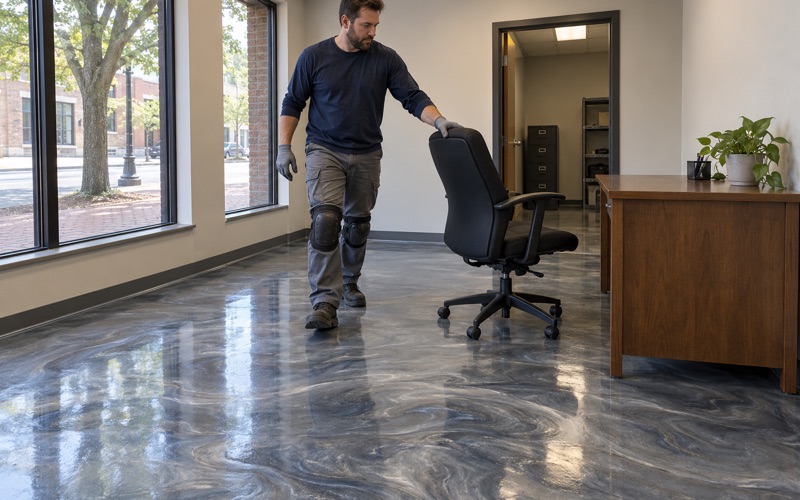
Hammond Epoxy Flooring has spent more than 20 years on epoxy-flooring in Bridgeview and the towns around our Hammond base, and the job that teaches the most is the one that cannot close. A restaurant, bakery or shop still needs a floor that cleans up and holds up, but it may be able to give a crew only a few hours. So the first question we ask is not about color or gloss. It is how long the room can sit empty, and who shares the air with it.
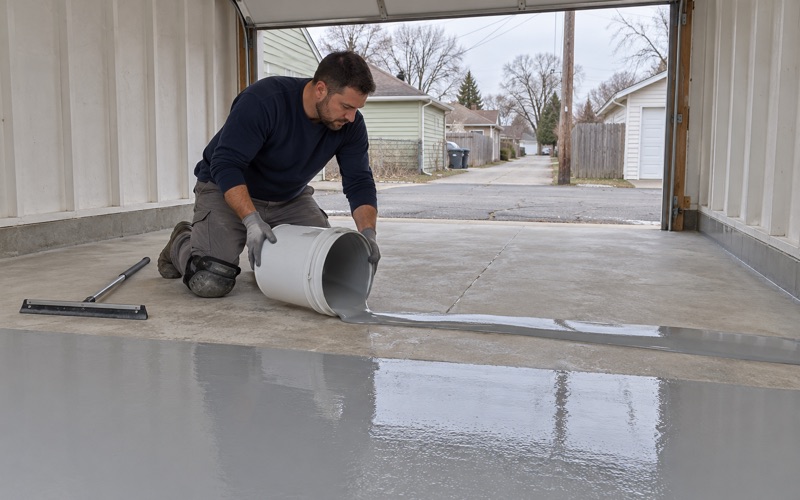
That answer decides which resin family comes off the truck. A conventional 100% solids epoxy is a strong, forgiving system, but it wants days before carts, chairs and steady foot traffic come back. A fast-cure methyl methacrylate floor, usually shortened to MMA, can go back into service far sooner, and it brings a strong smell that has to be planned around from the first conversation.
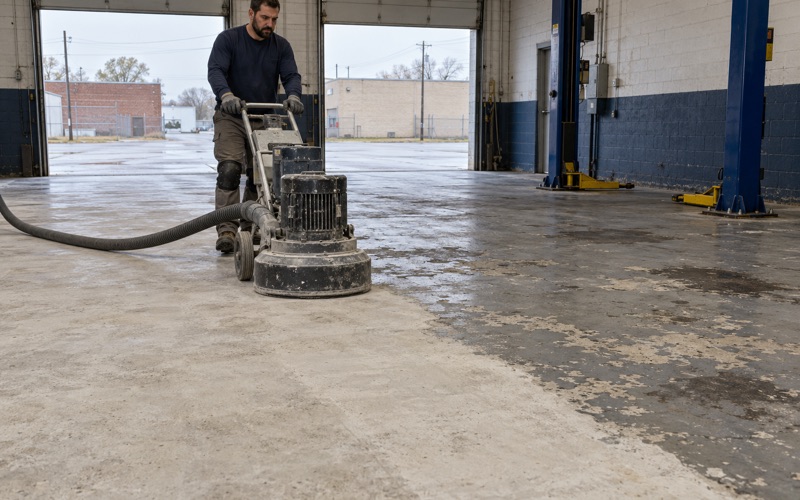
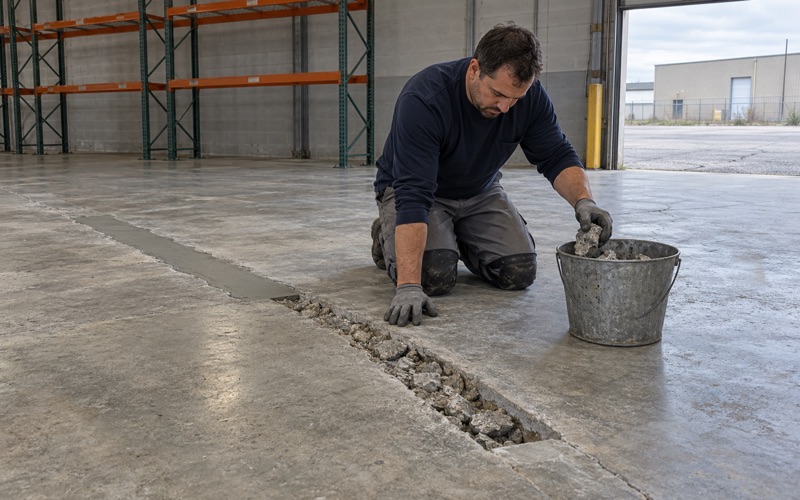
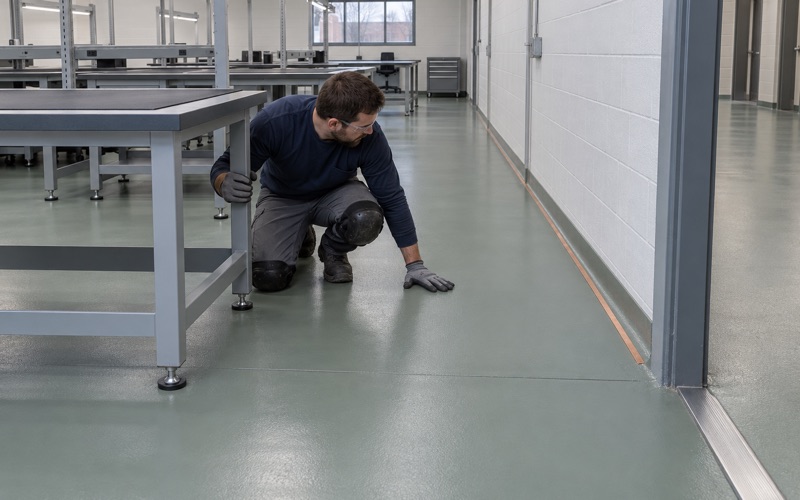
Whatever the system, the slab is opened by diamond grinding or shot blasting to a measured profile, never by acid etching. Cracks, spalls, old paint and patches are mapped before we price anything, and a slab that should be repaired first is called out first. Moisture testing is written into the scope, so the proposal names the test and the reading the concrete has to meet.
A Harlem Avenue Cafe That Stays Busy Past Midnight
Ramadan nights at 9150 South Harlem Avenue
In March 2026, WBEZ reported on Ramadan nights along Harlem Avenue and 87th Street, describing long lines that moved quickly and crowded dining rooms. At Milk Cafe Bakery, 9150 South Harlem Avenue, staff told the station that business picks up at 6:30 in the evening and stays busy until 2:00 a.m. Families tend to arrive two to three hours after iftar, and younger customers come later still.
We use the bakery only as a public example of how this stretch of the street keeps time. It is not a customer of ours, and we have not seen its floor or heard of any plan for floor work there. The same reporting found other late hours nearby, with Qamaria’s Bridgeview shop open 24 hours, and that late rhythm is what shapes a floor schedule on the avenue.
One night instead of one week
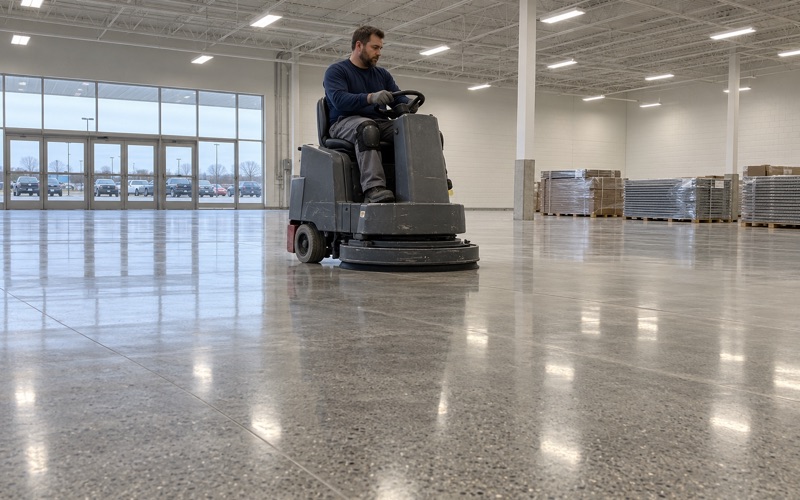
A storefront that does its biggest month between dinner and the small hours has very little room for a closure. The usable window is the gap between the last customer and the morning prep, and in a busy month that gap may be a single night. A system that needs several days before it can carry traffic simply does not fit inside it.
Ramadan follows the lunar calendar, so the busy month moves earlier each year and the slower weeks around it move too. For an owner on Harlem Avenue, the better floor window may fall outside that month entirely. We would rather plan the work around the owner’s own calendar than force a multi-day cure into the one week the room cannot spare.
Looking for epoxy-flooring closer to Hickory Hills? See Epoxy-Flooring in Hickory Hills.
What Fast-Cure MMA Floors Are For
Back in service in about an hour
MMA systems exist for exactly this squeeze. Stonhard says its methyl methacrylate floors are ready for normal operations in as little as one hour after installation, and it recommends a one- to two-day or overnight installation for restaurants and hotels to limit lost revenue. Sika describes its PMMA floors as super-fast curing even at low temperatures and lists commercial kitchens among their uses.
That one-hour figure is one maker’s claim for its own products, not a promise that holds for every system, mix or room temperature. Our proposal names the product line, the coat count and the finished thickness, and the cure time we plan on comes from that product’s own data. If the window is tighter than the product allows, we say so before the job is booked rather than on the night.
How MMA differs from a 100% solids epoxy
An epoxy cures through a slow chemical reaction between resin and hardener, which is why it is forgiving to place and slow to return to service. MMA cures by a much faster reaction, so each coat sets quickly and the next can follow within the same shift. That speed is the whole reason to choose it, and it comes with less time to fix a mistake once a coat is down.
For a dining room or a counter area that can close for several days, a 100% solids epoxy or a urethane cement system is often the calmer choice. For a room that gets one night, MMA is the family that makes the schedule possible. We lay both options next to each other in writing so the owner is choosing between known trade-offs, not between sales pitches.
The prep does not get shorter
A fast resin does not make a fast slab. The concrete still has to be ground open, cleaned and checked for moisture before the first coat, and on a one-night job that preparation often takes more of the clock than the resin itself. Where the floor needs crack repair or patching, that work may have to happen on an earlier night of its own.
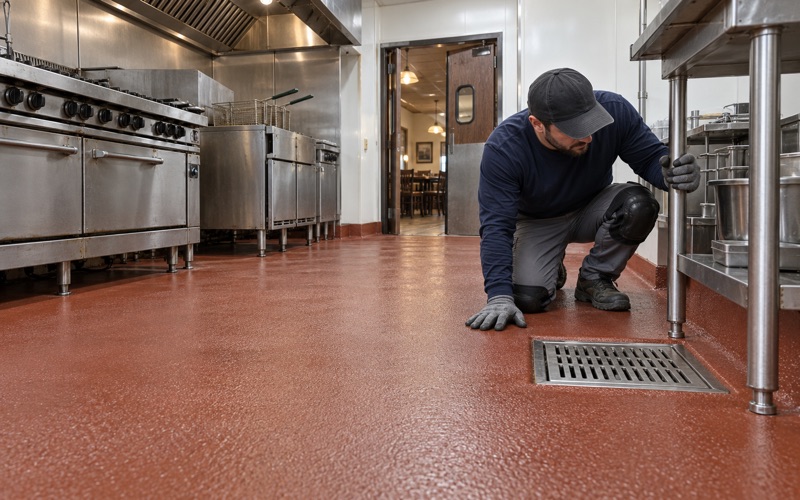
Grinding dust is vacuumed at the machine instead of being swept or washed toward a floor drain. In a food business that matters twice, because loose dust settles on every shelf and surface left in the room. A clean, well-captured grind is also what lets the crew move straight from prep into the first coat without losing an hour to cleanup.
The Trade-Off Is the Smell
MMA is not an odorless floor, and anyone who says otherwise is selling the wrong thing. Its monomer smell is strong, and Sika states plainly that proper ventilation is required during installation to avoid problems from the odor. A one-night floor in a shared-wall storefront row is therefore planned around the air as much as around the clock.
Ventilation is part of the scope
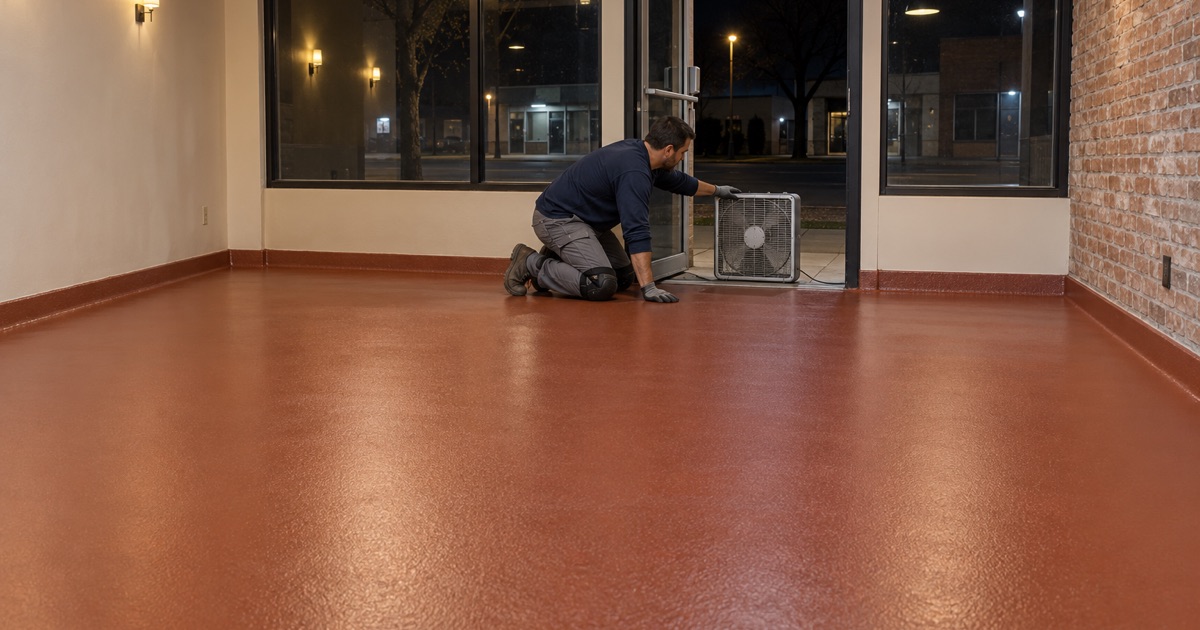
We write the ventilation plan into the proposal the same way we write the product and the thickness. That means deciding which doors stay open, where fans pull air out of the building and where fresh air comes in, before the first can is opened. A room that cannot be ventilated hard is not a room for MMA, however attractive the cure time looks.
One contractor source warns that unless ventilation is very good, MMA floors are not suitable in occupied areas because of the odor. We read that as a firm limit rather than a suggestion. The space is empty of staff and customers during the work, and nobody is asked to keep a counter open while the resin goes down.
Food and packaging out of the room
A bakery or cafe holds flour, sugar, pastry, cups, lids and boxes that can all take on a smell. Before an MMA night, food and packaging come out of the room entirely or go into sealed containers, and open shelving is cleared rather than covered loosely. Nothing in our plan treats an MMA install as safe to run around exposed food.
That clearing takes time and labor on the owner’s side, so we put it on the schedule as its own step with its own start time. It also sets the true length of the night: move-out, grinding, coats, ventilation and move-back have to fit between closing and the morning bake. If they do not, the job is split or moved.
The shop next door shares the air
Many storefronts along a commercial row share walls, ceilings and sometimes return air with their neighbors. An odor that clears from one unit by morning can still drift into a bakery, salon or office next door during the night. The neighbors are told before the first can is opened, not after someone calls about the smell.
We also look at where the exhaust air goes once it leaves the building. A fan pointed at a neighbor’s intake or a rear door used by another tenant simply moves the problem next door. Coatings are also chosen inside the VOC limits of 35 Illinois Administrative Code Part 223, which bind the applicator as well as the maker.
Choosing the System by the Hours You Actually Have
Matching the resin family to the closure window
The simplest way to choose is to start with the hours and work backward. A room that can close for a week can take a 100% solids epoxy with a polyaspartic or urethane topcoat. A room that can close for a weekend may suit a faster topcoat over an epoxy base, and a room that gets one night is the case MMA was built for.
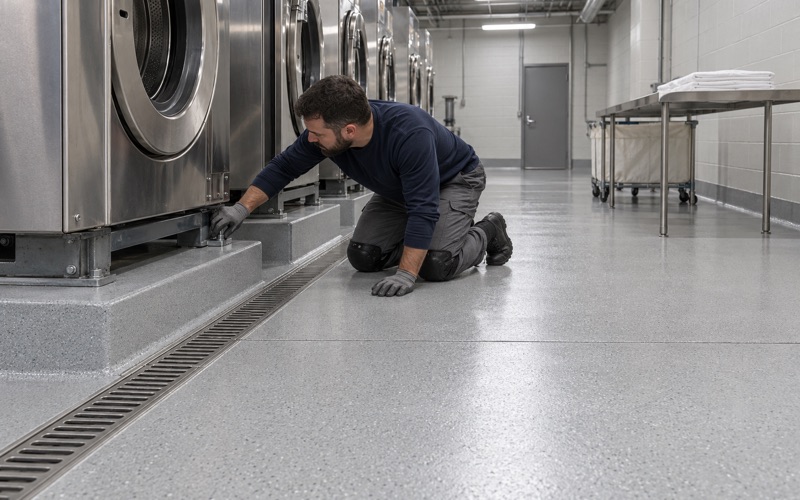
Slip resistance is specified by the broadcast media and topcoat, whether quartz aggregate in a wet prep area or a finer texture at the counter. Warranty exclusions are read out before the job is sold, starting with moisture, the failure most coating warranties leave out. That conversation is the same whichever resin family the hours point to.
Permits and paperwork in Bridgeview
The Village of Bridgeview Building Department works from the village hall on South Oketo Avenue. Its permit submittals call for the contractor’s license, a $10,000 surety bond and a certificate of insurance, and no permit is issued without drawings. Illinois licenses no general, flooring or coating contractor, so the village license and bond are the credential that counts here.
We check those requirements before a commercial job is booked rather than after the night is set. A storefront that has already moved its stock out cannot afford to lose the window to a missing document. The paperwork is lined up first, then the closure is scheduled.
Fast-cure and low-odor choices for a garage or basement
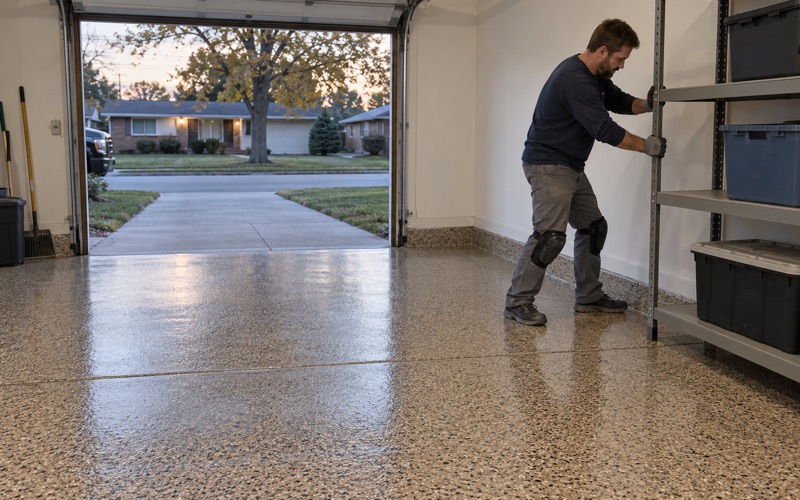
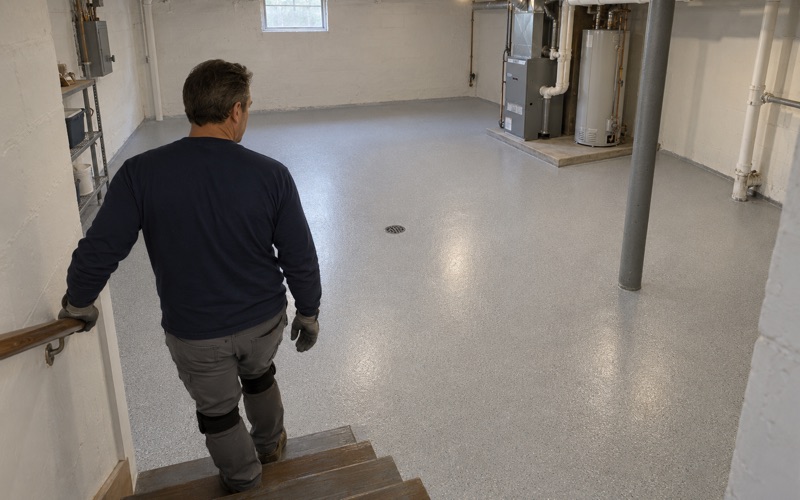
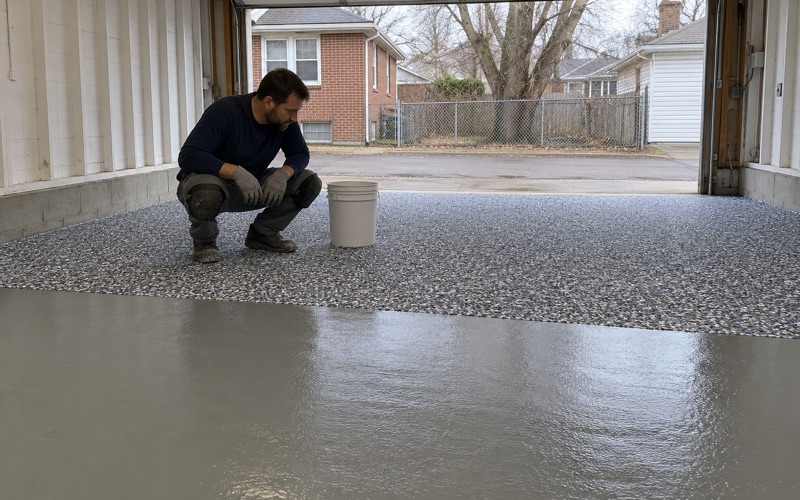
At home the trade-off reads differently. An attached garage or a basement shares air with the living space, so a strong-smelling MMA system is rarely what we would suggest for a house. A 100% solids epoxy base with a polyaspartic topcoat and vinyl flake broadcast is the usual garage choice, and we name each product’s cure and odor notes in the proposal.
Bridgeview has seen repeated flood losses, including homes along Roberts Road and 100th Place, and the village says most of its area sits in a high urban flooding susceptibility zone. A floor coating is never sold as waterproofing or flood protection. It can make a basement or garage floor easier to clean after water comes in, but keeping the water out is a job for drains, valves and grading.
- 20+ Years on Concrete
- Moisture Test in Every Scope
- Free Written Estimates