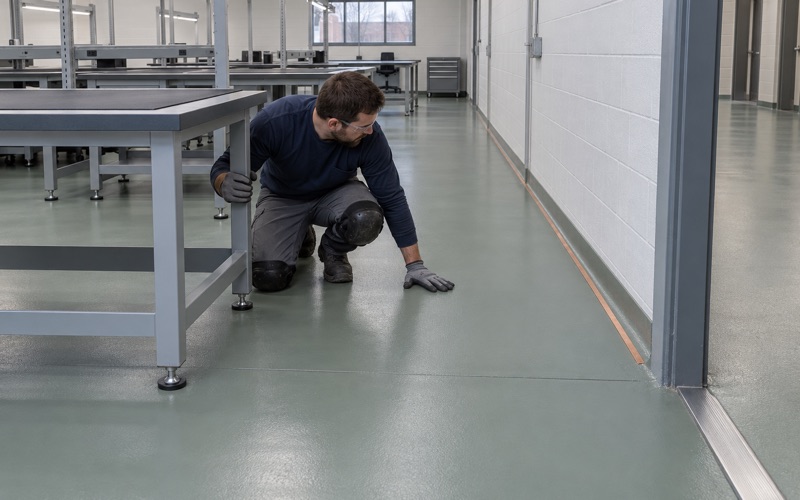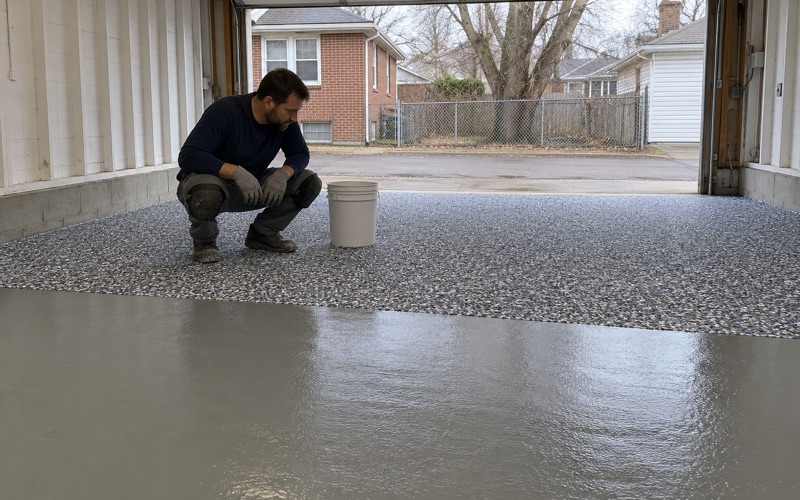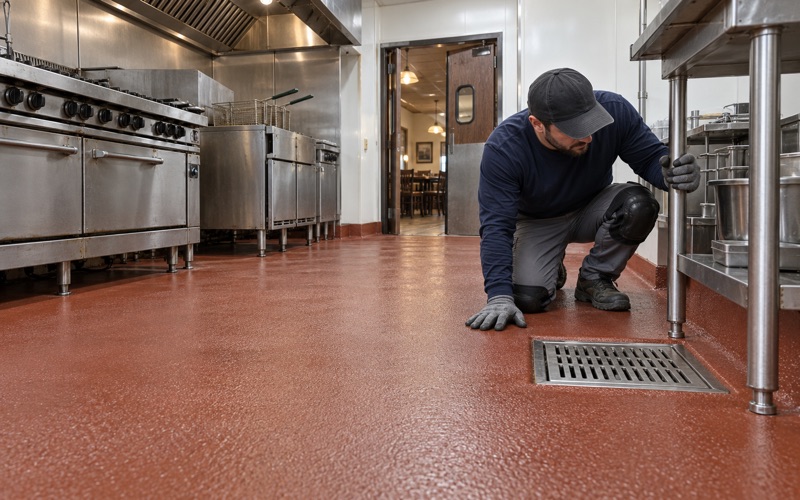
Hammond Epoxy Flooring takes on epoxy-flooring in Brookfield with more than 20 years in the trade, and this page starts from a white ring on a concrete floor rather than from a color chart. That ring is what diesel exhaust fluid leaves behind when a drip dries. Whether it sits on top of the floor or sinks into it depends on what the slab is wearing.
A bare slab is porous, so a spill of almost any water-based fluid works its way into the surface before anyone sees it. A properly bonded coating closes that surface, which keeps a drip where it landed and leaves the cleanup to a mop and a bucket. We explain that difference in plain terms before anyone picks a system, because it changes how the floor gets looked after for years.
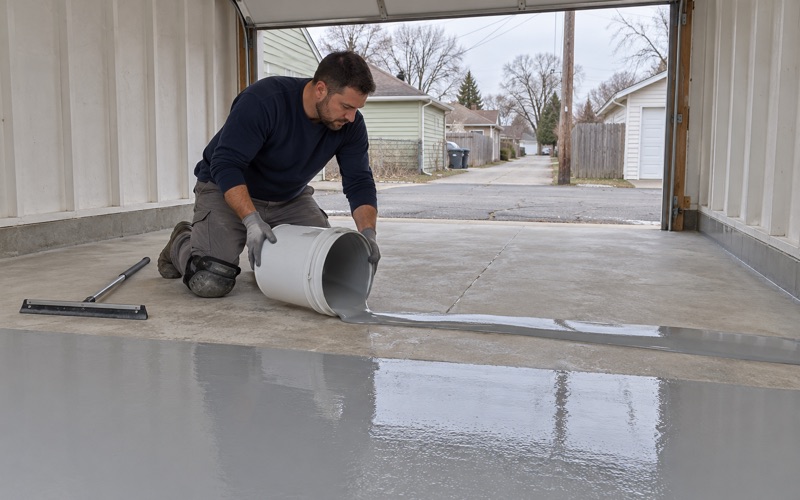
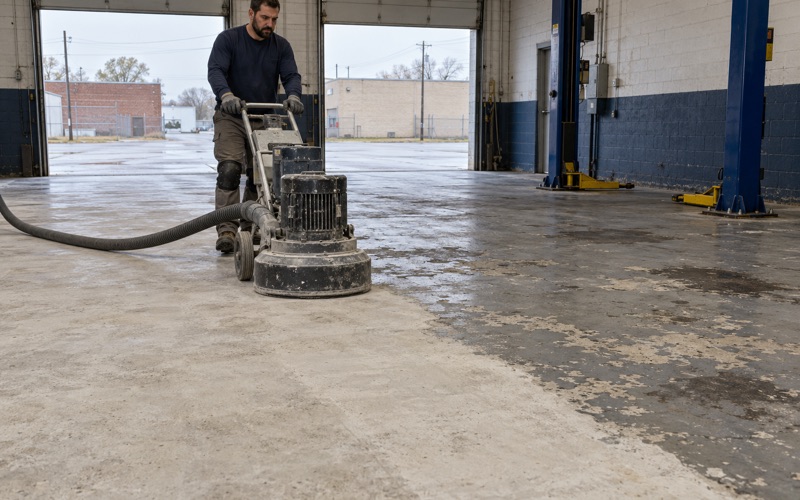
The bond itself comes from the preparation. We open the concrete with diamond grinding or shot blasting to a measured surface profile, never with acid, and the grinding dust is caught by a vacuum at the machine rather than swept out the door. The proposal then names the product line, how many coats go down and the finished thickness, so the floor can be checked against the page.
A Cartage Fleet on Plainfield Road and the Fluid Diesels Carry
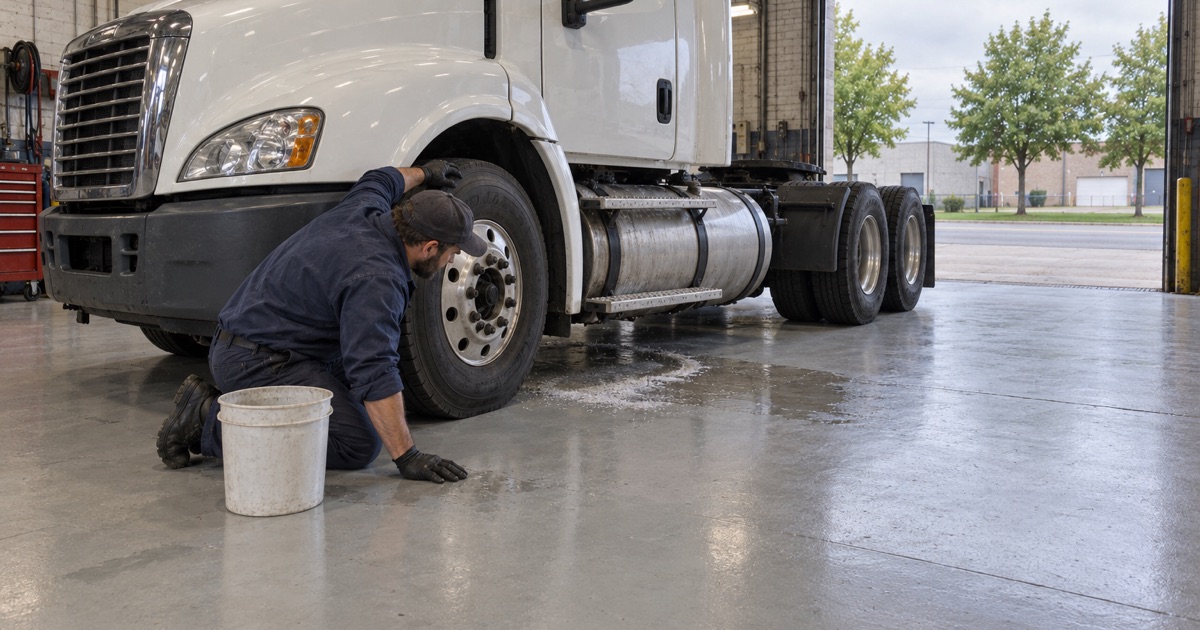
The village’s second-largest employer in 2023
Brookfield’s financial report for 2023 lists its ten largest employers, and second on that list, behind the zoo, is Conners Transportation with 150 employees. Federal motor carrier records show a for-hire carrier spelled Connors Transportation at 9100 West Plainfield Road, an address that falls inside the village in Lyons Township. We take the two to be the same firm from the name, the town and the trade, though that link is our inference rather than a confirmed fact.
The carrier’s federal record lists 31 power units and 31 drivers, with 809,503 miles reported for 2024, and a trucking directory describes it as a dedicated cartage company hauling general freight, produce, intermodal containers, beverages and paper products. Connors is not a customer of ours, and we have not seen its shop, its fueling area or its floors. It matters here as a reminder that heavy diesel trucking is part of Brookfield’s working economy.
Diesel exhaust fluid: urea, water and white crystals
Modern diesel trucks carry a second fluid alongside their fuel. Diesel exhaust fluid is a solution of 32.5 percent urea in 67.5 percent deionized water, and it lives in its own tank with its own lines and fittings. It is the one shop fluid that tends to announce itself on a floor, because of what happens when the water leaves.
When DEF evaporates, it leaves white crystals of urea where the drip sat. A fire-and-rescue driver bulletin adds that DEF is not corrosive to skin and that spills can be safely washed down with water. That pairing is what makes it worth planning a floor around: a fluid that marks the surface clearly and cleans up with water.
Where the drips collect
Wherever DEF is topped off or a DEF line seeps, the floor underneath collects the drips. In a truck shop or a fueling bay that is often the same few square feet, visited again and again. Those spots are where a floor either shows a problem clearly or quietly absorbs it, which is the difference this page is about.
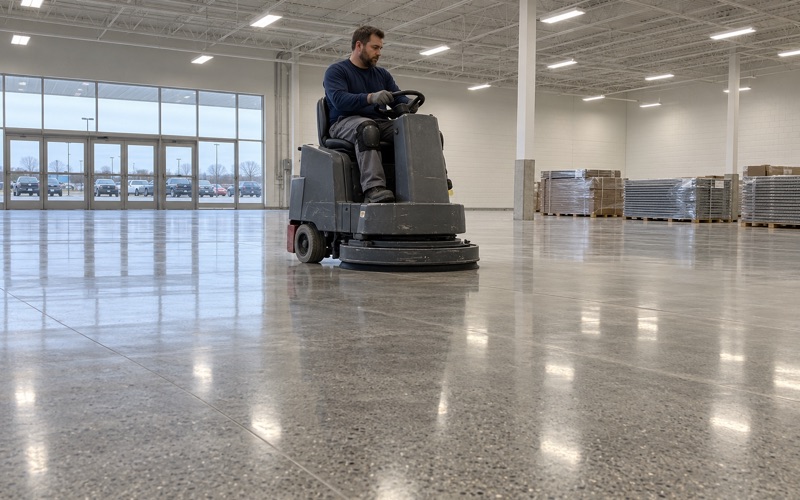
For the owner of a floor like that, downtime is usually the first question. We phase plant and shop floors around shifts, with overnight and weekend windows when a space cannot close, so a bay can come back into service on a schedule the owner sets. For a working truck floor, a urethane cement system is one of the options we price alongside epoxy.
Looking for epoxy-flooring closer to La Grange? See La Grange Epoxy-Flooring.
What a Truck Maker Does About a DEF Drip
Freightliner’s bulletin on crystal buildup
Freightliner Service Bulletin 49-33, issued in May 2012 for DEF and coolant line and fitting leaks, draws the line between normal and abnormal. It says a small amount of white crystal or powder around a DEF fitting is normal. Excessive crystal buildup, caused by DEF evaporating in the air, or dampness is what the bulletin treats as an indication of a leak.
The bulletin covers Cascadia, Business Class M2, Coronado and 108SD and 114SD trucks, and it notes that engine coolant runs through tubes in the DEF tank to keep the fluid from freezing. For a floor, the useful part is simpler. The truck maker reads white crystals on and around the equipment as information, and the same crystals on the floor beneath are part of that story.
Hot water, not a solvent
Freightliner’s instruction for a suspected leak is to clean the area around it thoroughly with hot water before pressurizing the system and inspecting it, and fittings and lines are cleaned with hot water before they are reconnected. There is no degreaser in that sequence and no solvent. DEF is a urea solution, not oil, and the cleanup follows from that.
A truck maker’s service tip adds a warning that carries over to the floor. Spilled DEF that is left to dry, or only wiped with a cloth, leaves a white residue that can later be misdiagnosed as a leak in the dosing system. Rinsing a drip away when it happens keeps the next white ring meaningful instead of confusing.
What a coating can and cannot do
A floor coating does not stop a DEF line from seeping and is no substitute for repairing the truck. The fitting, the line or the tank still needs a mechanic. What a coating changes is where the drip ends up and how much effort it takes to remove, and that is a narrower promise than some sales pitches make.
A sealed floor still needs cleaning, and we say so in the proposal. The same honesty applies to warranties, which we read out before the job is sold, starting with moisture, the failure most coating warranties leave out. A buyer should know what the paperwork leaves out before the grinder is unloaded.
Why a Sealed Floor Shows the Drip and Rinses It Away
Bare concrete soaks it in
On bare concrete, a DEF drip does not stay where it fell. The water carries the urea into the pores of the slab, and as it dries the crystals bloom in and on the surface. The floor ends up with a white mark that a quick wipe does not fully lift, and the next drip lands on top of the last one.
On a sealed, nonabsorbent floor the same drip stays on top. It dries as a visible white ring on the coating, which is the leak sign the truck maker describes, now showing on the floor as well as the fitting. A hot-water rinse and a mop take it away, and the floor is back to a clean surface that shows the next drip as plainly as the first.
A bond the drip cannot get under
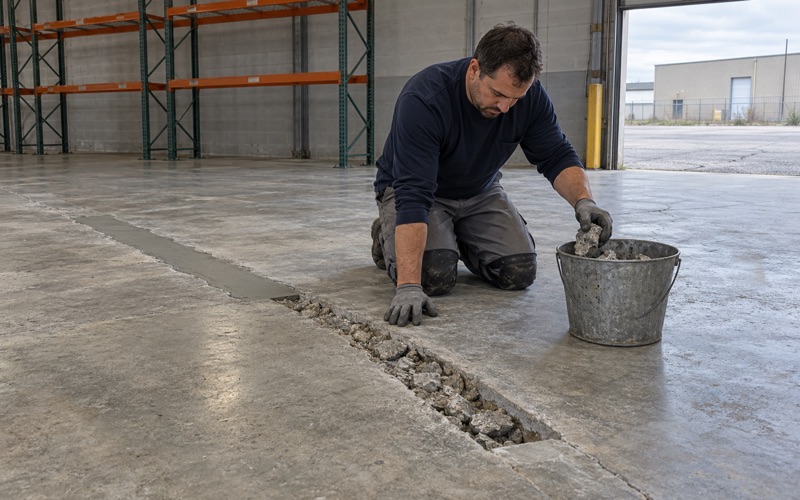
The visibility only holds if the coating stays bonded, which is why the preparation we described above is measured against an ICRI concrete surface profile rather than eyeballed. Before pricing, we also map cracks, spalls, old paint and patched areas. A slab that should be repaired or replaced is flagged first, because a coating over a failing slab inherits the failure.
For a floor that sees diesel trucks or a diesel pickup, our usual starting point is a 100% solids epoxy base with a polyaspartic or polyurea topcoat. A vinyl flake or quartz aggregate broadcast adds texture, and slip resistance is specified by the media and topcoat we use rather than promised as a slogan. Smoother finishes rinse faster, textured ones grip better, and we put that trade in writing.
Moisture from below in Brookfield
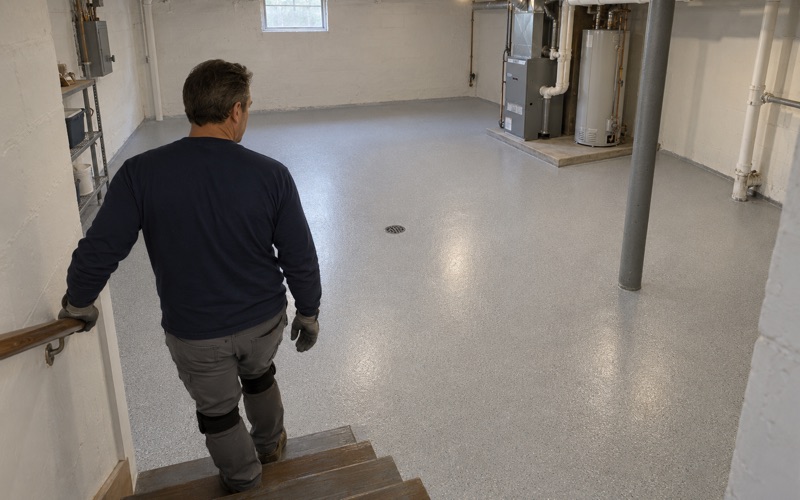
Brookfield’s own flood information says the village is uniquely vulnerable to flooding because of its proximity to waterways and a high water table due to bedrock, and that basement flooding is a major concern. Groundwater pressing up from under a slab is a different problem from a spill landing on top of it. It can push a coating off the concrete from beneath, whatever the topcoat is rated for.
So moisture testing is written into the scope before the price is final, and the proposal names the method and the reading the slab must meet, whether that is ASTM F1869 calcium chloride testing or ASTM F2170 in-situ relative humidity probes. Where a reading runs high, a moisture-mitigation primer goes into the plan. We never sell a coating as waterproofing or flood protection.
DEF Jugs and Diesel Pickups in Brookfield Garages
Topping off a pickup from a jug
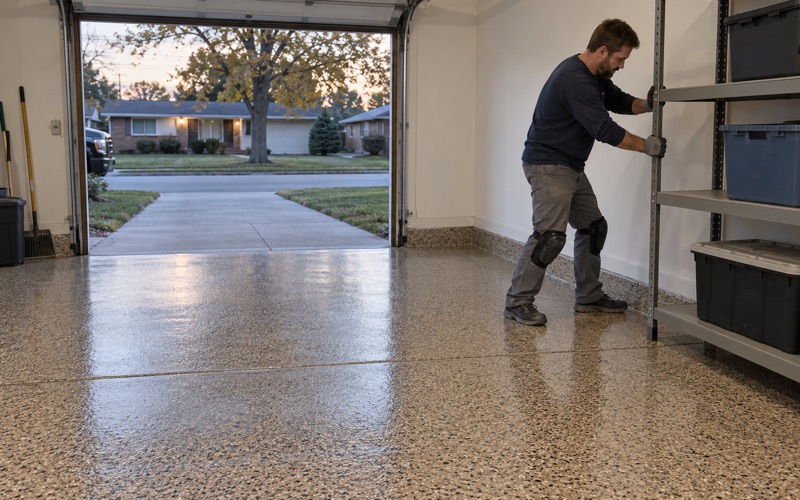
The same logic reaches into a home garage. When a diesel pickup’s DEF tank is topped off from a jug in the garage, a splash or a few drips on the floor are easy to miss in the moment. On bare concrete those drips soak in and dry white, while on a sealed floor they stay on the surface and rinse away.
We suggest keeping the jug, a funnel and a rag on a shelf beside the pickup’s parking spot, and following any spill with plain water rather than letting it dry. The fire-and-rescue bulletin cited above calls the fluid corrosive to aluminum, so a drip on an aluminum step or trim piece deserves the same rinse. None of that requires special products, which is the point of a floor that keeps the drip on top.
Older garages and cure timing
Much of Brookfield’s housing is old. Census figures count 2,543 of the village’s 7,927 housing units as built in 1939 or earlier and another 2,086 in the 1950s, and 5,726 owner-occupied homes are single-family detached. A garage slab that has served an older house for decades may carry repairs, patches or old paint, which is why the mapping step comes before the price.
Cure timing follows the slab’s temperature and the dew point spread at its surface rather than the calendar. An unheated garage in a cold month is told to wait, because a coating that cures too cold or under condensation can develop amine blush or a weak bond. A floor meant to show a white ring clearly has to cure clear and hard first.
Village paperwork before work starts
Every contractor working in Brookfield needs a Village of Brookfield Contractor License, with a fee that is typically $150, and a $10,000 License and Permit Bond. We check that licensing, bond and insurance before a job is booked. Inspections, where a job needs one, call for at least 24 hours of notice, and the village advises allowing two to three days in late March, early April and summer.
The village’s permit page does not name floor coatings, so whether a coating on an existing slab needs a permit is something we confirm with Brookfield before starting rather than assume. Coatings are chosen inside Illinois’ VOC limits for floor and industrial maintenance coatings, which bind us as the applicator. Home jobs also carry a written contract, signed before any grinding begins.
- 20+ Years on Concrete
- Moisture Test in Every Scope
- Free Written Estimates