Hammond Epoxy Flooring brings more than 20 years of epoxy-flooring work to Chesterton, IN, and the garage floors we get asked about here tend to share one demand: they have to carry a car that has just been driven. A tire coming off the road is warm, and warm rubber is harder on a floor coating than most owners expect. Our job is to pick a system and a preparation method that stand up to that, then tell you honestly how long to wait before the first parking.
We open the slab with diamond grinding or shot blasting rather than acid, because a coating can only hold as well as the surface it grips. Before a price is final, the proposal names the moisture test we will run and the reading the slab has to meet. It also names the product line, the number of coats and the finished thickness, so you can check the floor you got against the floor you bought.
What follows covers what hot tire pickup is, why some garage coatings lift where the tires sit, and how return-to-service times differ for cool and hot tires. It also covers what we look at in a Chesterton garage that holds a car its owner cares about. If your floor needs repair before any coating, we tell you that first.
Cruise-In Nights and Driven Cars in Chesterton, IN
Broadway on the last Saturday of the month
From May through September, the Town of Chesterton lists a Downtown Cruise-In on the last Saturday of each month, running from 4 to 8 in the evening at Thomas Centennial Park and Downtown Chesterton. The town’s events page calls it free and open to everyone, and it invites people to bring and display the car, bike, truck or other vehicle they are proud of. For 2026 the listed dates are May 30, June 27, July 25, August 29 and September 26.
A local news story from September 2025 says the Cruise-In has run for more than 10 years and that cars line Broadway from South Calumet Road to Fourth Street. The event is sponsored by Mel’s Detail. We have no connection to the event, its organizer or its sponsor; we mention it because of what it says about how cars in this town get used.
Driven there, driven home
The cars at a Cruise-In arrive under their own power, and the natural reading is that most go home the same evening. That makes a show car’s garage a place where tires come in warm on a regular basis, not once in a while. We are describing a pattern here, not any participant’s garage, since we have not seen one.
It also changes what the garage floor is for. A slab that only sees a cold car parked overnight is an easier job than one that takes a car straight off a summer drive down Broadway. The second case is the one hot-tire ratings and hot-tire wait times are written for, and it is the case we plan around when an owner tells us the car gets driven to shows.
Who sets the rules in town
Chesterton is a town in Porter County, not Lake County, and its Town Hall sits at 1490 Broadway in Westchester Township. Wikipedia places the town across Westchester, Jackson and Liberty townships and counts 14,242 residents at the 2020 census. Permit questions go to the Town of Chesterton Building Department, and we confirm the town’s requirements before a job is booked.
All three of those townships fall inside the Porter County part of the Chicago 2015 ozone nonattainment area, classified Serious since January 16, 2025. Indiana’s statewide rule, 326 IAC 8-14, caps floor coatings at 250 g/L of VOC and industrial maintenance coatings at 340 g/L, and those limits bind whoever applies the product. We choose garage systems that sit inside them.
Looking for epoxy-flooring closer to Lowell? See Epoxy-Flooring in Lowell.
Hot Tire Pickup and Why Garage Coatings Lift
What a warm tire does to a coating
Hot tire pickup is the trade name for a coating that softens under a warm tire and comes up with it, usually right where the car parks. Trade sources describe two forces working together: heat from the drive and the plasticizers in tire rubber. Between them they can soften an underbuilt film enough that it lets go of the slab and lifts in tire-shaped patches.
Garage owners on forums also describe brown tire marks on epoxy and urethane topcoats and blame the same plasticizers. Those are vendor and forum reports rather than independent test data, so we treat them as a warning to plan for, not as a measured failure rate. What the reports agree on is location: the trouble shows up under the tires first.
It is the system, not the word epoxy
Trade sources mostly put hot tire pickup down to the system rather than to epoxy as a material. Product choice, film build and surface preparation decide whether a coating holds under a warm tire. Resin makers even market modified resins, such as an epoxy-modified acrylic copolymer, on their resistance to it.
That is why we do not sell any garage coating as hot-tire proof. No system is immune, and resistance depends on what was applied, how thick it went down and how the slab was opened. What we can do is choose a system built for warm tires and install it to the thickness the proposal states.
Grinding versus etching
Many garage kits rely on an acid or citrus etch to open the concrete. Trade sources favor grinding over etching for hot-tire resistance, and one maker of a garage-floor paint recommends mechanical abrasion such as grinding, with acid etching as the fallback. Its data sheet asks for a roughened feel similar to 80 grit sandpaper.
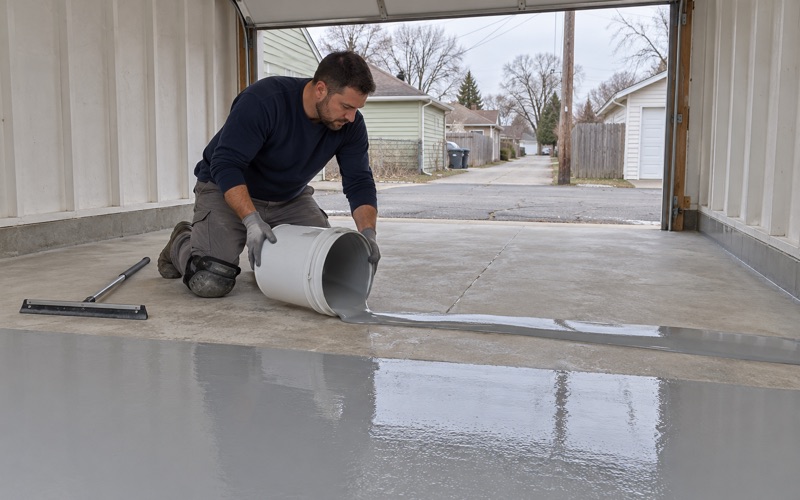
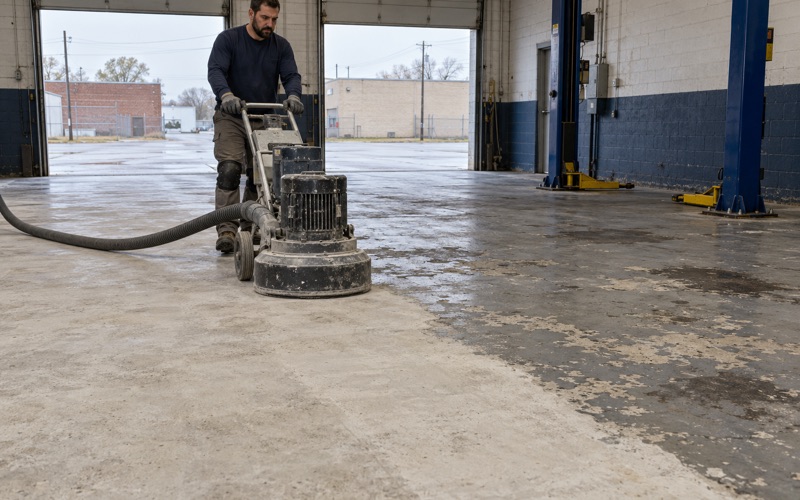
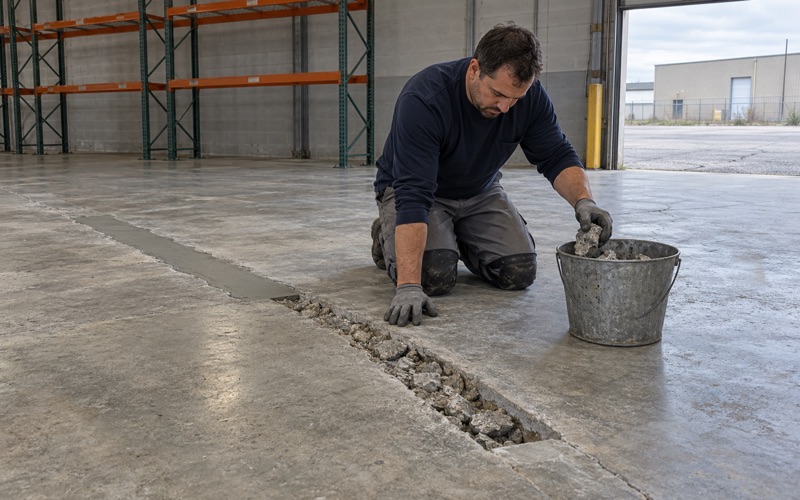
We grind or shot blast every slab we coat and never acid etch, so the coating bonds to a measured surface profile rather than a guess. Grinding dust is captured by a vacuum at the machine instead of being washed toward a floor drain. Before pricing, we also map cracks, spalls, old paint and patches, because a coating laid over a failing patch can lift there whatever the tires do.
Cool Tires, Hot Tires and the Wait Before Parking
One maker’s numbers
INSL-X, a Benjamin Moore brand, sells Hot Trax, an epoxy-fortified acrylic garage floor paint, on its resistance to hot tire pickup from cars. Its technical data sheet sets return to service at 24 hours for light foot traffic and 48 hours for heavy foot traffic. For vehicles it lists 5 days for cool tires and 7 days for hot tires.
Those are one maker’s figures for one acrylic product, not a rule for every system we install. They are useful anyway, because they show a manufacturer selling on hot-tire resistance and still separating cool tires from hot ones. The system named in your proposal comes with its own return-to-service times, and we hand you those numbers in writing.
Why the drive home counts
A cool tire is one that has sat long enough to settle to the garage’s temperature. A hot tire is one that has just come off the road. For a show car, the first parking on a new floor may well be the drive home from a Cruise-In on Broadway, which is the hot-tire case, not the cool one.
So we count the drive home when we set the wait. If a product’s sheet gives a longer time for hot tires, that is the time we plan around for a car that gets driven, and we say so before the job is booked. Parking a warm car early can undo a floor that was installed correctly.
Temperature and humidity stretch the clock
The same data sheet quotes its dry times at 77 degrees Fahrenheit and 50 percent relative humidity, and it says high humidity and cool temperatures lengthen dry, recoat and service times. It also says not to apply the product below 50 degrees. A garage holds heat and damp in ways a calendar does not show.
We time each coat by slab temperature and the dew point spread at the slab surface, not by the date. If an unheated garage is too cold for the system, we tell the owner to wait rather than push a cure that will not finish. That matters for a floor booked between shows, because a slow cure moves the first safe parking date.
A Show Car’s Garage Floor in Chesterton, IN
What we specify for a car that gets driven
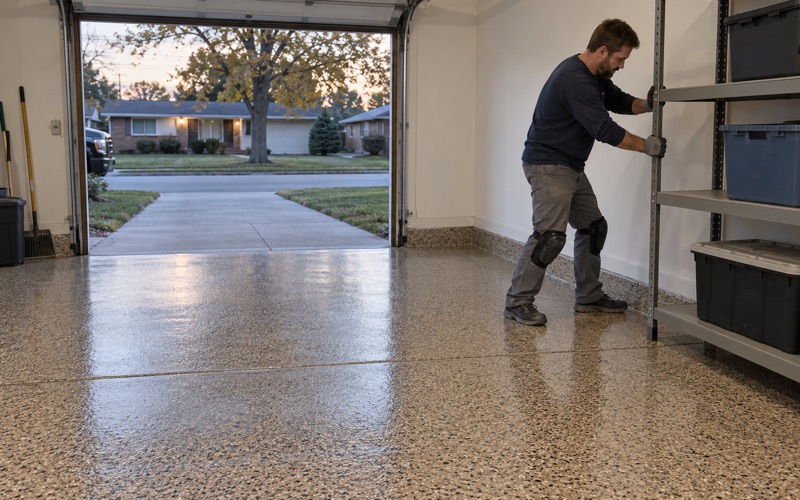
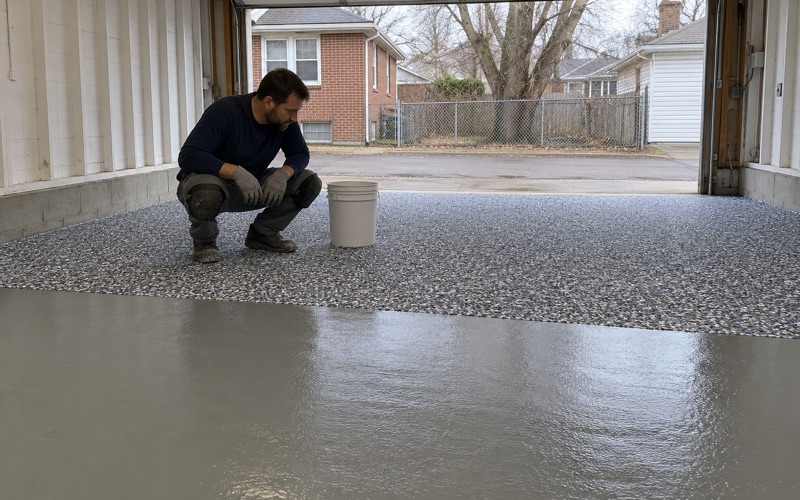
For a show car’s garage, we start from a full-strength system built for hot tires rather than a thin roll-on paint. That can mean a 100% solids epoxy base with a vinyl flake or quartz aggregate broadcast and a polyaspartic or polyurea topcoat, depending on the slab and the owner’s priorities. The proposal names the product line, the coat count and the finished thickness.
Slip resistance comes from the broadcast media and the topcoat we choose, and we specify it that way rather than promising it as a slogan. One data sheet we read notes that floor coatings may become slippery when wet. A car rolling in wet after a summer storm is the moment that note is about.
Moisture first, then the price
Chesterton’s housing runs from older homes to recent builds; census figures count 733 of the town’s 6,317 housing units built in 1939 or earlier and 909 built since 2010. A garage slab’s age says little on its own about what sits under it, so moisture testing is written into the scope. The proposal names the test, such as ASTM F2170 in-situ relative humidity probes or an ASTM D4263 plastic sheet test, and the reading the slab must meet.
Before the job is sold, we read the warranty exclusions out loud, starting with moisture, because it is the failure most coating warranties leave out. We also never sell a floor coating as waterproofing or radon reduction. If the slab should be repaired or replaced first, that comes before any number for a coating.
The paperwork before the grinder
Most Chesterton homes are owner-occupied detached houses, and a home garage job with us runs on a written contract. Indiana’s Home Improvement Contracts Act sets the items it must carry, and the Indiana Attorney General says home improvement contracts over $150 must be in writing. We get it signed before any grinding starts.
The contract and proposal together say what goes down, how thick, how long it cures and when the car can come back in. An owner getting ready for the next Cruise-In knows the date the garage is usable and can check the finished floor against the paper. If the timing does not fit before a show, we would rather move the job than shorten the wait.
- 20+ Years on Concrete
- Moisture Test in Every Scope
- Free Written Estimates