Hammond Epoxy Flooring has spent more than 20 years installing epoxy flooring, and in Country Club Hills the floors we think hardest about are the ones that take sweet, colored spills all day. Drink counters, snack bars, break rooms and the home garages where kids drop juice boxes share one problem: what lands on the floor is sticky, and it stains. A coating that answers only one of those two looks tired within a season.
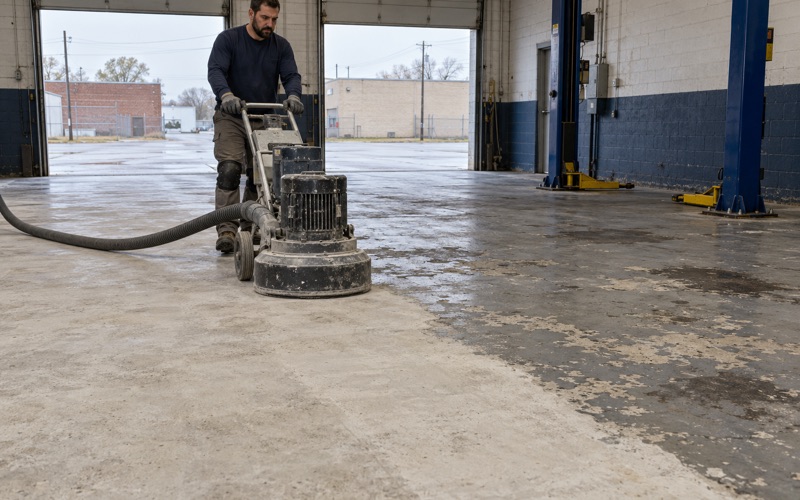
Our approach starts with the slab rather than the color chart. We open the concrete by diamond grinding or shot blasting, test for moisture before the price is final, and write the product line, the coat count and the finished thickness into the proposal. That way the floor we leave behind can be checked against the paper you signed, not against a memory of a sales conversation.
This page walks through what sugar and dye actually do to a floor, the system we pair against them, how we prepare the slab, and what changes for a homeowner in the city. Where we lean on a published source we say so, and where a detail was never confirmed we say that too, because a floor plan built on a guess fails the same way a floor does.
Eighteen Flavors of Lemonade on 167th Street
A Late-Night Drink Counter as the Local Example
Baby’s Cheesesteak & Lemonade, at 4003 W. 167th Street, describes itself as a family-owned and operated establishment since 2006. Its menu is built around the Crispy Cheesesteak and the hand-tossed Clubber’s Pizza, but the lemonade gets top billing: made fresh, poured tall and sold in more than 18 flavors. The doors stay open until midnight every night of the week.
We have not worked there and have not seen its floor, so nothing on this page describes it. We use it because it is the clearest local picture of a problem many counters share. Eighteen sweetened, colored drinks poured from late morning to midnight put two separate things on a floor every shift, and those two things fail a floor in different ways.
Sugar: a Tacky Film That Holds Grit
A splash of lemonade dries to a thin sugar film that turns tacky long before anyone notices it. Shoes press grit into that film, and the next pass of a cold mop spreads it rather than lifting it. Over a busy night it builds into a dull, gray layer that clings to the traffic path in front of the counter and along the route to the trash can.
Sugar is not a minor nuisance in the coatings trade. Flowcrete’s company history says its founder was asked in 1982 by a large confectioner for a floor that wouldn’t erode when exposed to significant quantities of sugar, and a bakery case study lists sugars and syrups among what can eat away at bare concrete and grout. The film also changes underfoot: dry, it grabs at shoes, and wetted again by the next spill or the mop, it turns slick.
Dye: the Stain That Soaks Into Anything Porous
The color in a flavored drink behaves differently from the sugar carrying it. Dye migrates into whatever will take it, which means bare concrete, cement grout lines and any spot where an old finish has worn through to the slab. Once it is in the pores, mopping cleans only the surface above it, and the mark stays.
A US patent for stain-resistant floor finishes notes that spills can cause semi-permanent dark yellow, brown or red stains to the coating itself or the underlying substrate. That is the honest frame for a drink counter: dye can mark a weak or worn coating as well as raw concrete. We have found no published test of flavored-drink dyes against epoxy, polyurethane or polyaspartic topcoats, so we will not quote a stain rating for any of them.
Looking for epoxy-flooring closer to Crestwood? See Epoxy-Flooring in Crestwood.
A Sealed, Seamless Floor With a Topcoat Chosen for Stains
Close the Pores and the Seams
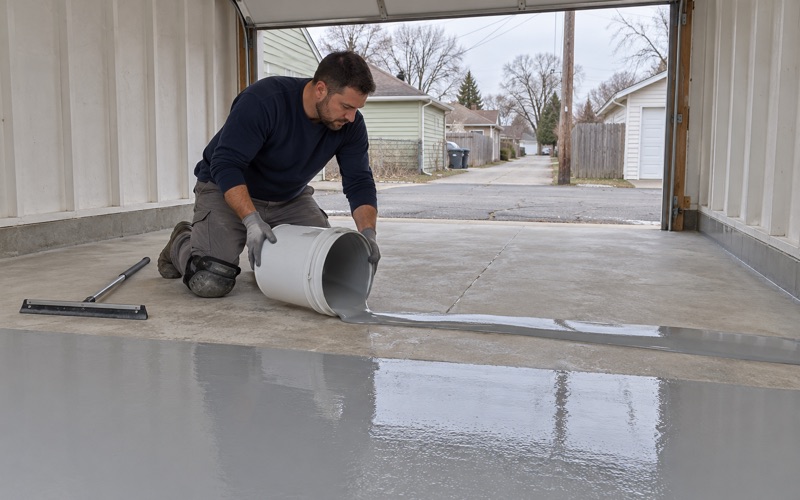
The first defense against both sugar and dye is a surface with nowhere for them to go. A 100% solids epoxy body coat seals the slab, and a seamless installation removes the grout lines that trap sugar and soak up color in a tile floor. With the pores closed, a spill sits on top where a mop can reach it.
Seams are where an older floor usually gives up first. A cracked joint, a chipped edge or a patch that never bonded becomes a channel for sticky liquid and a pocket for stain, so we treat those spots as part of the sealing job rather than as cosmetic touch-ups at the end. A floor that is sealed everywhere except its weak points is not sealed.
A Stain-Resistant Topcoat in a Mid-Tone
The topcoat is the layer the spill actually touches, so it is chosen for the stain risk rather than for gloss alone. Polyaspartic and polyurea topcoats and aliphatic polyurethanes are the usual candidates over an epoxy base, and we name the exact product line in the proposal so you can look it up yourself. What we will not do is call any of them stain-proof.
Color does real work at a drink counter. A very light floor shows every red and yellow drip, and a very dark one shows every dried sugar ring and footprint. A mid-tone gray, tan or blended vinyl flake broadcast hides the everyday drops between cleanings without hiding a mess that genuinely needs attention.
Texture at the Counter and Hot-Water Cleanup
A smooth, glossy floor is the easiest to wipe, and it is also the one that gets slickest when a sugar film is wetted. We specify slip resistance by the broadcast media and topcoat, typically a fine quartz aggregate in the counter zone, rather than promising it as a slogan. Texture is a trade-off against cleaning, so it goes where people stand and pour, not across the whole room.
Maintenance matters as much as the coating. Sugar comes up far more easily with hot water before it dries than after it sets into a tacky layer, so the cleaning routine we leave with a counter operator puts hot water and prompt mopping ahead of stronger chemicals. A sealed floor makes that routine easy; it does not make it optional.
Preparing the Slab Before the First Coat
Grinding, Never Acid Etching
No topcoat survives a poor bond underneath it. We open the slab by diamond grinding or shot blasting to a measured ICRI concrete surface profile, never by acid etching, which leaves an uneven profile and residue in the pores. Grinding dust is vacuumed at the machine instead of being washed toward a floor drain or a storm inlet.
Grinding also shows us what a slab has been hiding. Old paint, sealer and failed patches come up, and concrete that has already soaked up drink sugar or dye shows itself before it can lift a new coating from below. That is the moment to decide on repairs, not after the topcoat is down.
Moisture Testing Written Into the Scope
Moisture is the failure most coating warranties exclude, so we read those exclusions out before a job is sold. The proposal names the test, whether ASTM F2170 in-situ relative humidity probes or ASTM F1869 calcium chloride testing, and the reading the slab must meet. If the slab misses it, a moisture-mitigation primer goes into the scope instead of a hope.
Cure timing follows slab temperature and the dew point spread at the surface, not the calendar. A cold, unheated garage or storeroom in winter is told to wait, because coating a slab close to its dew point invites amine blush and a weak bond that shows up months later as peeling.
Mapping Cracks, Spalls and Joints
Before pricing, we map cracks, spalls, old paint and patched areas so the quote reflects the real floor rather than the best-case one. A slab that should be repaired or replaced is called out first, before anyone talks about flake colors or topcoat sheen.
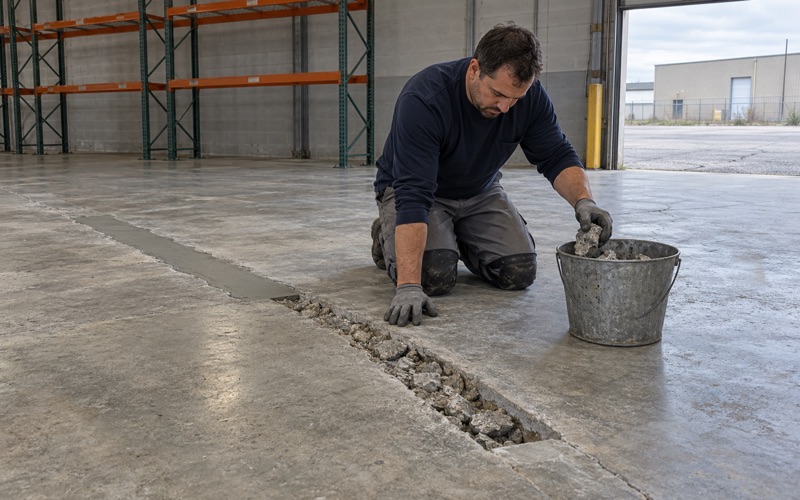
Joints get particular attention. A crack or control joint that a hand truck, a floor jack or a creeper rolls over every week chips first, so we fill and level those joints before coating instead of bridging over them and watching the line telegraph through the new floor.
Juice, Soda and Popsicle Spills on Country Club Hills Garage and Basement Floors
Homes That Take the Same Spills
The same chemistry plays out on a smaller scale at home. Country Club Hills is a city of houses: Census figures put 74.0 percent of occupied units as owner-occupied, 74.1 percent of units as detached houses and 16.1 percent as attached, and the 1970s are the largest build decade at 30.2 percent. Many of those homes have a garage or basement that doubles as a playroom, a spot for a beverage fridge or a chest freezer.
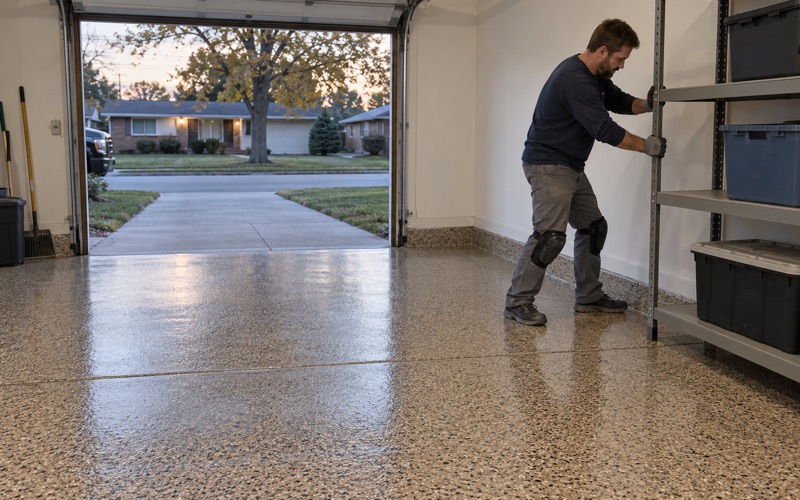
Juice boxes, dropped soda cans and melted popsicles leave the same tacky sugar and the same dye on a bare garage slab that a drink counter leaves on a commercial one. A vinyl flake system with a stain-resistant topcoat in a mid-tone handles that well, and for a garage it is also picked to stand up to the brine and rock salt that tires carry in from December to March.
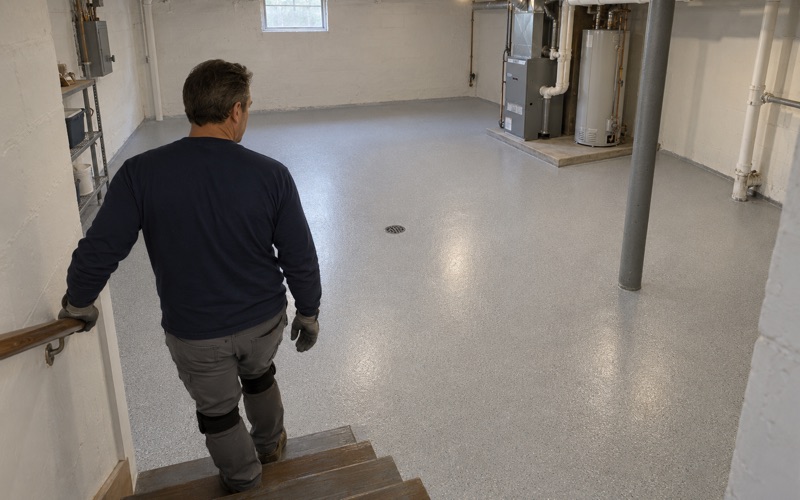
A floor coating is not waterproofing, radon reduction or flood protection, and we do not sell it as any of those. The city records one repetitive-loss property and flooding is not its defining condition, but a damp basement slab still gets a moisture test before it gets a coating.
Permits, Contractor Rules and Who Signs Off
Country Club Hills is a city, not a village, incorporated in 1958, and its City Hall sits in Bremen Township in Cook County. The Community Development and Building Department, on the lower level of City Hall at 4200 W. 183rd Street, issues building permits under the Building Commissioner. The city’s handout says all new construction, additions, alterations and repairs need a permit, while normal maintenance and repairs do not.
Where a floor coating falls on that line is a question for the Building Commissioner, and we ask it before booking. The same handout says every contractor engaged in construction work in the city needs a Country Club Hills Contractor’s License at $150, a $10,000 surety bond and a certificate of insurance. Permit applications are handled at City Hall and are not accepted by email or fax.
Illinois itself licenses no general, flooring or coatings contractor, so the city’s own requirements are the ones that apply here. Home jobs carry a written contract signed before any grinding starts, and coatings are chosen inside Illinois’ VOC limits under 35 Ill. Adm. Code Part 223, which bind the applicator as well as the manufacturer.
- 20+ Years on Concrete
- Moisture Test in Every Scope
- Free Written Estimates