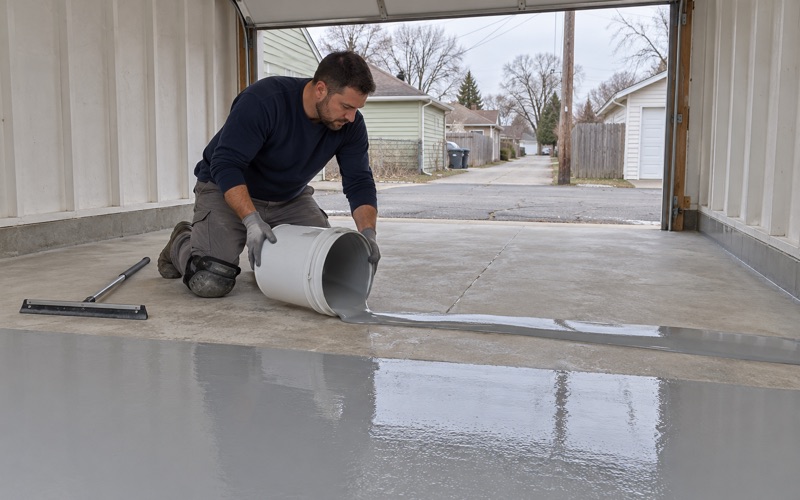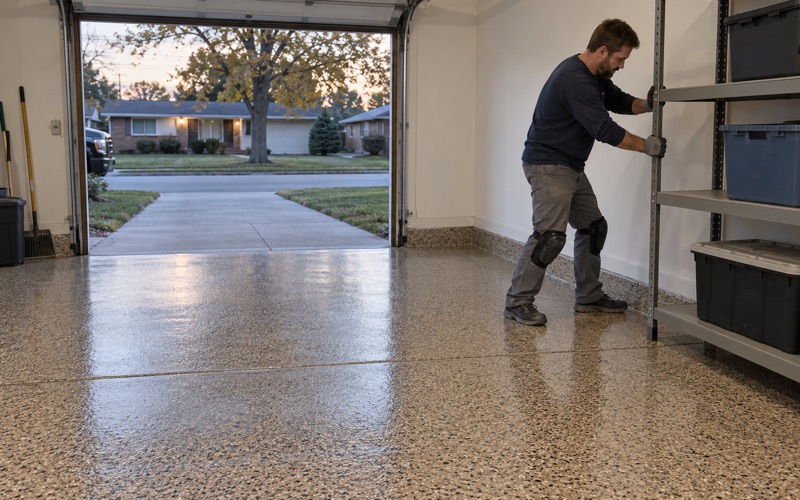
Hammond Epoxy Flooring has spent 20+ years on epoxy flooring, and in Crestwood the first question on a garage job is rarely the color. It is where the car sleeps while the coating cures. We build the schedule around that answer, because the product, the season and the driveway decide how many nights the garage stays empty.
Every proposal we write names the product line, the number of coats and the finished thickness, so you can hold the installed floor up against the paper. It also names the moisture test we will run and the reading the slab has to meet before the price is final. Those details are what let us give you an honest return-to-service window instead of a hopeful one.
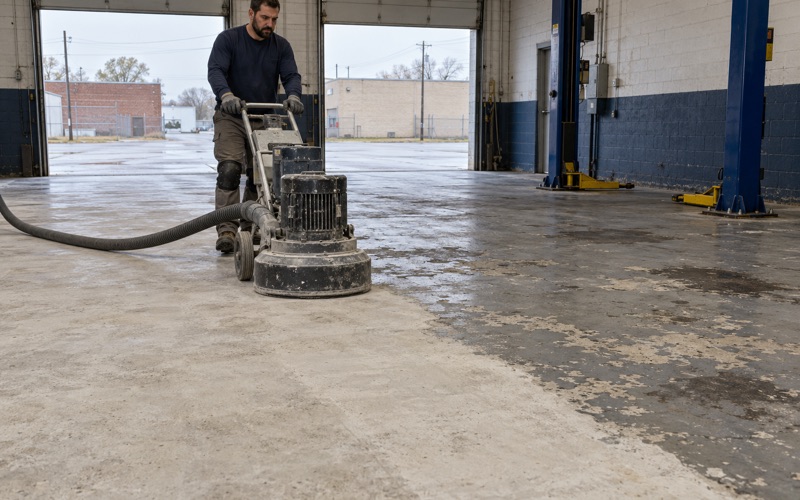
We open the concrete by diamond grinding or shot blasting, never by acid etching, and the dust is vacuumed at the machine. Cracks, spalls and old paint are mapped before pricing, and a slab that ought to be repaired first is called out first. What follows is how a garage floor here gets planned around the nights the car cannot come home.
No Street Parking From 2:00 to 6:00 a.m.
What the village ordinance says
Crestwood prohibits parking on any village street between 2:00 and 6:00 a.m. The June 2026 issue of The Crestwood Adviser, the village newsletter, calls it a village-wide ordinance and puts the initial fine at $75. It also states plainly that the village will continue to enforce it.
The newsletter gives its reasons. Police are alerted to abandoned or suspicious vehicles, and streets stay open overnight for fire and rescue equipment, which the village says is especially necessary where narrow streets can block large fire trucks. It also asks residents to make late-night and overnight guests aware of the rule.
Why that matters for a garage floor
In plenty of towns, a homeowner whose garage is being coated simply parks at the curb for a few nights. Here that option ends at 2:00 a.m., every night, so the car needs an off-street place to sleep for as long as the floor is closed to vehicle traffic.
That turns cure time from a footnote into the center of the plan. A one-car driveway with a second car already on it, a household with three drivers, or a visiting relative with a car of their own all change how many nights the garage can stay out of service. We ask about every vehicle before we recommend a system.
What we will not promise
We have not read the ordinance by section number, and we have found no village rule that treats contractor or construction parking differently. So we do not promise a pass, a waiver or an exception for your job. The plan we write assumes the rule applies to your household’s cars on every night of the work.
What we can do is plan around it honestly. If the only workable answer is a system the car can return to in a day or two, we say so before you pick a finish. If the driveway can hold everyone for a week, a longer-curing epoxy stays on the table.
Looking for epoxy-flooring closer to Evergreen Park? See Epoxy-Flooring Services in Evergreen Park.
From a Day to a Week: Vehicle-Traffic Times by Coating
Fast-return polycuramine and polyaspartic systems
Makers publish return-to-service figures at reference conditions, and the spread between product families is wide. Rust-Oleum’s RockSolid polycuramine garage kit lists vehicle traffic at 24 to 36 hours, with a recoat window of 24 hours. Polyaspartic and polyurea topcoats generally sit at the same fast-return end of the market.
For a household with one open spot in the driveway, a system in this family can mean one or two nights of the car outside rather than a week. Those figures are the maker’s, not ours, and they assume a garage near room temperature. We treat them as a starting point, then adjust for the slab in front of us.
Two-part epoxy and the seven-day wait
Rust-Oleum’s EpoxyShield MAXX, a two-part epoxy, lists 16 hours before light foot traffic and 24 hours before a recoat. Its data sheet gives a full cure of 7 days at 68 degrees, and that full cure is the point the maker calls suitable for vehicle traffic.
So a floor you can walk across the next morning may still be a week away from carrying a car. A 100% solids epoxy base under a vinyl flake broadcast is a durable build, but in this village it asks a household to find seven nights of off-street parking. Some families can manage that easily, and others cannot.
Reading a data sheet before you choose
Every proposal names the product line, so you can look up the same figures we are quoting. Light foot traffic, recoat, vehicle traffic and full cure are separate lines on most data sheets, and mixing them up is the easiest way to park on a floor too early. We set the return date from the vehicle-traffic line.
We also tell you which coats are in the build. A flake system with a base coat and a clear topcoat cures as a stack, and the slowest layer sets the date the car can come back. Slip resistance comes from the broadcast media and topcoat we specify, and that choice is written down as well.
Cold Garages, Humid Weeks and Longer Cures
Temperature stretches every schedule
The 68-degree reference on a data sheet is a lab condition, and an unheated garage in a cold month is not that. Cool or humid weather stretches all of these published figures, so a system rated for vehicle traffic in about a day can need longer, and a seven-day epoxy can need well beyond a week.
We time the cure by slab temperature rather than by the calendar. When a garage is too cold to cure on schedule, we tell you to wait. A floor that is driven on before it has cured is the floor that comes back soft, marked or lifting.
Moisture testing before the clock starts
Cure time also depends on what is coming up through the slab. Our scope names the moisture test, whether an ASTM F1869 calcium chloride test or ASTM F2170 in-situ relative humidity probes, and the reading the slab must meet before the price is final. A damp slab can call for a moisture-mitigation primer, which adds a coat and adds time.
Moisture is also the failure most coating warranties exclude, and we read those exclusions to you before the job is sold. Knowing them up front explains why we would rather push a start date than coat a slab that has not passed.
Picking a season that fits your driveway
Because the calendar bends with temperature, the season is part of choosing a product. A warmer stretch lets a multi-day epoxy finish closer to its published cure, while a cold one tilts the decision toward a faster-return system or a later start. The goal is a finish date you can actually plan your parking around.
The coatings themselves are chosen inside the Illinois VOC limits in 35 Ill. Adm. Code Part 223, which bind the applicator as well as the maker. That trims the product list a little, and every product that remains still carries its own published vehicle-traffic line we can schedule against.
Scheduling a Crestwood Garage Floor Around the Driveway
The houses and slabs we usually see
Crestwood is a village of 10,826 people, per the 2020 census, in Cook County about 23 miles southwest of downtown Chicago. Its detached single-family homes were mostly built from the 1950s through the 1970s, and the 1970s alone account for 30.0 percent of all housing units. Fewer than 3 percent were built since 2010.
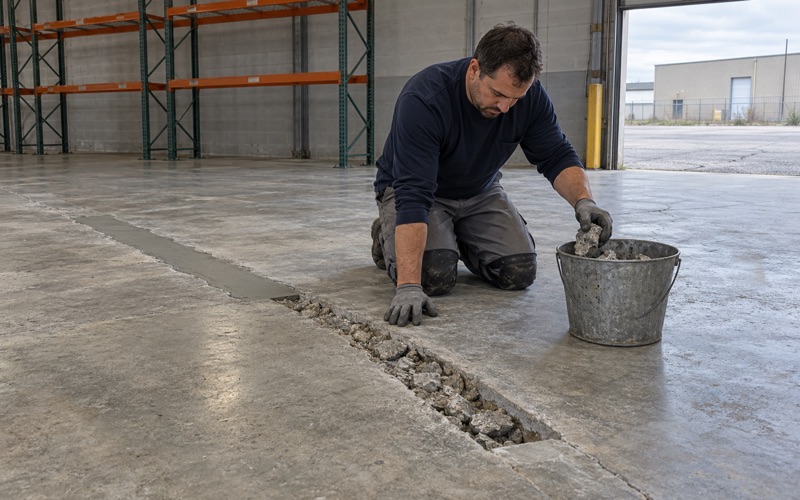
A garage slab of that age has usually carried decades of tires, oil drips and patching. We map cracks, spalls, old paint and patched areas before we price, and a slab that should be repaired or replaced is named first. Repair work adds days, and those days count toward the same parking plan.
Where the car sleeps, night by night
Before we book, we count the off-street spaces you have and the vehicles that need them. A long driveway can hold the garage cars for a week, while a short one may push the choice toward a 24-to-36-hour system. Some homeowners line up a neighbor’s driveway or an off-street lot, which is their call to make.
We write the expected return-to-vehicle-traffic date into the plan as the maker’s figure adjusted for the conditions we measured, not as a promise. If the garage reads colder than expected on the day, we tell you how that moves the date before the first coat goes down. Overnight guests during the job need the same warning the village asks residents to pass on.
Registration and the Building Department
Contractors working in Crestwood register with the village first, at $100 for a general contractor and $25 for a sub-contractor, and file a certificate of insurance naming the Village of Crestwood as additional insured. The village permit page lists painting and carpeting as exempt but does not mention floor coatings either way.
So we ask the Building and Zoning Department at 13800 S. Cicero Avenue rather than assume. Some local addresses carry a 60445 ZIP that is shared with Midlothian, and we go by the village boundary, not the ZIP, to decide whose rules apply. Your written contract, signed before any grinding, lists the system, coats, thickness and the cure window we planned around.
- 20+ Years on Concrete
- Moisture Test in Every Scope
- Free Written Estimates