
Hammond Epoxy Flooring installs ESD flooring in Hammond, IN, serving surrounding cities including Griffith, Riverdale, Harvey, Dyer and Homewood. Static-control floors protect sensitive electronics, instruments and some process environments from electrostatic discharge, and after more than 20 years on concrete we treat them as an engineered system, not a special color of epoxy.
An ESD floor only works when every part works together: a sound, prepared slab, a conductive layer, grounding tied into the building, a topcoat in the right resistance range and footwear that completes the path. We plan each of those with the facility’s static control program in hand, and the proposal names the target resistance range, the product line, the grounding layout and the testing that will prove it.
We install ESD floors in electronics assembly and repair areas, laboratories, server and telecom rooms, control rooms, and production spaces where static creates a hazard or a quality problem.
Static Control Requirements
ANSI/ESD S20.20 and Resistance Ranges
Many electronics programs follow ANSI/ESD S20.20, which requires flooring in electronics handling spaces to measure below 1.0 x 10^9 ohms. Within that, floors are classed as conductive, at or below 1.0 x 10^6 ohms, or static dissipative, between 1.0 x 10^6 and 1.0 x 10^9 ohms. Your program sets which range applies.
The standard also looks at the person, not just the floor: a person wearing approved grounded footwear on the floor should not generate more than 100 volts, measured by walking test. That is why we test the floor and footwear together, not the coating alone.
Conductive Compared With Dissipative
Conductive floors drain charge fastest and are used where very sensitive parts or certain hazardous environments are involved. Static-dissipative floors drain charge more gradually and suit most electronics assembly, lab and control room work. Choosing the wrong class can either fail to protect parts or create other hazards, so we confirm the target with your quality or safety team.
Footwear and Facility Programs
An ESD floor drains static through heel straps, ESD shoes or similar footwear, so ordinary shoes defeat it. We coordinate with your facility on the footwear program and test with it, because a floor that meets its range on paper can still fail the walking test if the footwear and the floor are not compatible.
How an ESD Epoxy Floor Is Built
Slab Preparation and Repairs
The slab is diamond ground or shot blasted to the profile the system requires, cracks and joints are repaired and the floor is moisture tested. Moisture matters more than usual on an ESD floor, because vapor pushing through the slab can cause blistering and also change electrical readings over time.
Old coatings, adhesives and contamination are removed to sound concrete. A conductive system cannot be trusted over a layer that is poorly bonded or full of residue.
Conductive Layer and Grounding
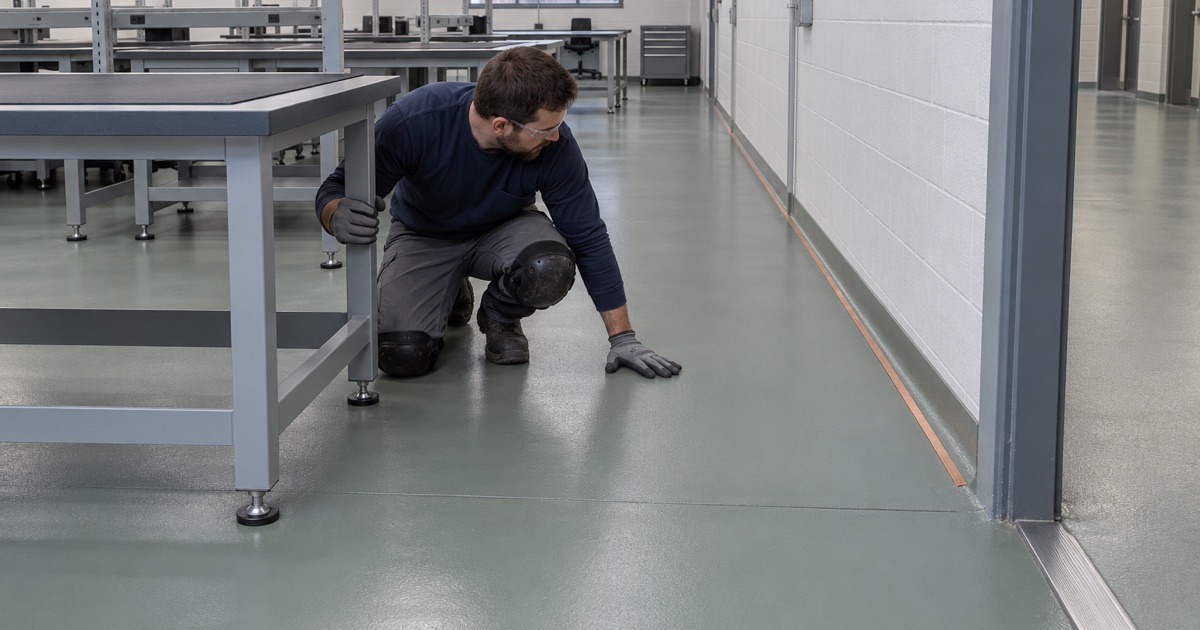
A conductive primer or layer goes down first, and copper grounding strips or tape are laid in it at spacing set by the manufacturer. Those ground points are later connected to a verified building ground by an electrician. This layer is what spreads charge across the floor and carries it away.
We plan the grounding layout with the room’s equipment, doorways and future workstations in mind, so ground points end up where they can be reached and verified.
Static-Control Topcoat
The topcoat contains conductive fibers or additives that bring its resistance into the target range while still giving a durable, cleanable surface. It is applied at a controlled thickness, because too much or too little can shift readings. Some systems use a light-colored topcoat with visible conductive fibers; others are solid colored.
The topcoat also has to suit the room’s other demands. A lab may need chemical resistance, an assembly area may need a light color that helps workers find dropped parts, and a server room may need a smooth surface for rolling racks. We pick a static-control topcoat that meets the resistance target and the room’s practical needs together.
Testing, Maintenance and Common Mistakes
Testing After Installation
Once the floor has cured, we measure resistance point to point and point to ground at multiple locations with a calibrated meter, following the test methods your program names. Readings are recorded on a floor map so you have a baseline for future audits.
Humidity affects static and some readings, and winter air in Northwest Indiana buildings is often very dry once heating systems run for months. We note the temperature and humidity at the time of testing, so later audits compare like with like rather than flagging a seasonal change as a floor failure.
Cleaning and Upkeep
Waxes, polishes and many standard floor finishes insulate the surface and can push an ESD floor out of range. We provide cleaning guidance that matches the system and recommend neutral cleaners made for static-control floors. Periodic testing confirms the floor stays in range as it wears.
Dirt is an insulator too. Grit, dried cleaning residue and tracked-in winter salt film can raise surface resistance, especially near entrances. Walk-off mats at doors into ESD areas and a regular cleaning routine with the right products keep the floor performing between audits.
Mistakes That Cause Failures
Common problems include coating over contamination, skipping or misplacing ground points, mixing the wrong topcoat thickness, sealing the floor with an ordinary finish and assuming any shoe will do. Each one is avoidable, and each is the reason we plan, install and test ESD floors as a complete system.
Another frequent mistake is treating ESD as an afterthought in a larger coating job. When static control is needed in one room of a plant, its grounding, transitions and testing should be planned at the same time as the rest of the floor, so the boundary between ESD and standard coating is clean, marked and easy for staff to recognize.
- 20+ Years on Concrete
- Moisture Test in Every Scope
- Free Written Estimates