
Hammond Epoxy Flooring installs epoxy garage floor systems in Hammond, IN, serving surrounding cities including Griffith, Riverdale, Harvey, Dyer and Homewood. With more than 20 years on concrete, we treat a garage as a working floor that takes winter brine, hot tires and dropped tools, not as a surface to paint.
The difference between a garage coating that lasts and one that peels by spring is almost always preparation. We open every slab by diamond grinding, map and repair the cracks and spalls, and set a moisture test before the price is final. The coating comes last, and the proposal names its product line, coat count and finished thickness.
That written spec is what lets you check the floor after we leave. If the proposal says a 100% solids epoxy base, a full vinyl flake broadcast and a polyaspartic topcoat, that is the floor that should be in your garage.
What Goes Into a Garage Epoxy System
The Base Coat
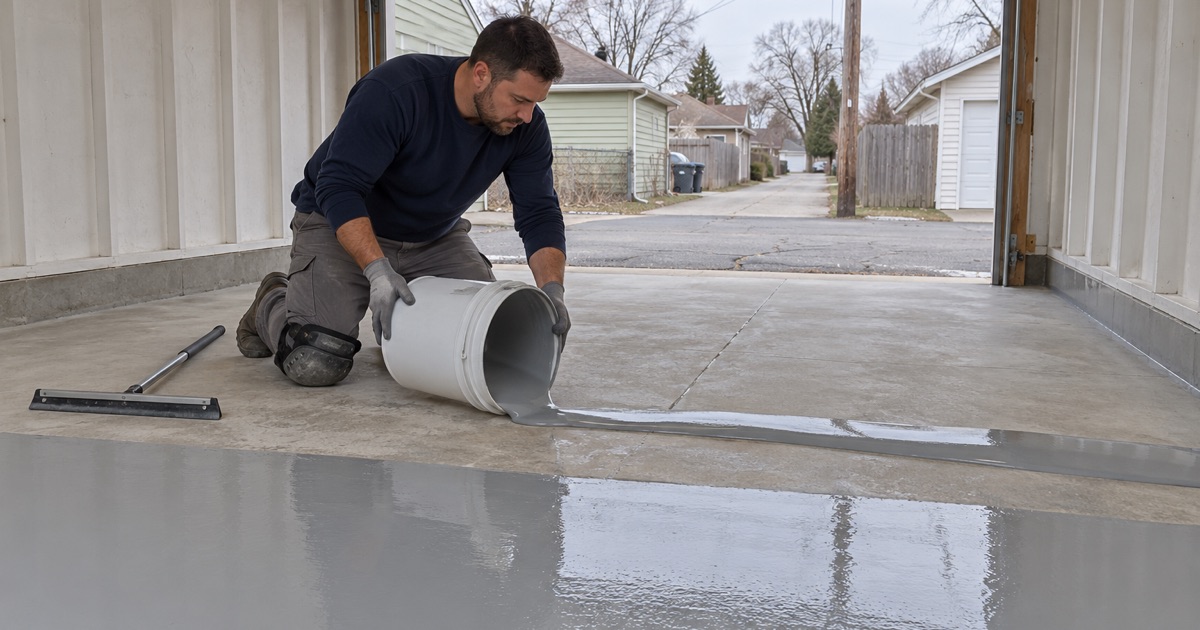
The base coat is the layer that bonds to the concrete, so it carries most of the floor’s adhesion. We favor a 100% solids or high-build epoxy here because it penetrates a ground profile, builds real thickness in one pass and does not shrink as solvent evaporates. Thin water-based coatings, the kind in most retail kits, leave a film too light to resist hot tire pickup.
On a slab with a borderline moisture reading, the base may be a moisture-mitigation primer instead. That decision comes from the test result, and the proposal states which primer is used and why.
The Broadcast Layer
While the base is wet, vinyl flake or quartz is broadcast into it. A full broadcast to rejection covers the floor completely, hides small slab flaws and gives the finished surface texture underfoot. A partial broadcast shows more of the base color and costs less in media.
The broadcast also sets how slippery the floor is when wet. A tighter chip and a textured topcoat give more grip in a garage that sees slush all winter, so we specify slip resistance by the media and topcoat rather than calling any floor non-slip.
The Topcoat
The topcoat takes the wear. Polyaspartic and aliphatic polyurethane topcoats resist abrasion, stand up to road salt and gasoline drips, and hold their color in sunlight, where a plain epoxy topcoat would amber near an open door. Sheen is chosen here too, and satin hides tire marks and dust better than gloss.
Garage Floors and a Lake County Winter
Brine, Rock Salt and Calcium Chloride
From December to March, tires carry brine and rock salt into every garage in the region. On bare concrete that salty water soaks into the pores, and repeated freeze and thaw scales and pits the surface around the parking spots. A sealed, coated floor keeps the salt on top, where it can be squeegeed out the door.
We choose the system with that season in mind. A topcoat rated for chemical exposure and abrasion keeps its finish through salt season, where a thin coat dulls and wears through in the wheel paths by the second winter.
Cold Slabs and Cure Timing
Epoxy and polyaspartic cure by chemical reaction, and a cold slab slows that reaction or stops it short. When the slab sits too close to the dew point, moisture condenses on the surface and leaves an amine blush that can weaken the next coat’s bond. We measure slab temperature and dew point spread before coating rather than going by the date on the calendar.
That is why an unheated detached garage in January is usually booked for spring. A heated attached garage can often be coated year-round, and we tell you which one you have.
Garage Slabs and Vapor
Residential codes, including the IRC R506.2.3 exception carried into the 2020 Indiana Residential Code, let a garage slab go down without the vapor retarder required under heated floors. A garage can therefore push vapor into a coating even when the house next to it is dry. We test the garage slab itself before quoting a system.
A quick ASTM D4263 plastic sheet test can flag an obvious problem in a day, but it is a screen rather than a measurement. When the result matters to the system choice, we use a calcium chloride test or in-situ relative humidity probes, and the reading goes into the proposal next to the limit the product allows.
Garage Slab Problems We Fix Before Coating
Cracks and Control Joints
Shrinkage cracks and control joints are opened with a grinder, filled with a repair material compatible with the coating and ground flush. Joints can be honored as clean lines in the finished floor or filled and coated over, depending on the look you want and whether the slab is still moving.
A crack that has opened since last winter, or one with one side higher than the other, gets a closer look before any filler goes in. In parts of north Hammond built over old slag fill, slabs have been known to lift as the fill expands, and a crack like that is a question about the ground, not the coating.
Pitting, Spalls and Scaling
Salt damage and age leave garage floors pitted and spalled, especially in older homes where the slab has seen decades of winters. We grind off loose material, fill pits and rebuild spalled edges so the base coat goes down on a flat, sound surface, rather than bridging hollows that crack under a tire.
Most of Hammond’s housing was built before 1980, and close to a third of it before 1940, so many garage slabs here have outlived several coats of paint and a patch or two. Old paint and failed patches come off along with the loose concrete, since a new system bonds no better than the weakest layer left beneath it.
When Replacement Beats Coating
A slab that has heaved, settled badly or has wide, displaced cracks is moving, and no coating will stop that. We map the damage before pricing and tell you plainly when replacing the slab is the better spend, because a coating over a failing floor only adds cost to a job that will be torn out anyway.
If the slab is sound but tired, coating is usually the far cheaper route, and grinding plus repair can bring back a floor that looks past saving. Either way, the call is made in writing before the price is set, so you are not discovering a replacement halfway through an install.
Our Step-by-Step Epoxy Garage Floor Process
Step 1: Slab Walk and Moisture Test
We walk the garage, map cracks, spalls, old coatings and stains, and set a moisture test such as an ASTM F1869 calcium chloride kit or ASTM F2170 relative humidity probes. The proposal follows the result and names the reading the floor must meet.
Step 2: Diamond Grinding and Dust Control
The slab is diamond ground to a profile matched to the coating, with vacuums running at the grinder so dust stays out of the house and nothing is washed toward a floor drain. Acid etching is never used.
Step 3: Repairs
Cracks, pits, spalls and control joints are filled and ground flush. Oil-soaked areas are cleaned or ground back until the concrete takes the primer evenly.
Step 4: Base Coat and Broadcast
The base coat goes down at the thickness the proposal states, and flake or quartz is broadcast into it while it is wet. Excess media is scraped and vacuumed once the base has cured.
Step 5: Topcoat and Return to Service
The topcoat is rolled at its specified rate and sheen. You get written times for foot traffic and for parking, set by the slab temperature on the day.
- 20+ Years on Concrete
- Moisture Test in Every Scope
- Free Written Estimates