Hammond Epoxy Flooring has spent more than 20 years on epoxy flooring in Harvey and the rest of the south suburbs, and the floors we think hardest about here are the ones children use. A coated slab can be very easy to keep clean. It is also hard, and a page about floors where kids play has to say both of those things in the same breath.
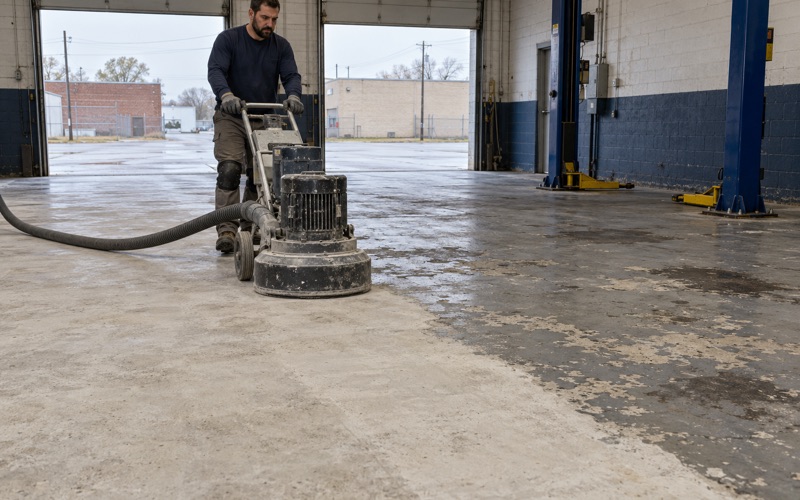
Our work starts the same way on every slab. We open the concrete with diamond grinding or shot blasting to a measured ICRI CSP profile, never with acid, and we map cracks, spalls, old paint and patches before a number goes on paper. If the slab should be repaired or replaced instead of coated, we tell you that first.
The written proposal names the moisture test, the reading the slab has to meet, the product line, the coat count and the finished thickness. We read the warranty exclusions aloud before you sign, starting with moisture, because that is the failure most coating warranties leave out.
A Children’s Care Home on 154th Street and the Rules It Points To
Harvey is home to the Children’s Habilitation Center at 121 W. 154th Street, a care home for medically fragile infants and children. It is a useful reference point for anyone planning a floor in a space built around kids, because the state rules for that kind of building put two demands on a floor side by side.
What the center describes itself as
The center’s own site describes specialized medical care for complex children of all ages, along with physical, occupational and speech therapy, respiratory therapy and an education program. Its site and directory listings put it at 67 beds licensed by the Illinois Department of Public Health. A 2026 magazine advertisement for the center calls it “one of the largest pediatric ventilator-capable facilities of its kind in the United States,” which is the center’s own promotional wording.
We have no connection to the center and have not seen its floors or play rooms. We mention it because it makes the question on this page concrete: what does a floor need to do in a building full of children who are cared for, cleaned up after and encouraged to move?
Two sentences from Illinois’ code for children’s care homes
Illinois’ rules for long-term care facilities serving people under 22, 77 Ill. Adm. Code 390, say that floors “shall be smooth, free from cracks and finished so that they can be easily and properly cleaned.” A few sections over, the same code asks for a furnished playroom on each floor with “adequate space to permit children to run.”
Read together, those two lines pull in slightly different directions. One asks for a hard, tight, washable surface. The other asks for a room where children will run, trip and land. That tension is the heart of every playroom floor we plan, whether it sits in a licensed building or under a house.
Looking for epoxy-flooring closer to Dyer? See Epoxy-Flooring in Dyer.
Smooth, Crack-Free and Cleanable: What a Seamless Floor Does Well
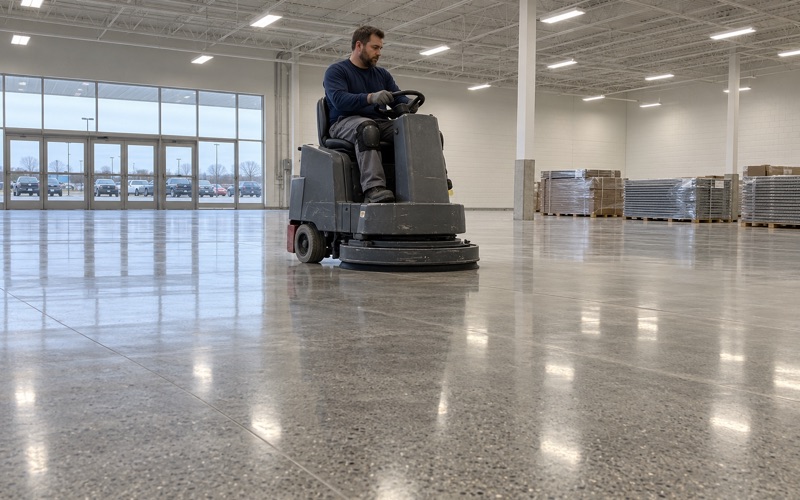
The first of those two sentences describes almost exactly what a properly installed resin floor delivers. The value is in the details, because a coating only looks seamless if the slab under it was handled honestly.
No grout lines and no seams to hold dirt
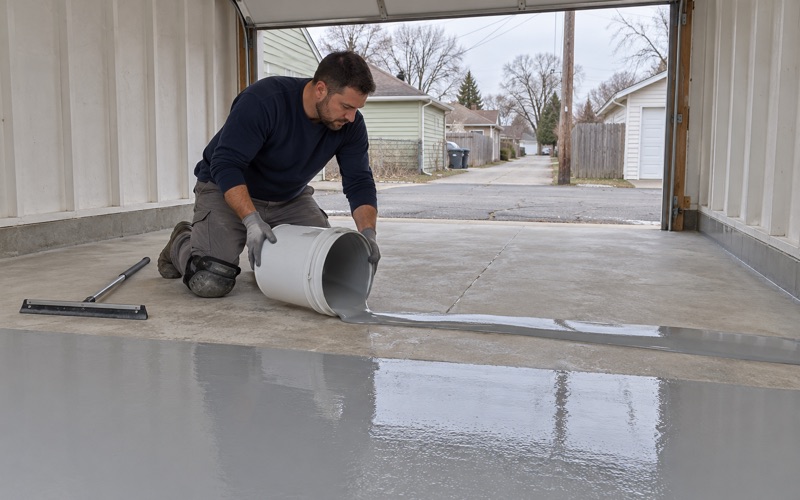
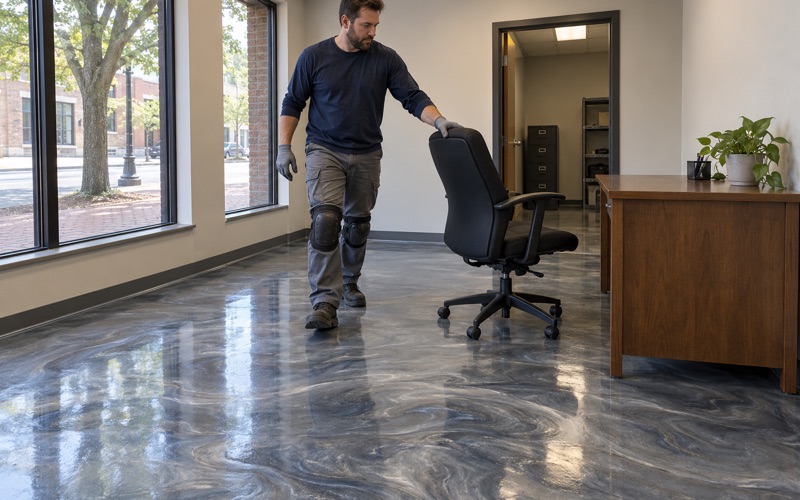
A 100% solids epoxy base with a polyaspartic or urethane topcoat cures into one continuous surface. There are no grout joints, tile edges or carpet seams for spills and cleaning water to settle into. A mop and a neutral cleaner reach the whole floor, and the floor does not soften or swell when it is wet-cleaned often.
That matters in any room where children eat, spill, paint and crawl. It is the main reason a coated slab is worth considering in a playroom at all.
Free from cracks starts before the first coat
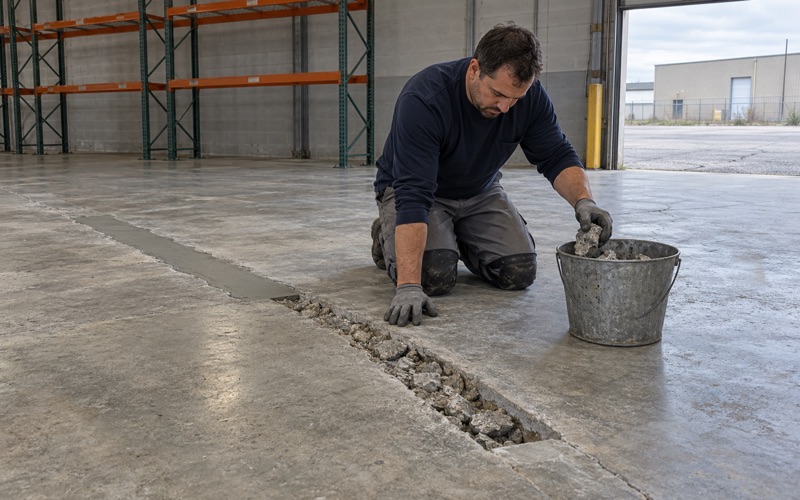
A coating does not make a cracked slab whole. It follows every crack under it, and a moving crack will telegraph through a new floor within a season. So the crack map we draw during the estimate becomes a repair list, and those repairs are finished and ground flush before any primer goes down.
Static hairline cracks are filled and leveled. Active cracks and broken edges are called out in writing, and if the slab has too many of them, we say the floor needs concrete work first. Saying so up front costs less than a failed coating does.
Moisture is tested, not assumed
A basement or ground-floor playroom sits on concrete that can carry moisture from below. Before a price is final, we run the test the proposal names, usually ASTM F2170 in-situ relative humidity probes or ASTM F1869 calcium chloride testing, and the slab has to meet the stated reading.
When it does not, a moisture-mitigation primer goes into the scope rather than a hope. Cure timing then follows the slab temperature and the dew point spread at the surface, not a date on the calendar.
Hard Is the Catch: Where Children Play, Mats Go on Top
Here is the part of the conversation that a coating salesperson tends to skip. A seamless resin floor is a hard surface, and the second sentence in that code, the one about space to permit children to run, is about bodies landing on the floor.
What the federal safety agency has said about hard surfaces
The U.S. Consumer Product Safety Commission’s Public Playground Safety Handbook notes that falls from play equipment remain the largest single hazard pattern on playgrounds. Its cover memo states that the Commission has long recommended that playgrounds not be installed over concrete, asphalt or paved surfaces, because of serious head injuries from falls.
The handbook is guidance for public play equipment, not a rule for your basement. Still, the reasoning travels: concrete with a resin coat on it is still concrete when a child falls on it.
The coated floor is the base, impact mats are the layer that cushions
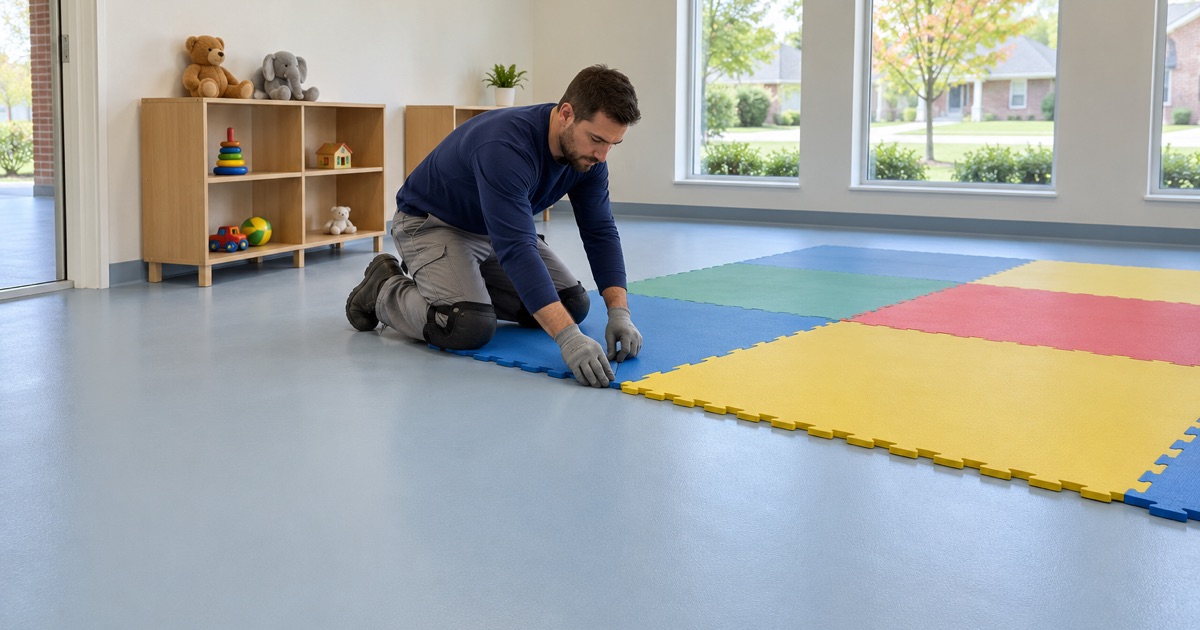
So we plan play and therapy space in two layers. The coated slab is the clean, durable, moisture-tolerant base. Impact mats, gym mats or interlocking cushioned play tiles go on top wherever children climb, tumble or play on equipment.
We will never sell a coating as fall protection. No epoxy or polyaspartic system cushions a fall, and the mats you choose should be selected for that job on their own terms. Our part is a flat, sound, cleanable surface that lets those mats lie evenly and come up easily.
Choosing a texture that still cleans
Slip resistance on a coated floor comes from the broadcast media and the topcoat, so we specify it rather than promise it. In a children’s room we usually lean toward a fine texture: enough grip for socks and bare feet in the open areas, without a coarse surface that scrapes knees or traps grime.
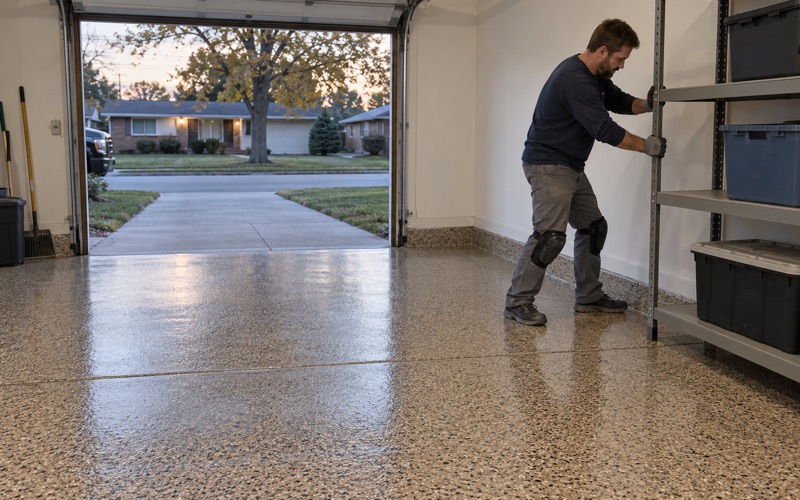
A vinyl flake broadcast under a clear topcoat is a common choice. It hides minor wear and gives the eye something to read, and a light quartz aggregate in the topcoat can be tuned to the grip the room needs.
A Basement Playroom in a Harvey Home
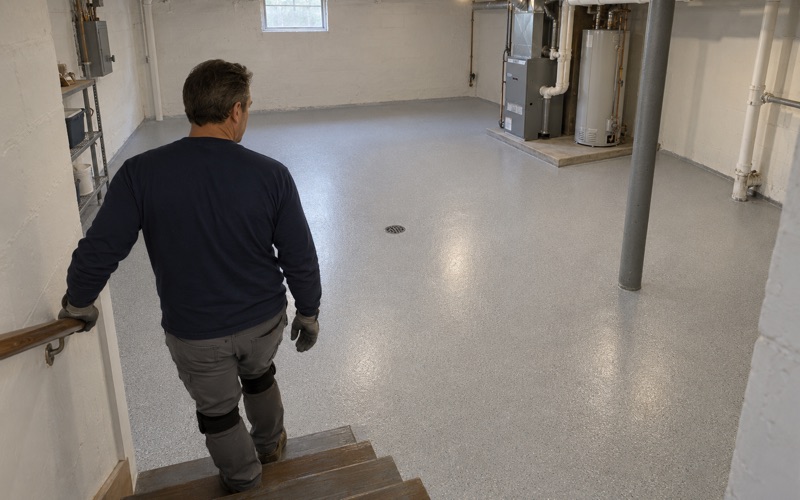
The same two-layer plan scales down to a house. Harvey’s housing is old: about 70 percent of its units were built before 1970, and nearly a quarter predate 1940. Many of those basements are the first place a family looks for a playroom.
Getting an older slab ready
A basement floor in a house of that age often carries decades of paint, sealer, mastic or patching. We identify what is there and grind it down to sound concrete, collecting the dust with a vacuum at the machine rather than washing it toward the floor drain.
If the slab shows efflorescence, water staining or seepage, we stop and talk about the source. A coating is not waterproofing, and it is not flood or sewer backup protection. Harvey itself names combined-sewer backflow during heavy rain as a problem in parts of the city, and that is handled with plumbing and drainage before any floor goes down.
Foam play tiles on a coated slab
Once the coated slab has cured, foam play tiles or mats go down over the play area. Interlocking tiles can be lifted in sections, which is the point: lift them now and then so any moisture trapped beneath can dry and the coated floor underneath can be cleaned.
The coating makes that cleanup quick. Juice, crayon and craft paint come off a sealed surface with a damp mop, and the tiles go back down the same afternoon.
Paperwork before the grinder starts
Harvey requires contractors to be registered and licensed with the city before any work begins, and its permit list covers work such as pouring concrete. A coating over existing concrete is not on that list as the city states it, so we confirm the current requirement with Harvey Planning, Building and Inspectional Services before booking.
Every home job gets a written contract with the terms laid out, signed before any grinding. The coatings we use stay within Illinois’ VOC limits under 35 Ill. Adm. Code Part 223, which bind the applicator as well as the manufacturer.
- 20+ Years on Concrete
- Moisture Test in Every Scope
- Free Written Estimates