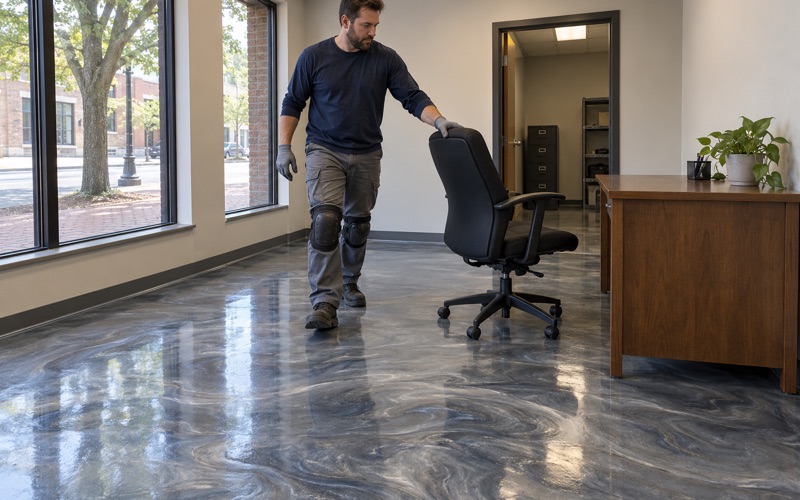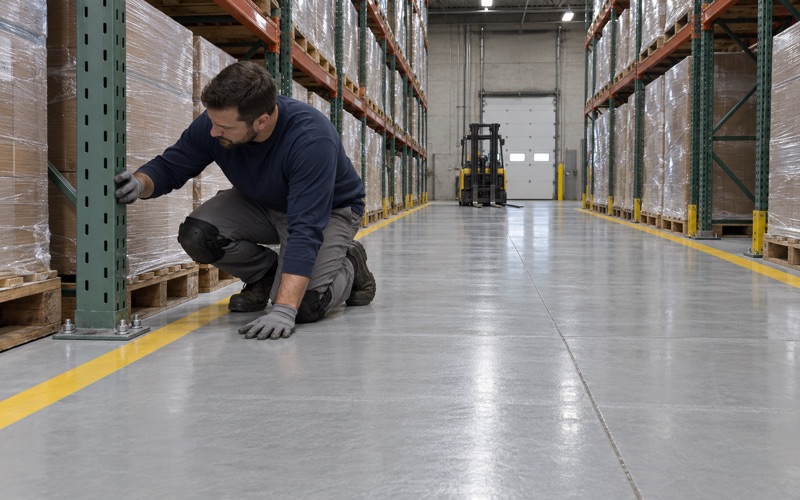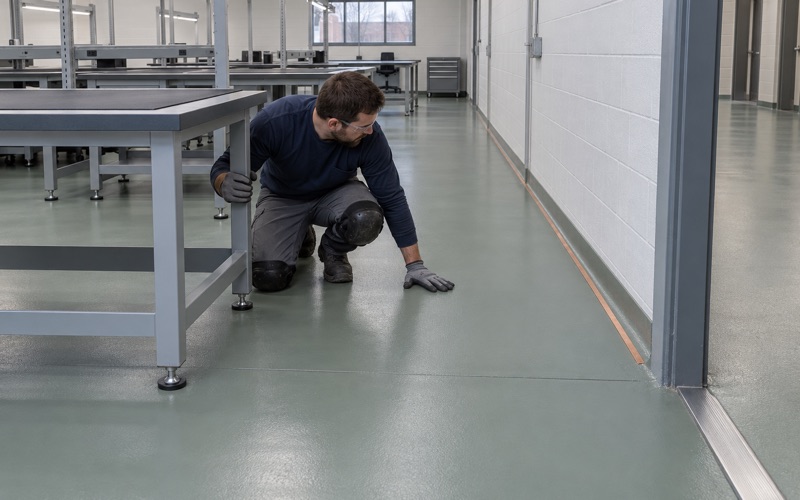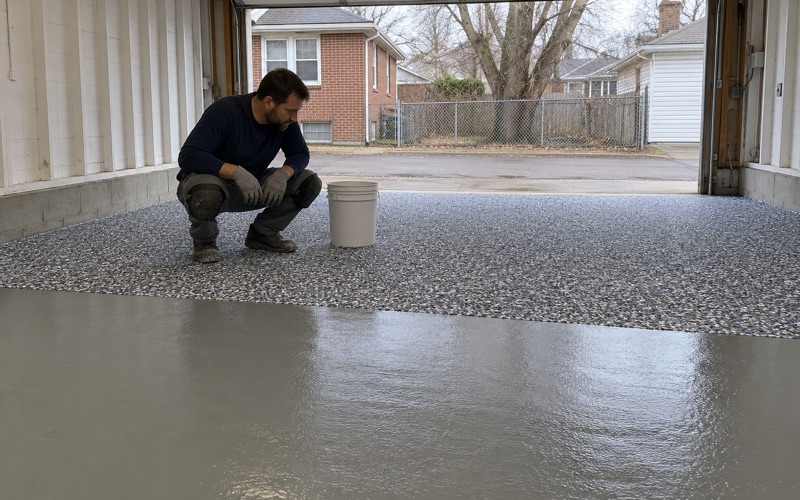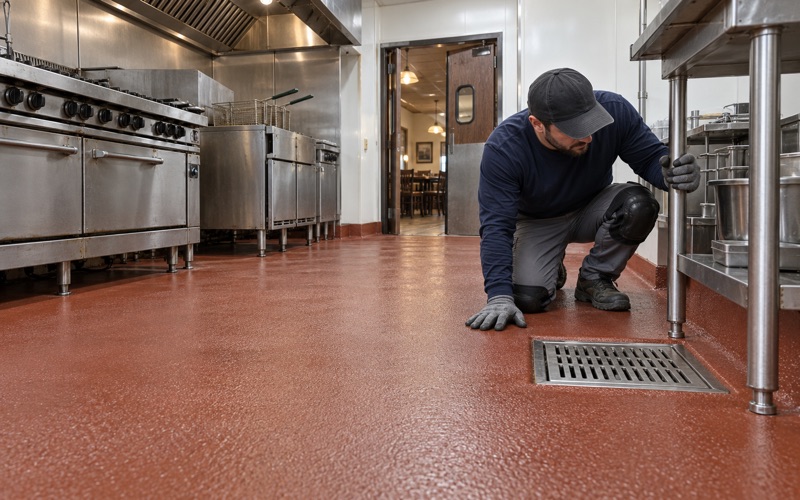
Hammond Epoxy Flooring has spent more than 20 years installing epoxy flooring in Hazel Crest and the surrounding south suburbs, and the floors that teach us the most are the ones that get cleaned the hardest. A garage floor takes road salt for a few months a year. A treatment-room floor takes a chemical cleaning routine every working day for as long as the room is in use.
Both floors come down to one question: will the finish still be sound after the thousandth wipe? We try to answer that before we price anything. Every proposal we write names the product line, the number of coats and the finished thickness, so the floor that goes down can be measured against the paper that sold it.
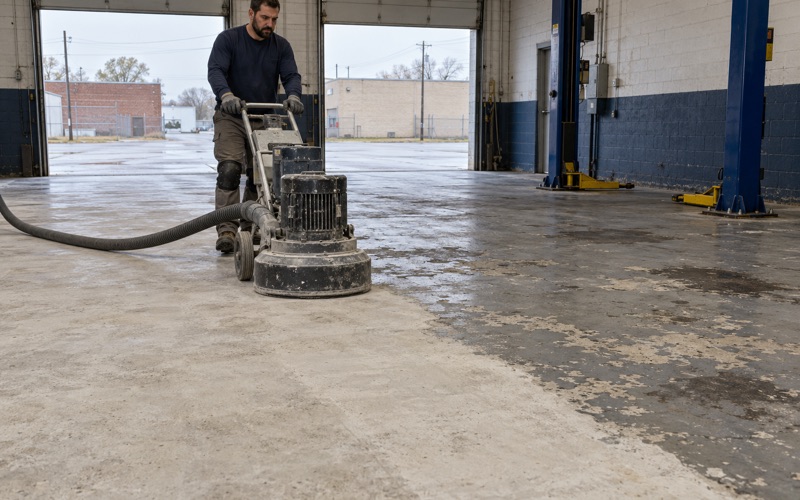
The slab itself is opened by diamond grinding or shot blasting, never by acid etching, which gives the coating a measured surface profile to grip instead of a guess. This page follows one demanding kind of floor, the kind where cancer drugs are handled and the cleanup is chemical, then carries the same thinking into a home bathroom and back out to the garages and basements most Hazel Crest owners call us about.
A Cancer Institute on Kedzie Avenue and the Residue Question
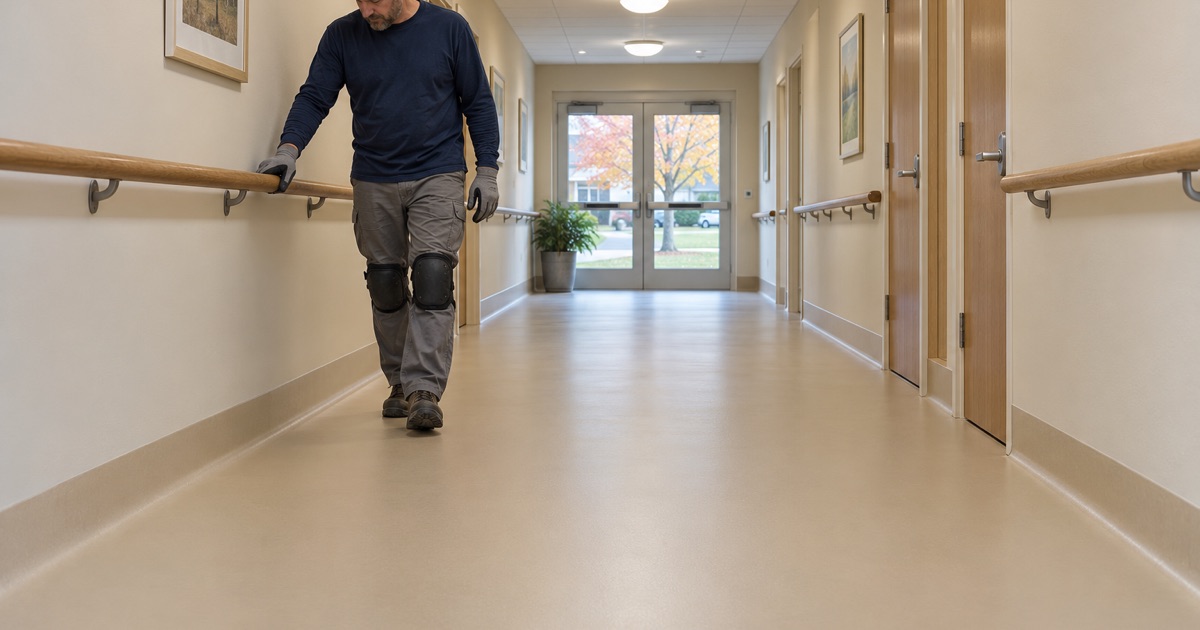
What the Institute Lists
The Advocate South Suburban Cancer Institute is listed at 17750 Kedzie Avenue, inside the village in Bremen Township, with chemotherapy among its services. Advocate South Suburban Hospital stands beside it at 17800 Kedzie Avenue. We have no relationship with either building, and we have not seen their floors, their cleaning products or their procedures.
They matter here as a local example of a building type whose floors face an unusually demanding routine. Where chemotherapy is actually infused for Hazel Crest patients is not something public listings settle. What we can describe is what published research says about floors in rooms where these drugs are prepared and given, and what that means for anyone choosing a coating for such a space.
Where Residue Lands: Under the Infusion Stand
A 2020 hospital wipe study from the Oncology Center of Cyprus, published in PLoS One, tested surfaces for cytotoxic drug residue. In one sampling round, ifosphamide was detected only on the floor of a patient’s room. In the follow-up, the floor area under the infusion stand at the daycare unit tested positive for several drugs, which the authors tied to spillage during preparation and administration.
Those findings come from a cancer center in Cyprus, not from any building in Hazel Crest. Their value is the pattern they show: drips fall, and the floor below the pole is where they land. The authors called comprehensive cleaning protocols essential, which means a floor in a room like that is wiped with something far stronger than a neutral cleaner, again and again.
Why the Floor Belongs in the Plan
A floor does not handle drugs, but it receives them. That makes it one of the surfaces a cleaning protocol has to reach completely, including the edges, the base of the wall and every joint between two materials. A finish that breaks down under that protocol leaves exactly the rough, open surface that holds onto what lands on it.
So the selection questions are practical. Which chemicals will this floor see, how often, and what does its surface look like after years of them? A coating supplier can answer those with test data, and we put them to the supplier before a product ever goes into one of our proposals.
Looking for epoxy-flooring closer to Midlothian? See Epoxy-Flooring Services in Midlothian.
Deactivate, Then Neutralize: The Two-Step Wipe
Hypochlorite First
The usual pattern for cleaning hazardous-drug residue from surfaces runs in two steps. First comes a sodium hypochlorite wipe, a bleach-type solution that deactivates the drug, and a Defense Health Agency technical information paper treats hypochlorite as an acceptable deactivation agent. Kit strengths vary, from 2% hypochlorite in one kit to 5.25% in another.
Hypochlorite is corrosive, and that is where flooring enters the conversation. A finish that softens, chalks or discolors under repeated bleach exposure will need stripping or replacement long before its time. Worse, a damaged surface is harder to clean properly the next time the routine runs, so the problem compounds.
Sodium Thiosulfate Second
The second wipe is sodium thiosulfate, which neutralizes the hypochlorite left on the surface. One kit maker describes the step as rendering the corrosive hypochlorite neutral on the surface so as to maintain the surface’s structure and integrity. Some kits finish with a third wipe of 70% isopropyl alcohol.
Read plainly, the people who make these kits are saying their first step is hard on surfaces. A floor in a treatment room sees hypochlorite, then thiosulfate and sometimes alcohol, every time the routine is followed. The coating has to tolerate all of them over years, not just pass a single splash test on the front page of a data sheet.
What a Coating Does Not Do
A coating does not deactivate drugs. It is not a hazardous-drug control, and it is not antimicrobial. The cleaning protocol does the work, and the floor’s job is to let that protocol do it without breaking down. We will not describe any floor we install as anything more than that.
We also do not quote standards we have not read. A facility’s own safety staff and written procedures set the cleaning products and how often they are used. Our part is to match a floor system to those products and show the data behind the match, so the people responsible for the protocol can judge it.
Seamless, No Grout, and Tested With the Real Products
No Grout Lines or Tile Seams
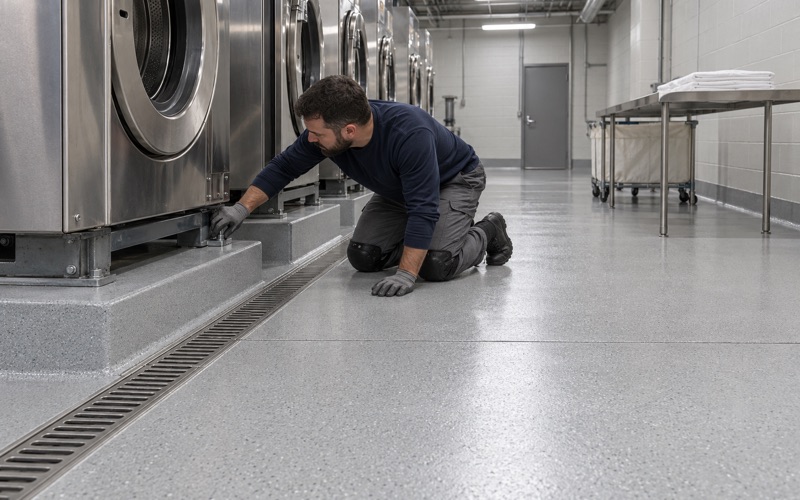
Grout and seams are the weak points in any floor that gets wiped with chemicals. A grout line is a shallow channel that holds liquid, and a seam between tiles or sheets is an edge that can lift and trap what runs under it. A resin floor placed as one continuous surface has no grout lines or tile seams to hold residue, and it can turn up the wall as an integral cove so the floor-to-wall joint is wiped like the rest.
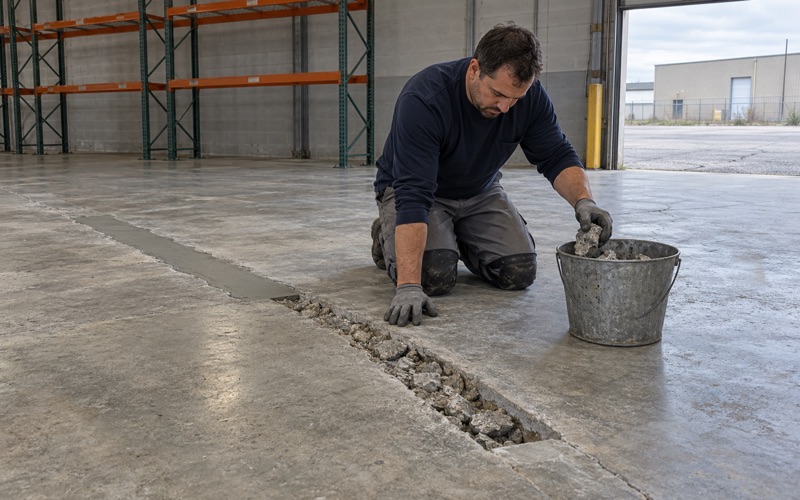
That seamless surface is only as good as the slab under it. We map cracks, spalls, old paint and patched areas before pricing, and a slab that should be repaired or replaced is called out first. Treating a crack properly at the start is what keeps a seamless floor seamless after it has been in service for a few years.
A Topcoat Checked Against the Facility’s Own Products
A chemical-resistance chart is a starting point, not the answer. One maker’s chart cannot tell you how its topcoat behaves under the particular hypochlorite strength and neutralizer a given facility uses. The better check is supplier data or a test patch run against the actual deactivation products, watching for softening, staining or lost gloss before the floor is chosen.
We usually start from a 100% solids epoxy body coat under a chemical-resistant urethane or polyaspartic topcoat, then let the testing decide. Moisture testing is written into the scope before the price is final, whether that is ASTM F2170 in-situ relative humidity probes or an ASTM F1869 calcium chloride test, and the proposal names the reading the slab must meet.
Slip Resistance That Is Specified
A freshly wiped floor still has to be walked on while it is wet. We specify slip resistance by the broadcast media and the topcoat, such as a fine quartz aggregate broadcast locked under the finish coat, rather than promising it as a slogan.
Texture is a trade-off on a floor like this. A heavier texture grips better but is harder to wipe clean, while a smooth finish cleans easily and can be slick. The profile is chosen with the cleaning routine and the foot traffic in mind, and it is written into the proposal so it can be checked.
The Bathroom Floor at Home During Chemotherapy
What One Cancer Center Tells Patients
The same thinking reaches the home. Memorial Sloan Kettering’s patient education says most chemotherapy medicine leaves the body within 48 hours, though some may take up to 7 days. It advises patients and caregivers to wear two pairs of disposable gloves when cleaning up body fluids, and after 48 hours to clean and sanitize the toilet and the bathroom floor.
That is one cancer center’s general guidance. Anyone in treatment follows their own care team’s instructions, and nothing on this page is medical advice. Our point is narrower: a bathroom floor that is about to be cleaned carefully and often is a floor worth looking at closely.
What That Means for a Home Floor
A bathroom with cracked grout or a lifting vinyl seam is harder to clean thoroughly than one smooth, continuous surface. Most of Hazel Crest is owner-occupied houses built from the 1950s through the 1980s, so plenty of bathrooms here have had decades of wear. Where the floor is sound concrete, a seamless resin system is one option, with a topcoat chosen to tolerate the cleaners the household actually uses.
Home jobs carry a written contract signed before any grinding starts, and warranty exclusions are read out before the job is sold, beginning with moisture, the failure most coating warranties leave out. Nobody should learn what their warranty skips after the floor is down.
Garages and Basements in the Village
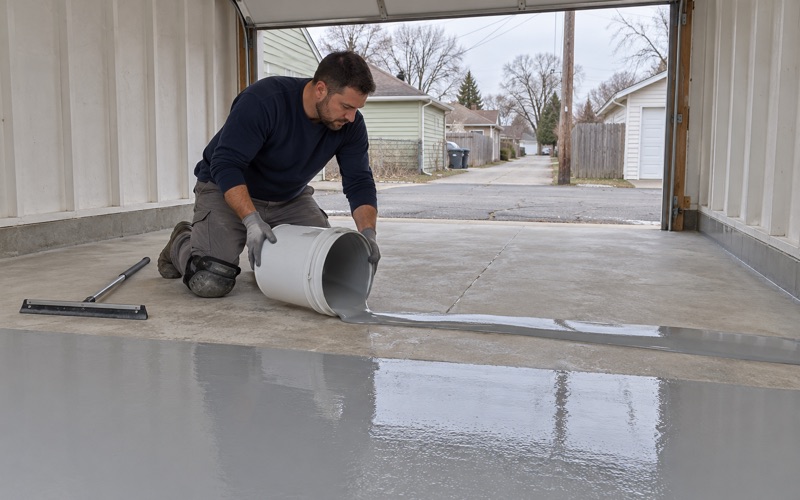
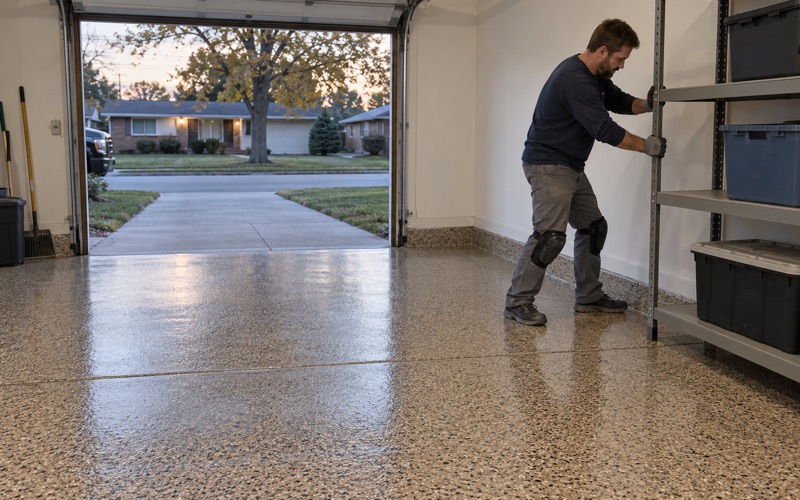
Most of our Hazel Crest calls are still garages and basements. Garage systems are picked to stand up to the brine and rock salt that tires carry in from December to March, and cure timing follows slab temperature and dew point rather than the calendar. A cold, unheated garage is told to wait for better conditions.
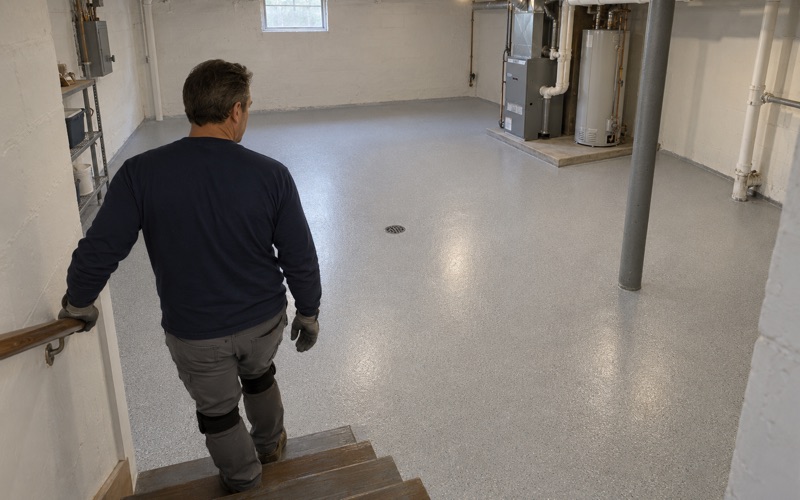
Basements come with their own caution. A floor coating is never sold as waterproofing or flood protection, so any seepage is dealt with first and only a dry, sound slab gets coated. Hazel Crest extends its flood building-protection rules into the 500-year floodplain and counts alterations cumulatively from April 1, 1990, so whether a floor job counts is the Building Department’s call before we start.
- 20+ Years on Concrete
- Moisture Test in Every Scope
- Free Written Estimates