Hammond Epoxy Flooring brings more than 20 years of epoxy flooring in Homewood and across the south suburbs to a question that comes up more often than people expect: can a resin floor go over the tile that is already there? Sometimes it can. The answer depends on the tile, the bed under it and how much preparation the owner is willing to pay for.
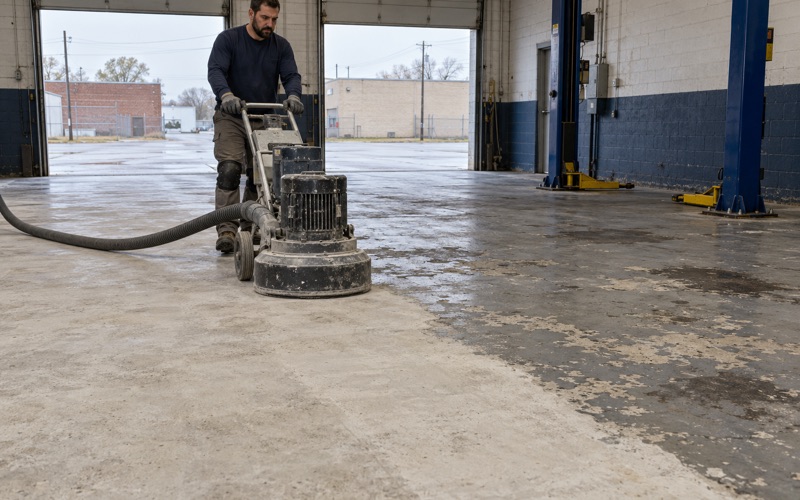
Our approach starts with the floor rather than the brochure. We open bare concrete by diamond grinding or shot blasting, never acid, and over tile we abrade the glaze mechanically for the same reason: a coating needs a measured profile to grip. Every proposal names the product line, the number of coats and the finished thickness, so the installed floor can be checked against the paper.
This page is about one situation in particular, a business moving into a space that already has a tiled floor, and the inspection that decides whether that tile stays. We cover how each tile is checked, what happens to the grout and the glaze, and when we recommend tearing the tile out instead of coating over a bed that is already failing.
A Dixie Highway Restaurant Building Changes Hands
From Cilantro Cocina Mexicana to 3B Burger-Bird-Brews House
Downtown Homewood has been refilling empty restaurant spaces. According to a September 3, 2026 post quoting village trustee Lauren Roman, Antoine Washington bought the shuttered Cilantro Cocina Mexicana property at 18755 Dixie Highway in February 2026. The concept going in is 3B Burger-Bird-Brews House, a burger-and-chicken brand built to franchise, and the Homewood Village Board approved its Class 5 liquor license on March 24, 2026.
The address sits at the south end of the village, which lies in Bloom Township rather than Thornton Township like the village hall on Chestnut Road. We mention the project because it shows a pattern, not because we are involved in it. 3B is not our customer, and we have not seen the floor inside that building.
What a Second Restaurant Inherits Underfoot
When one restaurant takes over another restaurant’s building, it usually takes over the kitchen floor too. In commercial kitchens of that kind, the floor is commonly quarry or ceramic tile set on a mortar bed, with cement or epoxy grout between the pieces. It was chosen for the first tenant’s line, and it has carried that tenant’s grease, hot water and dropped pans for years.
Ripping that floor out costs time, money and a lot of dust, so many new operators ask whether a resin system can simply go over it. Trade case studies say yes in the right conditions. A UK resin flooring federation case describes a hotel kitchen system laid over the existing quarry tiles, and another contractor describes cleaning, grinding and repairing hollow ceramic tiles before priming.
Deciding the Floor Before the Equipment Arrives
A kitchen floor is easiest to fix while the room is empty. Once walk-ins, fryers and prep tables are set and an opening date is announced, every repair has to be squeezed into a closed night. Settling the tile question during the buildout, before the line goes in, gives the floor its full cure and keeps the opening from depending on it.
When a space truly cannot close, we phase the work into overnight and weekend windows, the same way we schedule plant floors around shifts. Methyl methacrylate, or MMA, systems are sometimes laid over tile overnight because they cure fast, though their strong odor during application has to be planned around in an occupied building.
Looking for epoxy-flooring closer to Markham? See Markham Epoxy-Flooring.
Sounding Every Tile Before Anything Goes Over It
How a Hollow Tile Gives Itself Away
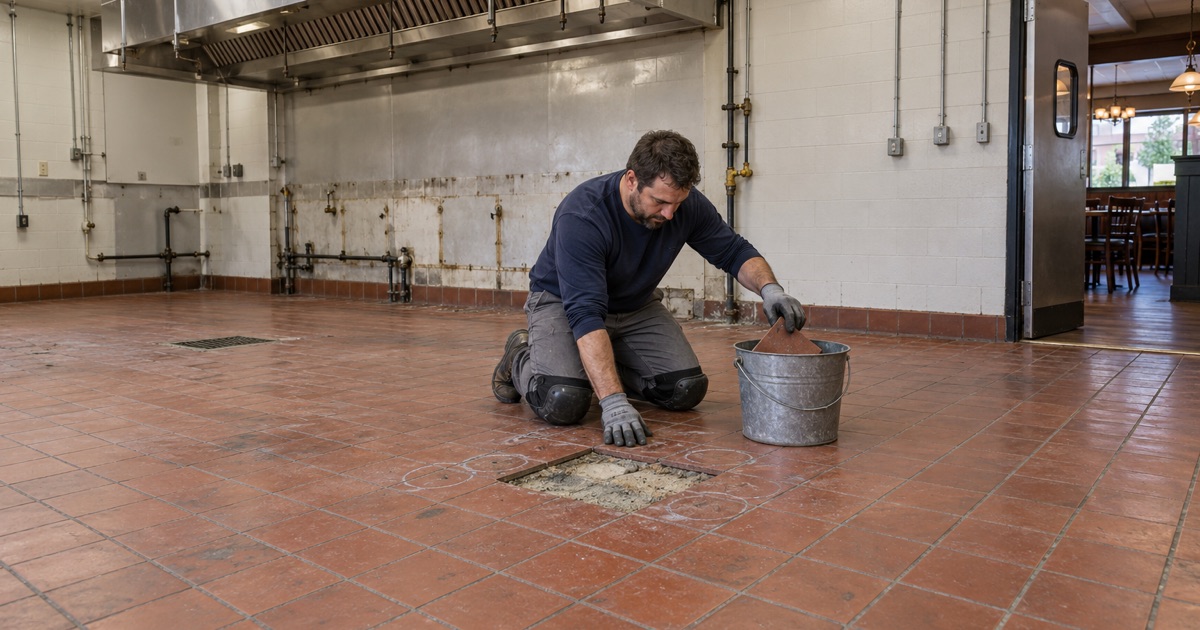
A coating over tile is only as good as the bond between each tile and the mortar under it. We check that bond the old-fashioned way, by tapping or dragging a steel tool across every tile and listening. A well-bonded tile gives a sharp, solid sound. A hollow tile rings dull or rattles, which means the mortar under it has let go.
We mark every hollow tile on a floor plan as we go, the same way we map cracks, spalls and old patches on a bare slab before pricing. That map is what the price is built from. A floor with three loose tiles by the dish pit is a very different job from a floor where loose tiles run the length of the cook line.
Cutting Out Failures and Filling the Voids
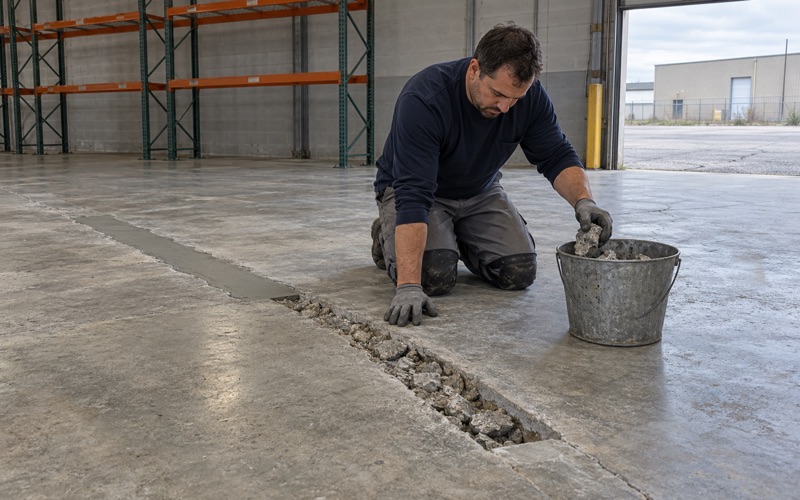
A hollow tile cannot be coated over and forgotten. Under a rigid resin it keeps moving, and the coating cracks along its edges. Each failed tile is cut out, the loose mortar beneath it is removed down to a sound base, and the hole is filled flush with a repair mortar compatible with the coating system that will go over it.
Tiles that sound solid but sit next to failures get a second look, because debonding tends to spread outward from a wet spot or a cracked bed. Where a cluster of repairs is needed, we let the patches cure on the schedule the repair material calls for before any primer goes down. Rushing a patch is how a repair becomes the next failure.
When the Honest Answer Is to Take the Tile Up
Sometimes the sounding tells us the whole floor is moving. When many tiles ring hollow, the mortar bed itself has usually failed, and a resin layer laid over it will only follow the bed down. In that case we say so before quoting any coating, and we recommend taking the tile up and working from the concrete underneath.
Some trade advice goes further and says glazed or very smooth tile should simply be lifted. We treat that as a judgment call: where the glaze can be ground and the bed is sound, coating can work, and where either is in doubt, removal is the safer path. Taking tile up costs more at the start, but less than removing two failed layers later.
Grout, Glaze and a Primer Made for Glazed Surfaces
Opening and Filling the Grout Lines
Grout joints are the low points of a tile floor and the place where years of kitchen grease collect. Left as they are, they telegraph through a thin coating as a grid of shallow lines and trap contamination under the primer. We open the grout lines, clean out the soft and oil-soaked material, and fill them so the surface reads as one plane.
How much fill a floor needs depends on the joint width and how far the grout has worn. Wide or deeply eroded joints may call for a leveling coat across the whole floor before the main system goes down. That layer is part of the build, so it appears in the proposal alongside the product line, the coat count and the finished thickness.
Grinding the Glaze and Taking Off Old Grease
A glazed tile needs abrasion, not just cleaning. Its surface is designed to shed liquids, which is exactly what a primer must not do. We grind or abrade the glaze to give the coating something to grip, and the dust is vacuumed at the machine rather than washed toward a floor drain.
Years of kitchen grease are the other half of the problem. Degreasing is one step in the preparation, not the whole of it: oil that has soaked into the grout and the edges of chipped tiles has to come out before grinding, or the grinder simply smears it across the floor. A clean, abraded tile is the only surface a primer should see.
Primer, Build and Topcoat Over Tile
Ordinary concrete primers are made to soak into porous concrete, and glazed tile is not porous. Over tile we use a primer designed for glazed and difficult surfaces, the same principle the hotel kitchen case relied on. We do not promise a bond figure over tile; the sounding and the preparation decide how the floor performs, not a number on a sheet.
Above the primer, the system is chosen for the room. A dry storage area might take a 100% solids epoxy build with a quartz aggregate broadcast for texture, while a hot washdown zone may call for something else entirely. Slip resistance is specified by the broadcast media and the topcoat, and it is written into the proposal rather than promised as a slogan.
Coating Over Tile in a Homewood Basement, Mudroom or Garage
Old Tile in a Basement or Mudroom
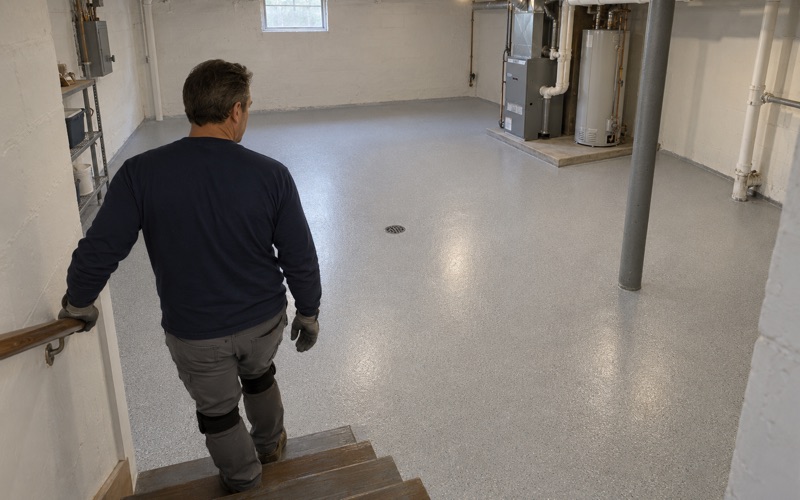
The same questions apply at home. Plenty of Homewood houses have ceramic tile in a basement, laundry room or mudroom, and owners ask whether a flake floor can cover it instead of tearing it out. We sound every tile, open the grout, abrade the glaze and use a glazed-surface primer, exactly as in a commercial kitchen, only on a smaller scale.
Residential tile often sits on a thinner bed than a restaurant floor, and a basement bed may have been set directly on a slab that takes on moisture. That is why the inspection does not stop at the tile surface. Where the bed or the slab beneath it is suspect, we recommend removal before we recommend a coating.
Moisture Along Ridge Road and Off It
Ground conditions vary inside the village. Ridge Road follows the sandy old shoreline of prehistoric Lake Chicago, while Homewood also sits on limestone near Thornton Quarry. A damp basement floor in one spot and another across town can have different causes, so we test rather than assume, using ASTM F2170 in-situ relative humidity probes or ASTM F1869 calcium chloride testing where concrete is exposed.
The test and the reading it must meet are written into the scope before the price is final. Moisture is also the failure most coating warranties exclude, so we read those exclusions out before the job is sold. The village has named Ridge Road and Chayes Park Drive as flood spots, and a coating is not flood protection or waterproofing; we never sell it as either.
Garages, Cold Slabs and Permits
Tile in a garage is less common, but some attached garages and converted workshops have it. Our garage systems are picked to handle the brine and rock salt that tires carry in from December to March, and over tile that choice still applies. Cure timing follows slab temperature and dew point, not the calendar, so a cold unheated space may be told to wait.
Homewood’s building code is Municipal Code Chapter 22, updated in 2022 and 2023, and it is administered by the Community Development Department at 2020 Chestnut Road. We confirm with that office whether a project needs a permit and whether village contractor registration applies before we book. Coatings are chosen inside Illinois’ VOC limits under 35 Ill. Adm. Code Part 223, and home jobs carry a written contract signed before any grinding starts.
- 20+ Years on Concrete
- Moisture Test in Every Scope
- Free Written Estimates