Hammond Epoxy Flooring has spent more than 20 years on epoxy flooring in Justice and the rest of our Illinois service area, and the shops that keep us busiest are the ones where something slick ends up on the floor. A coating that looks great dry can turn treacherous under a thin wet film. We build floors around what actually gets spilled on them, not around a showroom sample.
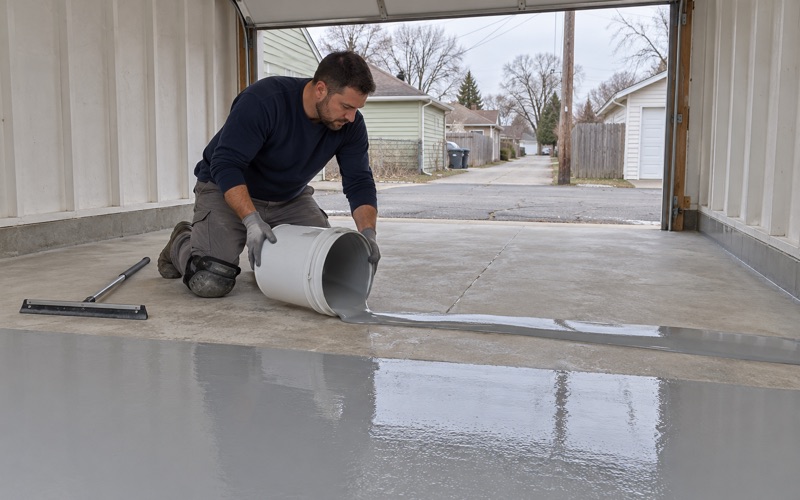
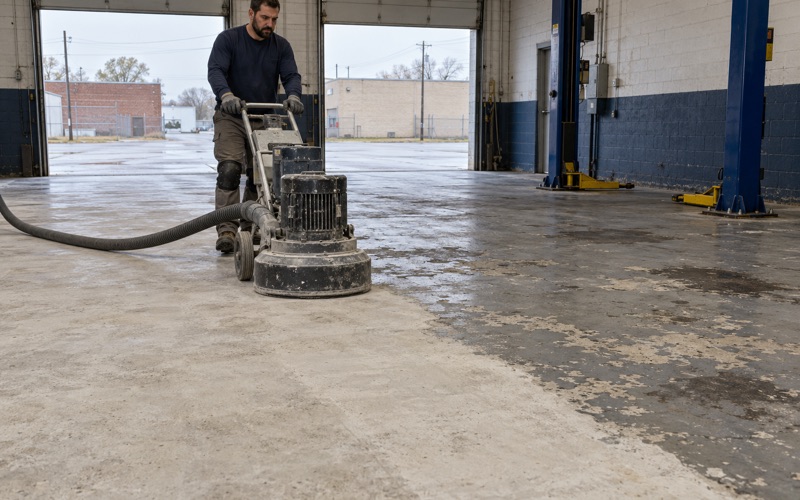
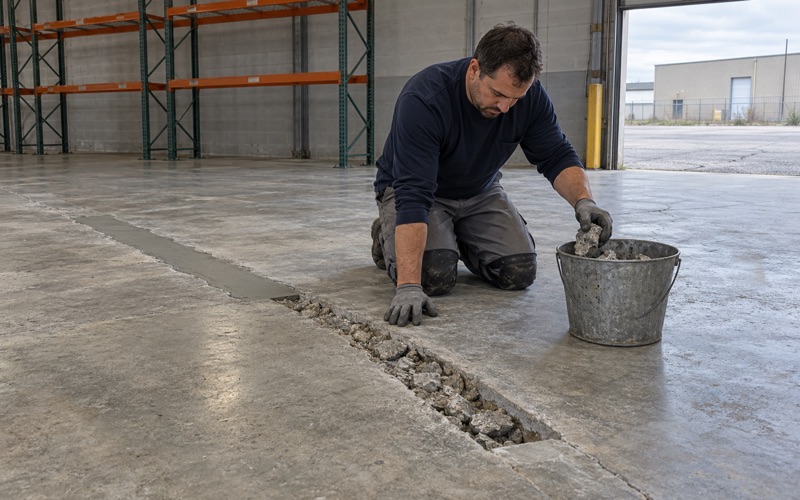
Every job starts with the slab, not the resin. We open the concrete with diamond grinding or shot blasting to a measured ICRI concrete surface profile, never with acid, and we map cracks, spalls, old paint and patches before a price goes on paper. If a slab should be repaired or replaced first, we say so at the start rather than coating over the problem.
Our proposals name the product line, the number of coats and the finished thickness, so you can hold the installed floor against the paper. Moisture testing is written into the scope before the price is final, with the test named, whether ASTM F2170 relative humidity probes or ASTM F1869 calcium chloride, and the reading the slab has to meet. Warranty exclusions get read aloud before the job is sold, moisture first.
Semi-Truck Tires and the Lube That Seats Them
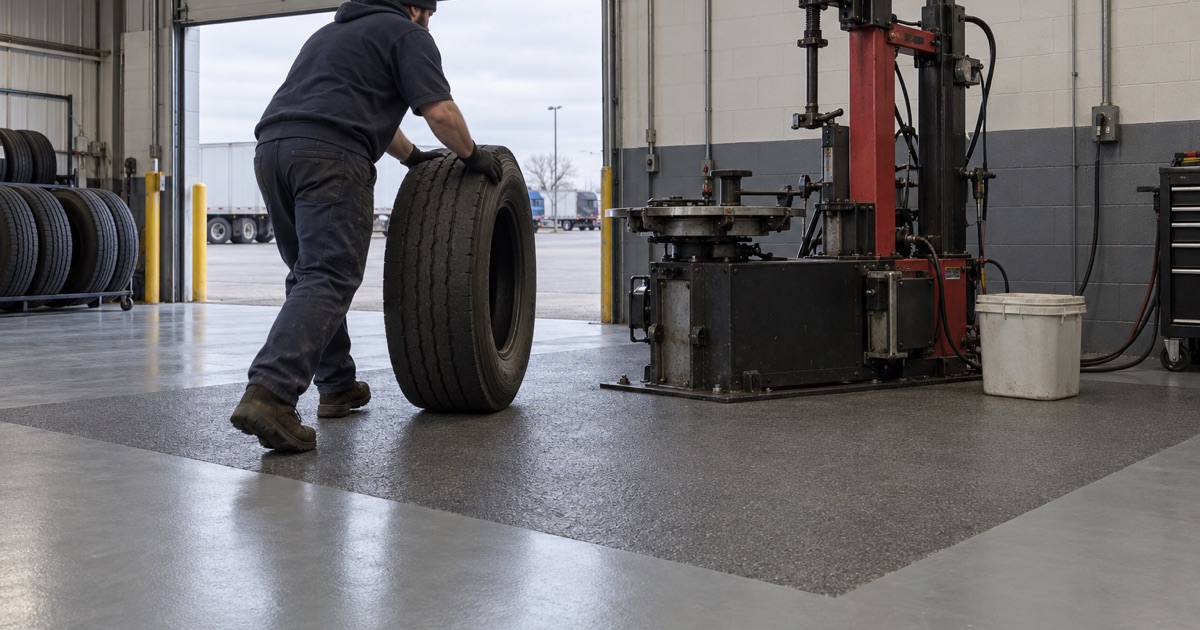
A Tire Shop on West 84th Place
Justice is a village in Cook County, established in 1911, and its own hazard plan says that while it has no major industries, it has several truck repair shops and body shops in its industrial park. One tire business in the village is Illinois Tire Sales at 8801 West 84th Place, which advertises purchase and installation for commercial tire needs, semi truck tires included.
We have no relationship with that shop, and we have not seen its floors, its products or how it works. We name it because it shows the kind of work done here: big commercial tires broken down, mounted and inflated on a concrete floor. That work leaves a specific residue behind, and it is the residue this page is about.
What Mounting Lubricant Is Made Of
A truck tire’s bead has to slide over the rim flange and seat cleanly, and mounting lubricant is what lets it. The lubricants we looked at are soap pastes or soap solutions. REMA’s Universal Mounting Paste, for one, is described on its safety data sheet as an aqueous soap solution with propylene glycol, carrying no hazard statements.
That is good news for a resin floor in one way. Soap does not attack a cured coating the way some shop chemicals can, and one manufacturer’s chemical resistance chart rates soap solution at its top mark across every coating type it lists. The trouble with tire lube is not chemistry at all. It is traction.
Why the Makers Warn About Spills
Craft Labs puts the hazard plainly on its Slip Tire Lube and Slip Thick sheets: floors may become very slippery when product is spilled. The same sheets tell users to reach for absorbent materials or a mop immediately. A Wurth mounting paste safety data sheet likewise says to soak spills up with inert absorbent and not to flush them toward surface water or sanitary sewers.
We read those warnings as a floor specification. A product that its own maker calls a slip risk on a spill is going to end up on the floor around a tire changer sooner or later, so the floor has to be designed for the day it does. Hoping the crew never drips is not a plan.
Looking for epoxy-flooring closer to Summit? See Summit Epoxy-Flooring.
A Soap Film on a Glossy Floor
Why Smooth Topcoats Are the Worst Case
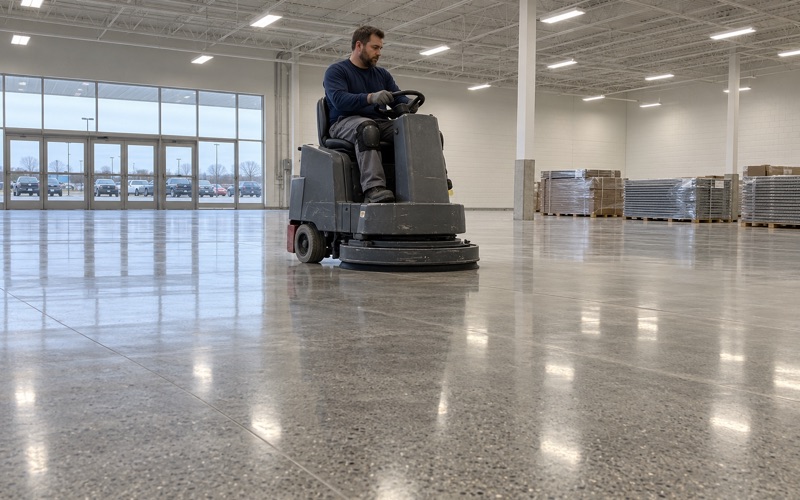
A high-gloss 100% solids epoxy or polyaspartic topcoat is easy to clean precisely because it is smooth and closed. That same smoothness is what makes a wet soap film so dangerous on it. There is nothing for a boot sole to bite through, so the film acts like a layer of grease between the shoe and the coating.
Bare concrete does not solve the problem either once soap is spread across it, and an older sealer that has worn glossy in the traffic lanes can be worse. So the question in a tire bay is never just epoxy or no epoxy. It is which surface texture sits where the lube lands, and how the crew handles a spill in the minutes after it happens.
Where the Lube Actually Lands
In a truck tire bay the slick zone is predictable. Lube gets brushed onto beads at the changer, drips as the tire is lifted and rolled, and follows the tire into the inflation cage. Wet tires then carry a film a few steps further. That footprint, rather than the whole building, is where the slip problem lives.
We walk that footprint with the shop before we price anything, marking where the changer, the cage, the lube tub and the bead breaker sit and where the crew stands while they work. Those marks become the boundary of a separate texture zone on the drawing, and the proposal shows it so nobody is surprised by a rougher patch in the middle of a smooth floor.
What Slip Resistance Means on Paper
We never promise that a floor cannot be slipped on, and we do not quote a slip-resistance figure we have not measured. What we put in writing is the broadcast media, its grit size and the topcoat that locks it down, zone by zone. Those are things you can see and check on the finished floor.
Texture is a trade-off, and we say so up front. A coarser surface holds more grime and takes more effort to mop, which is why we keep it to the zone that needs it. The rest of the shop can stay smoother and easier to keep clean, where what crosses it is carts, creepers and dry boots.
Texture, a Brush-On Tub and Absorb-First Cleanup
A Coarser Broadcast at the Tire Station
Inside the marked zone we build a coarser broadcast than the rest of the floor. Quartz aggregate is seeded into a wet epoxy coat, the excess is swept off after cure, and a topcoat goes over it at a rate chosen to lock the grains in without drowning them. Too heavy a topcoat fills the texture back in and wastes the step.
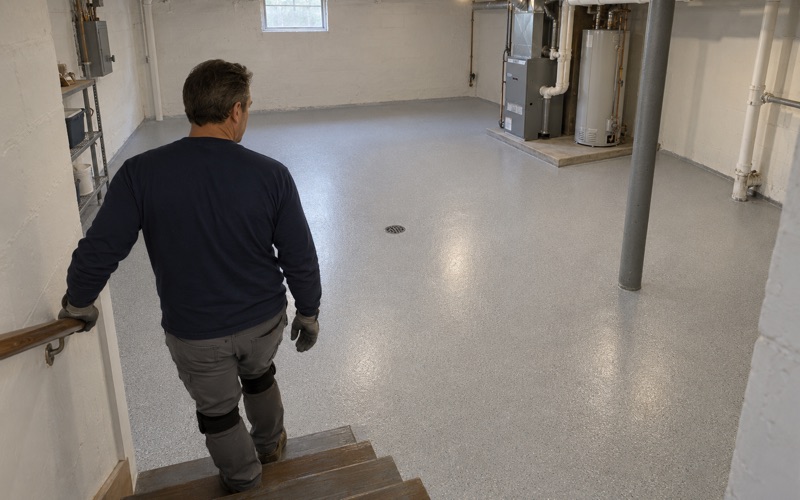
Outside the zone, a finer broadcast or a vinyl flake system under a polyaspartic topcoat suits the general shop floor. The transition between the two is laid on a straight line where it is easy to see and easy to sweep along. Both areas still start from the same ground or blasted profile, because texture on top does nothing for a coating that never bonded.
Brush It On From a Tub
How the lube is applied matters as much as the floor under it. TECH markets its tire paste as going on with a brush, eliminating spills and slip hazards in the service area. A paste brushed from a tub stays on the bead; a solution splashed from an open bucket ends up in a ring around the changer.
We are flooring people, not tire people, so we do not tell a shop which product to buy. We do point out that a brush-on paste kept in a lidded tub on a shelf or cart, rather than on the floor, keeps the slick material in fewer places. The textured zone then does its job as a backstop instead of a daily crutch.
Absorb First, Then Mop
When lube does hit the floor, the makers’ own instruction is to deal with it right away rather than let it dry. A drying soap film may look gone while still leaving a slick skin on a smooth surface. Our cleanup sheet for a tire station says to absorb the spill, mop the spot with clean water and squeegee it dry before anyone walks through.
Absorbed material is picked up and bagged rather than swept toward a floor drain, in line with the Wurth sheet’s advice about sewers. The same thinking runs through our own prep: grinding dust is pulled into a vacuum at the machine instead of being hosed toward a drain. A tire shop that already keeps soap out of its drains will find our crew works the same way.
Home Garages, Village Permits and Cure Timing in Justice
Home Garages See the Same Film
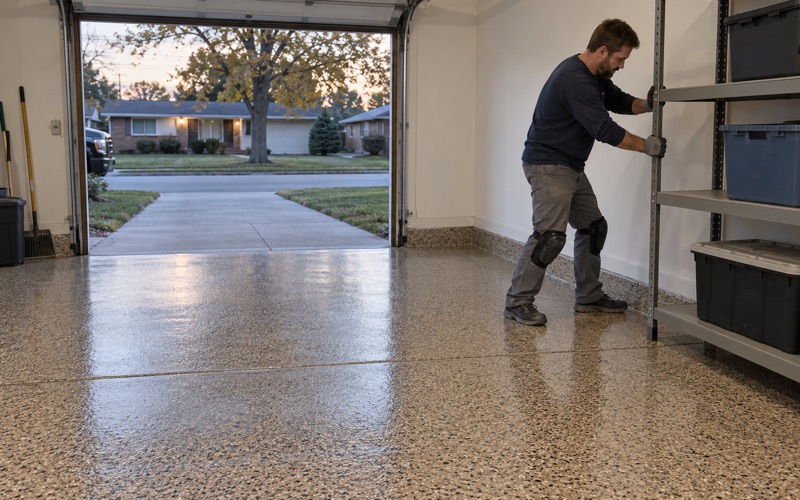
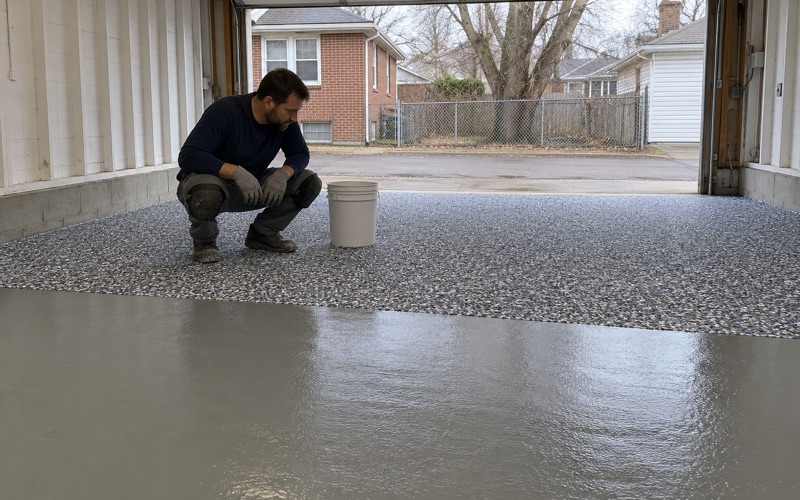
The slip problem is not limited to commercial bays. Homeowners who swap seasonal tires, wash a car indoors in winter or mop with a heavy dose of soap put the same kind of film on a garage floor. On a glossy flake system it can catch someone carrying a tire or a bag of salt across the slab.
For those garages we add a light broadcast to the topcoat in the area where tires are changed or a car is washed, and keep the rest of the floor easier to sweep. Our garage systems are also picked to stand up to the brine and rock salt that tires drag in from December to March, which is its own reason to choose the topcoat carefully.
Registered and Bonded Before Any Permit
Permitted work in Justice runs through the Village of Justice Building Department on West 82nd Place. Its Contractor’s Work Permit Program requires contractors to be insured, licensed and registered with the village, and no building permit issues until each contractor on the job is registered and bonded. The permit bond is $10,000 for contractors other than sewer contractors, on a licensing year running February 1 through January 31.
We check those requirements before a Justice job is booked, the same way we check licensing, bond and insurance rules in every town we work. Concrete work is a listed permit item in the village, so slab repairs that come up during mapping are flagged early, before they can hold up a coating schedule. Illinois itself licenses no flooring or coatings contractor, so the village registration is the credential that counts here.
Timing, Cure and Honest Limits
Cure timing follows slab temperature and the dew point spread at the surface, not the calendar. A shop bay that loses its heat each time a truck pulls in during January, or an unheated home garage in the same month, can sit too cold for a coating to cure, and in that case we tell you to wait. A coating laid on a cold, damp slab is how amine blush and soft spots happen.
We also keep the claims honest. A floor coating is not radon reduction, waterproofing or flood protection, and Justice’s own list of flood-prone areas is a matter for drainage and plumbing, not resin. What a textured coating can do in a tire bay is give boots something to grip and give the crew a surface that cleans up fast, and that is what we put our name on.
- 20+ Years on Concrete
- Moisture Test in Every Scope
- Free Written Estimates