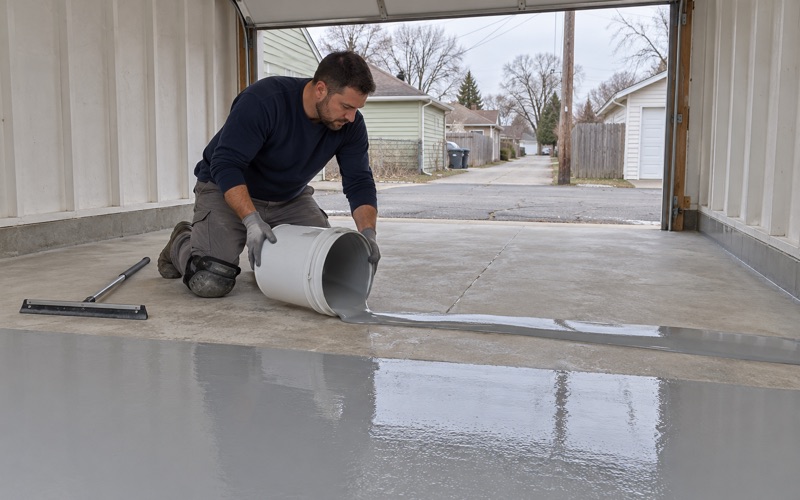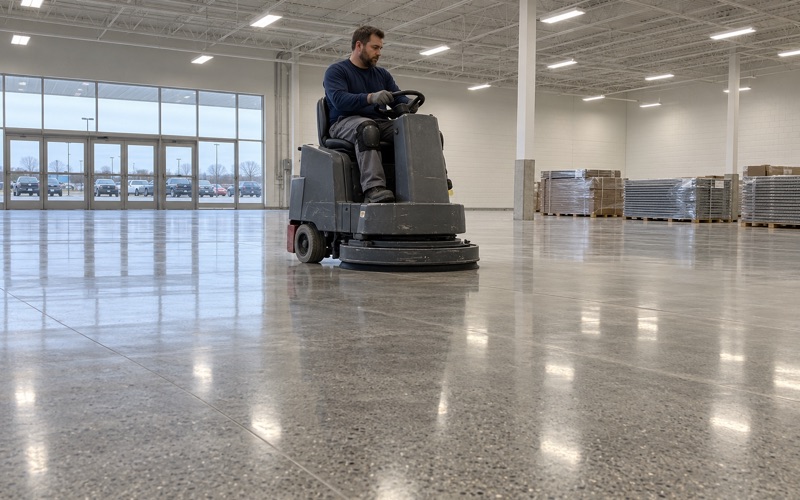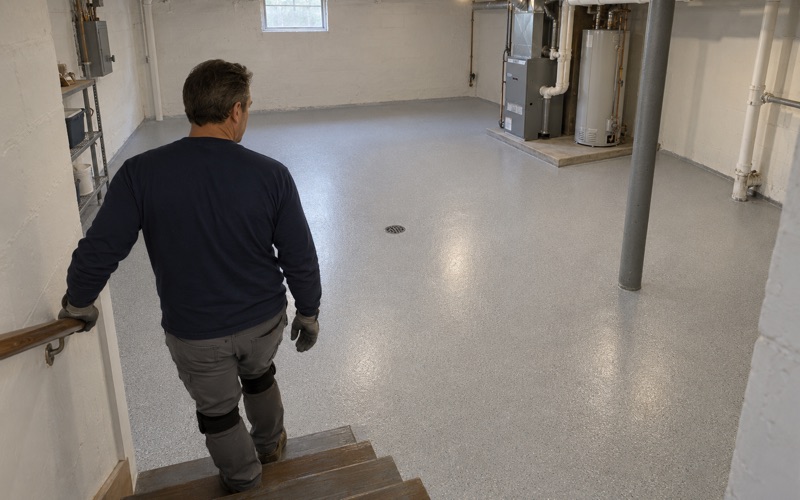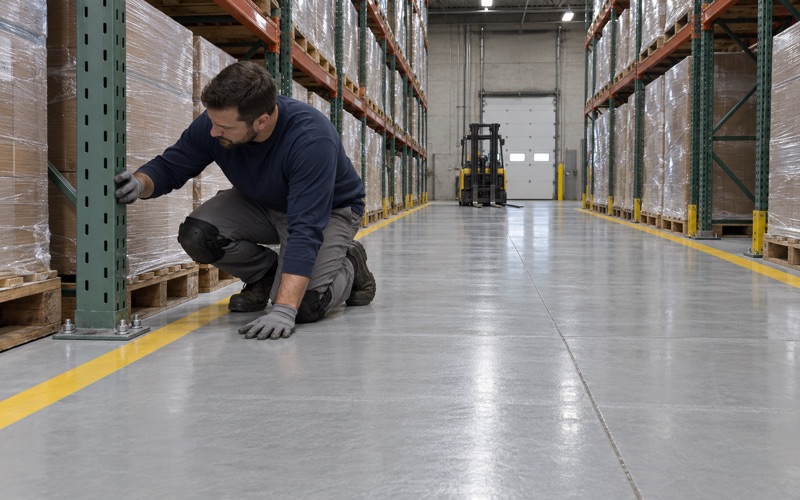
Hammond Epoxy Flooring has handled epoxy flooring in Lake Station for owners of shops, wash bays and home garages through more than 20 years in the trade, and the first question we ask here is what chemistry the floor will meet. A coating that does well under rock salt and tire traffic can lose its grip under a different spill, so the system is matched to what actually lands on the slab.
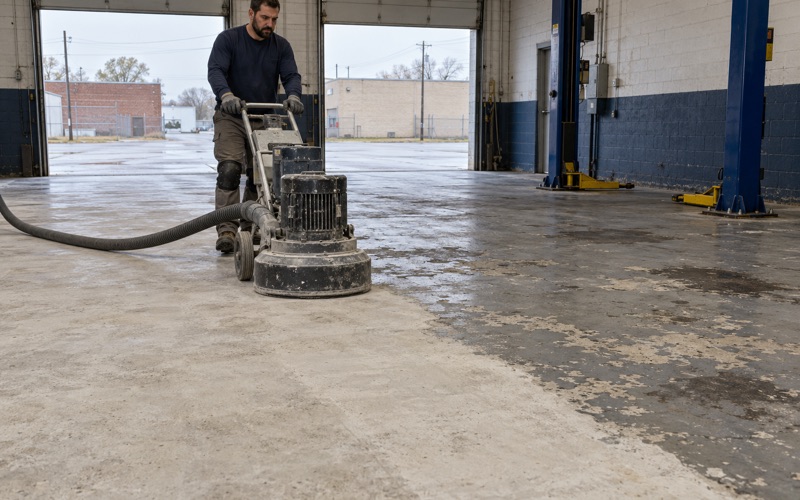
Every job starts with the concrete itself. We open the slab by diamond grinding or shot blasting to a measured profile, never by acid etching, and we map cracks, spalls, old paint and patched areas before a price is set. When a slab ought to be repaired or replaced instead of coated, we say so before anything else.
The proposal then names the moisture test and the reading it has to meet, along with the product line, the coat count and the finished thickness. Warranty exclusions are read aloud before the sale, moisture first, because that is the failure most coating warranties leave out. The sections below cover the local conditions that shape those choices in this city.
Truck Washing Around the Clock on Ripley Street
Two Blue Beacon Locations, Five Bays
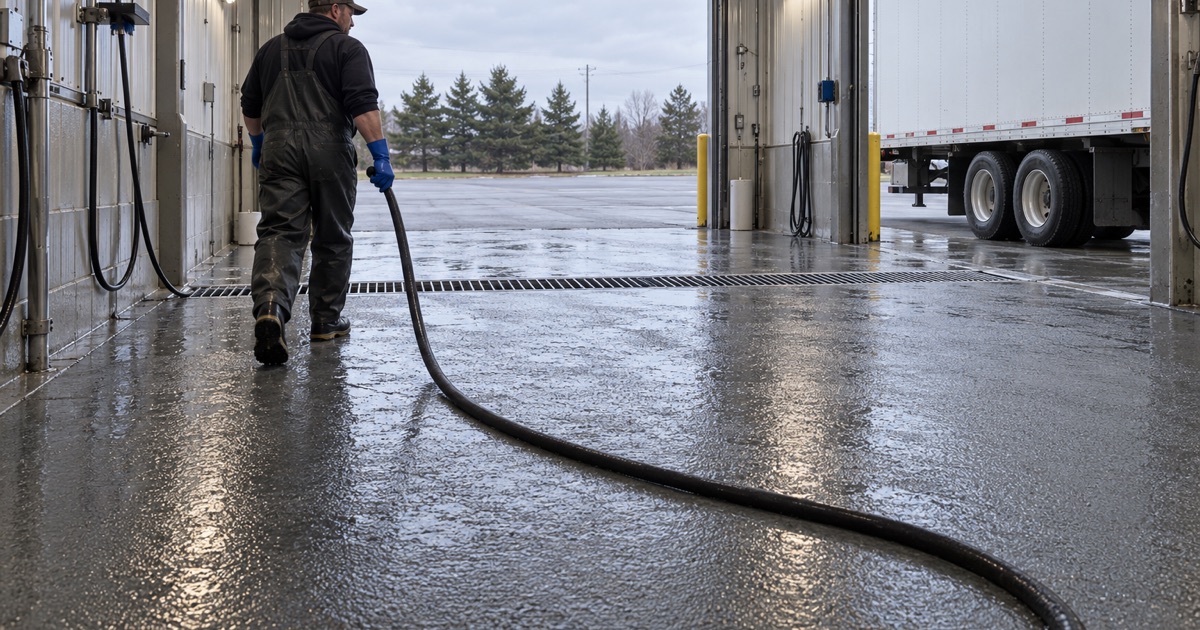
Ripley Street in Lake Station carries heavy truck traffic, and two Blue Beacon truck washes sit on it. The Lake Station North location at 1241 Ripley St lists two regular wash bays open 24 hours, and the location at 1535 Ripley Street lists three bays with the same services. A Pilot Flying J travel center with diesel lanes is listed nearby at 1235 Ripley St.
We have no relationship with either wash and have never seen their floors. We name them because they show the kind of work that goes on along this stretch of town, and because the services they advertise point straight at a floor chemistry question that matters to an owner of a wash bay or a shop slab here. Nothing on this page describes their floors or the products they use.
What the Service List Says
Both locations list truck washing, exterior trailer washing, reefer and dry box trailer washouts, engine wash and tire dressing. They also list aluminum trailer and accessory brightening, which is the service that raises the floor question. Polished aluminum on a trailer or tank stays bright because of what is sprayed on it, and whatever is sprayed eventually ends up on the ground.
Blue Beacon’s pages do not name the brightener chemistry, and we have not read which product either Lake Station wash uses. What the trade literature does say is that one acid family is common in aluminum brightening at vehicle washes, and that this family behaves badly on concrete. That is the subject of the next section.
Looking for epoxy-flooring closer to Alsip? See Epoxy-Flooring in Alsip.
What Makes Aluminum Shine, and What It Does to a Slab
Hydrofluoric Acid Brighteners
An insurer’s brochure from ICW Group describes hydrofluoric acid, or HF, as ‘Commonly used in car and truck wash products to brighten aluminum and break down roadway grime.’ Its table, drawn from each product’s safety data sheet, lists named brighteners with HF content reported as high as 10 to 20 percent. Others sit lower, such as TC-303 Acid Aluminum Truck Brightener at under 5 percent. We cite it because it is plain about where the acid ends up.
The same brochure weighs the cost of switching away from HF and counts ‘savings from not having to replace concrete and conveyors’ in favor of the switch. It also describes a car-wash worker burned on the feet by a cleaner diluted to about 2 percent HF. Those are hazards to people first, and we leave chemical safety to the product’s data sheet and to medical professionals.
Glass, Sand and a Quartz Broadcast
The NIOSH Pocket Guide entry for hydrogen fluoride is blunt on this point: ‘Corrosive to metals. Will attack glass and concrete.’ Glass is mostly silica. So is the sand in ordinary concrete, and so is the quartz aggregate many coating systems broadcast into the resin for texture and slip resistance.
That makes the usual floor recipe worth a second look in a bay that sees brightener. A quartz broadcast that gives a wet floor its grip is the same mineral HF goes after, and bare concrete around a drain or at a cracked joint leaves sand and cement paste exposed to the acid. A coating is not acid-resistant by default, and it is not waterproofing either.
Non-HF Brighteners as a Floor Choice
Aluminum brighteners without HF are on the market. Dultmeier sells Luma Shine 502 labeled ‘Does Not Contain Hydrofluoric Acid!’, and DuBois markets a fleet-wash acid cleaner as an alternative to HF brighteners. A wash or shop owner weighing a new floor can treat the brightener choice as part of the floor decision rather than a separate purchase.
We do not tell anyone which cleaner to buy. We do ask what is sprayed in the bay before we pick a system, because a floor specified for one acid family and then exposed to another is a floor specified for the wrong job, and the fix later costs far more than the question does now.
Choosing and Keeping a Wash-Bay Floor
Start From the Coating Maker’s Acid Data
For a slab that will see brightener, we pick the floor system from the coating manufacturer’s own chemical data for that acid family, not from a general claim that a product is tough. The primer, the body coat, the topcoat and the broadcast media are each checked against what will land on them, and the proposal names the product line so the owner can read the same data.
Slip resistance comes from the broadcast media and the topcoat we specify, not from a slogan. In a bay where quartz may be a poor partner for the chemistry, that changes which media goes into the floor and how it is locked in, and we put that choice in writing before the job is priced so nobody is surprised by it later.
Profile, Moisture and Thickness on Paper
A wash bay is wet for most of its working life, so the moisture work matters as much as the resin. We test before the price is final, using ASTM F2170 in-situ relative humidity probes or ASTM F1869 calcium chloride testing, and the proposal states the reading the slab has to meet. Where it falls short, a moisture-mitigation primer goes into the scope rather than into a later argument.
The slab is ground or shot blasted to an ICRI concrete surface profile that fits the system, and grinding dust is vacuumed at the machine instead of washed toward a floor drain. Coat count and finished thickness are written down, so the installed floor can be measured against what was sold. Bays that cannot close are phased around shifts, with overnight and weekend windows.
A Rinse Routine the Floor Depends On
No coating choice replaces cleanup, and a hose and squeegee at the end of a shift do more for a wash-bay floor than an extra coat could. On a floor that sees an HF-type brightener, the practice is to keep the floor rinsed so the acid does not sit on the coating, in the joints or around the drains. We talk through the bay’s rinse routine with the owner before the work starts, because how the floor is kept matters as much as how it is laid.
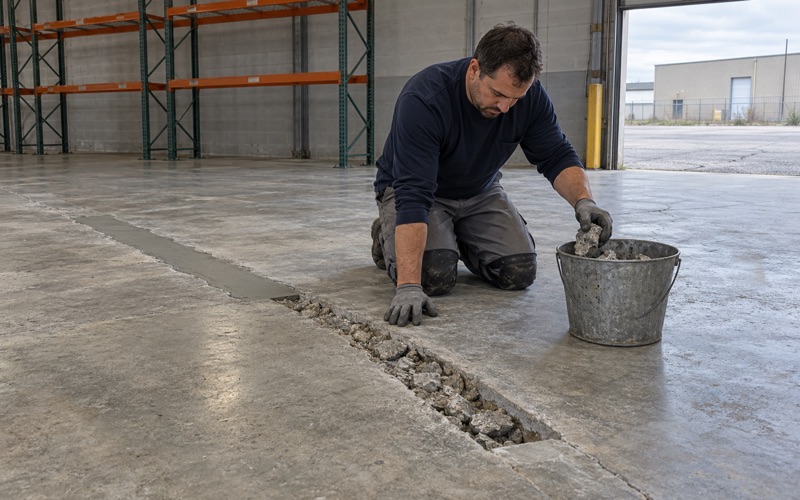
Edges, trench drains and the line where coating meets bare concrete are the spots we study closest when we map the slab. Spalls and cracks there are mapped and repaired before pricing, since a gap in the coating gives runoff a path straight down to the sand in the concrete underneath it. We also check the slope toward the drains, so rinse water leaves the floor instead of pooling where the acid landed.
Acid Wheel Cleaners in a Lake Station Garage
Rinse It Off the Slab at Once
The same concern turns up in home garages in a smaller bottle. Acid wheel cleaners are sold for cars and trucks, and a Lake Station homeowner who uses one in the garage should rinse it off the slab at once rather than letting it dry where it dripped. The product’s data sheet is the place to learn what it contains. A rinse costs a minute, while a dulled patch beside where the wheels sat costs a repair.
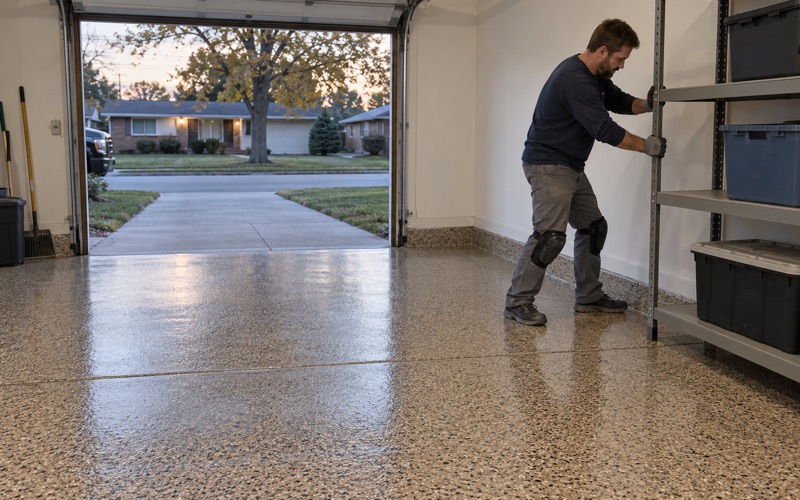
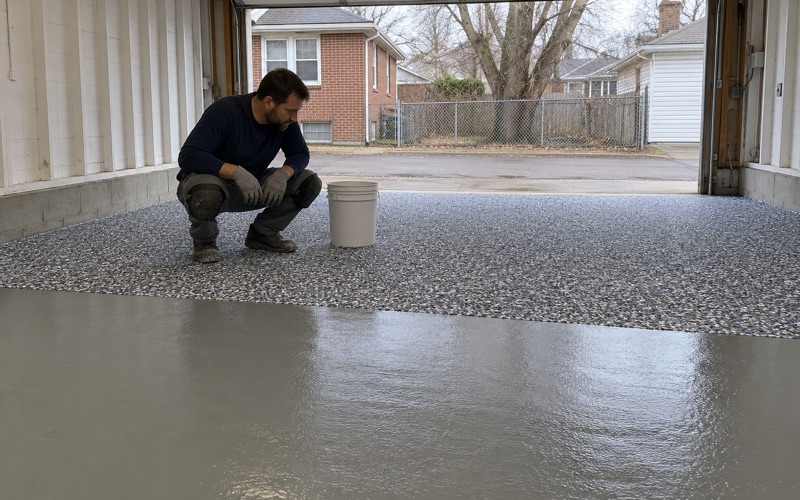
For a garage we often lean toward a vinyl flake broadcast under a polyaspartic or polyurea topcoat, built to hold up to the brine and rock salt that tires carry in from December to March. That choice is about salt and traffic. It does not change what an acid cleaner can do to a floor left wet with it, so the rinse habit still applies.
Older Detached Houses and Their Garages
Lake Station, known as East Gary from 1908 until it was renamed in 1977, is a Lake County city of 13,235 people at the 2020 census. Its housing leans older and owner-occupied: 68.2 percent of units predate 1980, 72.0 percent of occupied units are owner-occupied, and 81.8 percent are detached houses.
A garage slab that has carried cars for decades often holds old paint, patches and cracks, which is why we map it before pricing. Cure timing follows the slab temperature and the dew point spread at the surface rather than the calendar, so a cold, unheated garage is told to wait. Home jobs get a written contract with the terms Indiana’s Home Improvement Contracts Act requires, signed before any grinding.
Permits, Licensing and VOC Limits
The City of Lake Station Building Department, at 1969 Central Avenue, licenses contractors who work in town. Its requirements include a $5,000 bond recorded with the Lake County Recorder, a $1,000,000 certificate of insurance naming the city, and proof of licenses from two other cities or towns for a first-time applicant. We check those rules before a job here is booked.
The city’s permit form says trucks must be lettered with the business name or jobs are stopped, and the permit is posted in the customer’s front window. Lake Station sits in Hobart Township, inside the Lake County part of the Chicago 2015 ozone nonattainment area, and Indiana’s 326 IAC 8-14 caps floor coatings at 250 g/L, a limit that binds the applicator.
- 20+ Years on Concrete
- Moisture Test in Every Scope
- Free Written Estimates