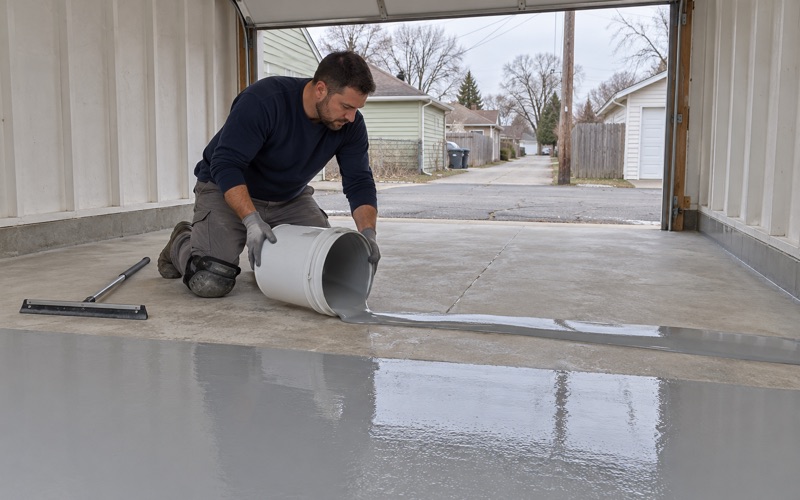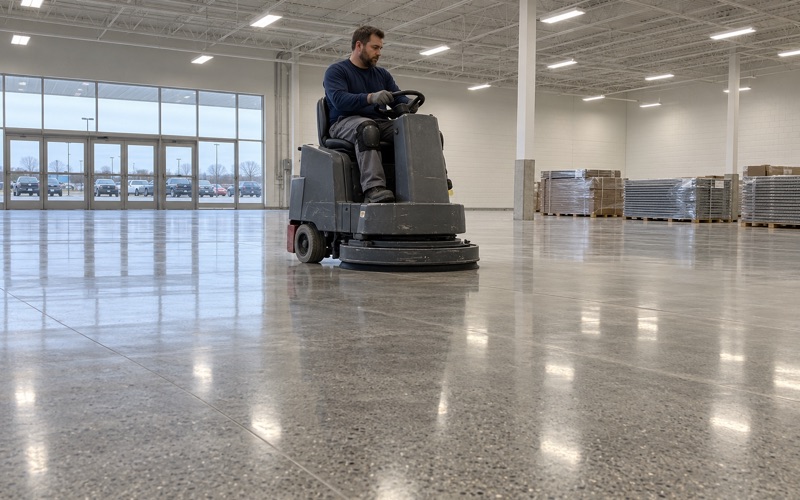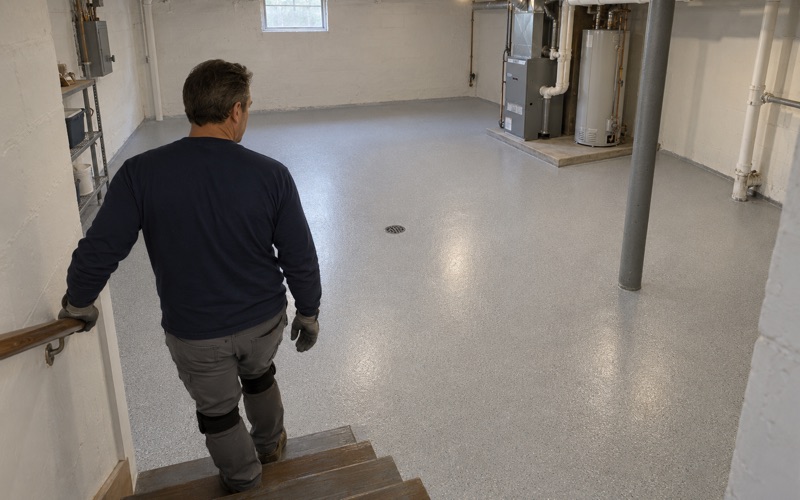
Hammond Epoxy Flooring brings more than 20 years of epoxy-flooring work to Lowell, IN, and the question we hear most from food retailers is about water rather than looks. A sales floor that stays wet in some places and dry in others needs a coating plan that treats those zones differently. One finish poured wall to wall rarely suits a store that mists vegetables at one end and stacks canned goods at the other.
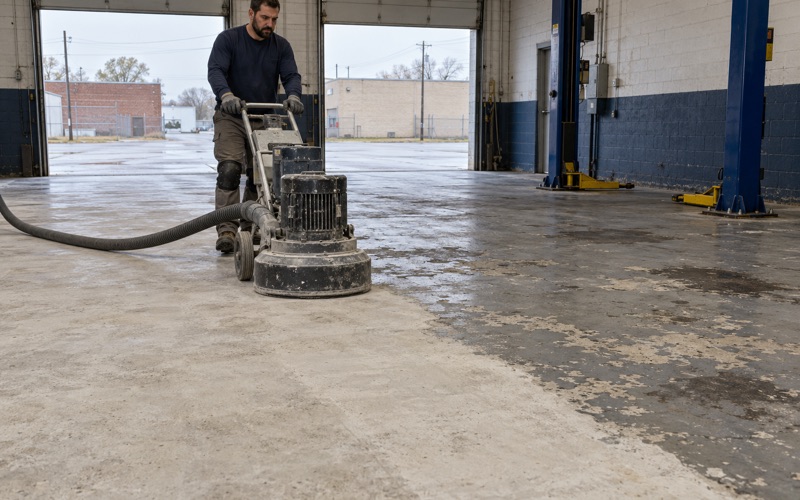
Before anyone talks about color, we open the slab by diamond grinding or shot blasting, never acid etching, so the coating grips a profile we can measure against the ICRI CSP scale. Moisture testing is written into the scope ahead of the final price, and the proposal names the test and the reading the slab has to meet. That keeps a damp slab from becoming a peeling floor six months later.
Every proposal also lists the product line, the coat count and the finished thickness, so the floor you receive can be checked against the paper you signed. Slip resistance is specified by the broadcast media and the topcoat we choose, never promised as a slogan. The sections below walk through how that plays out on a grocery floor and in a home garage.
A Lowell, IN Supermarket Remodeled Around Fresh Food
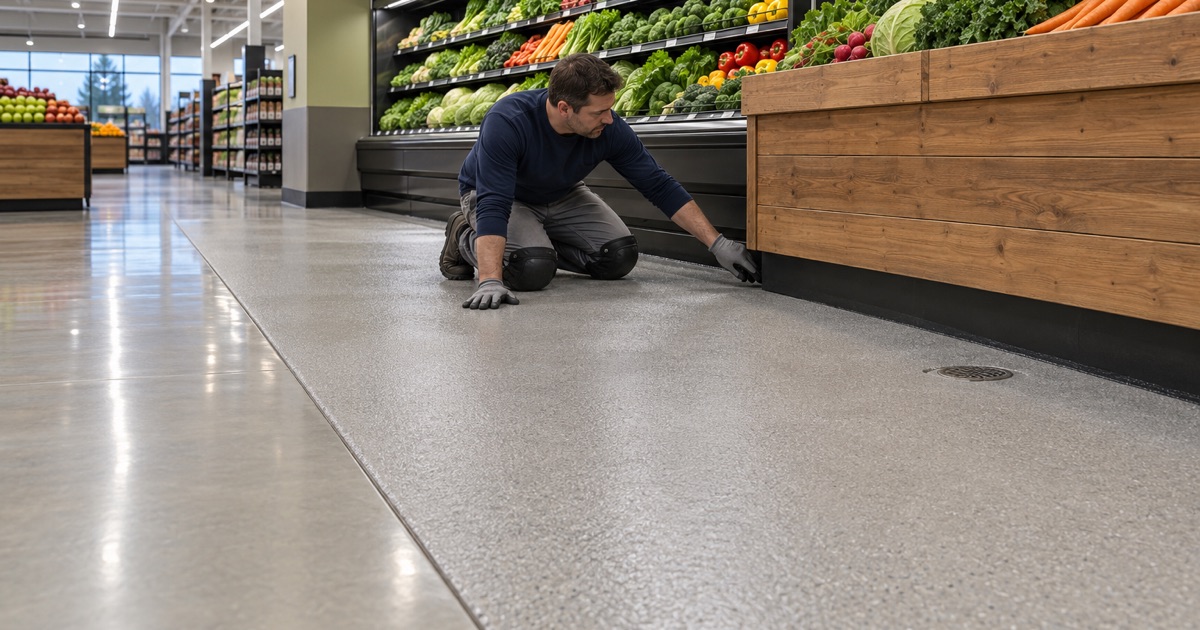
The clearest local example of a floor under pressure from water is a store that just grew the departments that make it. In Lowell, IN, that store is the Strack & Van Til at 2080 East Commercial Avenue, inside the town limits in Cedar Creek Township. Its 2025 remodel is a useful case study for any food retailer weighing a coating.
What the 2025 grand re-opening changed
According to the chain’s own February 2025 announcement, the Lowell store’s sales floor was expanded, with new lighting, new shelving and modern, energy-efficient refrigerators. The produce, deli and seafood departments were enlarged, more fresh food and prepared meals were added, and customer traffic flow was rearranged. The work was completed without interrupting daily operations.
The announcement does not mention flooring, and we have not seen the store’s floor. Strack & Van Til is not our customer, and we make no claim about what is under its carts. We point to the remodel because it describes, in plain terms, the kind of store layout where a floor coating has to do more than one job.
Why bigger fresh departments put more water underfoot
Produce, deli and seafood are the wet side of any grocery. Enlarging them, and adding refrigerated cases to serve them, means more square footage where water reaches the floor as part of a normal shift. That is not a sign of poor housekeeping; it is what selling fresh food involves.
A remodel done while the doors stay open adds a second pressure. Any coating work in a live store has to be phased around trading hours, with overnight and weekend windows, which is how we already schedule plant and back-of-house floors that cannot close. A grocery floor gets the same treatment, one zone at a time.
Looking for epoxy-flooring closer to Brookfield? See Epoxy-Flooring Services in Brookfield.
Where Water Lands and Why a Smooth Floor Slips
Water on a sales floor comes from a short list of predictable sources. Knowing where each one shows up is what lets us put texture in the right place instead of everywhere. The research behind that approach comes from regulators and court records rather than marketing claims.
Misted produce, display ice and case condensate
Misting systems keep produce looking fresh and leave droplets on the floor in front of the display. Seafood sits on ice that melts through the day, and refrigerated and frozen cases shed condensate along their fronts. Shoppers then push carts from the frozen aisle and leave a trail of drips behind them.
US court records show how routine this is. A New Jersey appellate opinion concerns water allegedly leaking from a refrigerated soda case onto a checkout aisle, and in a Mississippi case from 1981 the store’s own accident report described water from a leaking frozen-food case. A Virginia case records employees calling a trail of water from frozen-food carts a common occurrence.
What Britain’s safety regulator found about smooth floors
The UK Health and Safety Executive published a case study on a supermarket chain whose floors had been in place for several years and were quite smooth. On those floors, light contamination from rainwater tracked in on shoes and from spillages in the retail area was enough to make people slip. Management ranked pedestrian slipping among its most significant safety issues.
The regulator’s catering guidance makes a related point: even a well-wrung mop leaves a thin film of water, and that film is enough to create a slip risk on a smooth floor. A floor smooth enough to clean easily is also the one that turns slick under the lightest film. That trade-off is the core design problem on a grocery floor.
Spill stations and what they achieved
The chain’s short-term fixes were supplementary entrance matting, quick mopping, staff trained to spot and clear spills, and spill stations placed throughout the store. Longer term, it began a rolling program of improving floors and entrances. The company reported a 25 percent fall in slipping incidents in stores running the spill-station system.
That figure belongs to the spill stations and the cleanup routine, not to any floor coating, and we never present it otherwise. It is useful because it shows that people and process carry real weight. Texture helps where water is expected, but it does not replace someone with a mop arriving quickly.
Zoning a Coated Grocery Floor
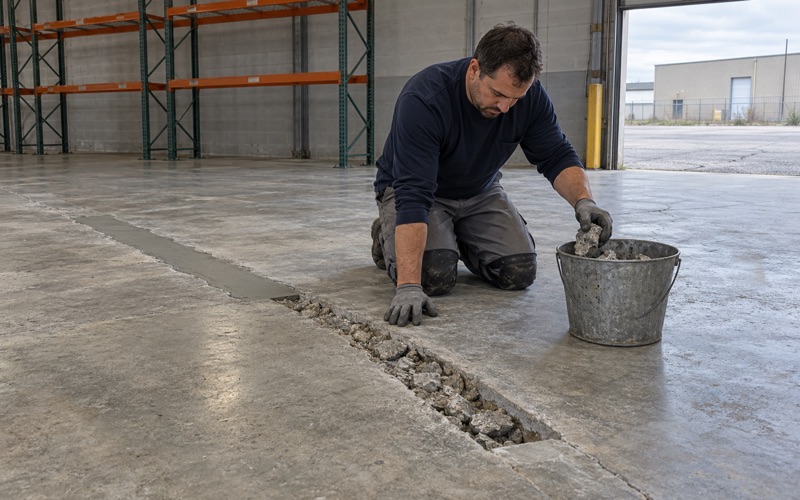
Our approach to a sales floor is zoned rather than uniform. Wet zones, dry aisles and the lighting overhead each change what the finish should be. Mapping the zones comes after we map cracks, spalls, old paint and patched areas, because a slab that should be repaired first gets called out before any price is final.
Fine broadcast texture where water is expected
In front of produce, around seafood ice, along the faces of refrigerated cases and near entrances, we specify a fine quartz aggregate broadcast locked into a hard topcoat, such as a polyaspartic or polyurea layer. The aggregate size and the topcoat thickness set the texture, and both are written into the proposal. Too coarse a profile traps dirt and fights the scrubber.
The goal is a surface that keeps grip with a thin film on it while still cleaning up at night. A fine broadcast does that better than a heavy one in a retail setting. We size it by the zone, not by habit, and the same texture is not carried into every aisle.
A smoother finish in the dry aisles
Center-store aisles with packaged goods see far less water, and a smoother finish there is easier to scrub and kinder to cart wheels. Running full texture through every aisle adds cost and cleaning time without adding much safety where the floor stays dry. The transition between zones is planned so it does not create a trip edge.
For those dry runs, a 100% solids epoxy body coat under a durable clear topcoat is a common choice. The system still has to handle cart traffic, pallet jacks during restocking and nightly scrubbing. We pick the product line for that load and name it in the scope so it can be checked after installation.
A sheen that does not hide a puddle
Bright new store lighting reflecting off a glossy floor can mimic liquid, and litigation commentary argues it can also mask a real spill. A shopper who cannot tell a reflection from a puddle has no warning. That makes topcoat sheen a safety choice as much as a looks choice.
We specify a satin or lower-sheen topcoat in wet zones, so a film of water reads as different from the surrounding floor under the lights. In a store that was just relit, that choice deserves a walk-through with the lighting on. Paired with spill stations nearby, the floor and the cleanup routine work together instead of one standing in for the other.
Refrigerators, Freezers and Wet Spots on a Lowell, IN Garage Floor
The same logic scales down to a house. Lowell is mostly owner-occupied detached homes, and a garage that holds a second refrigerator or a chest freezer sees a small version of the grocery problem. Those appliances can drip condensate or defrost onto the slab, usually in one predictable spot.
Texture by the appliance and the entry door
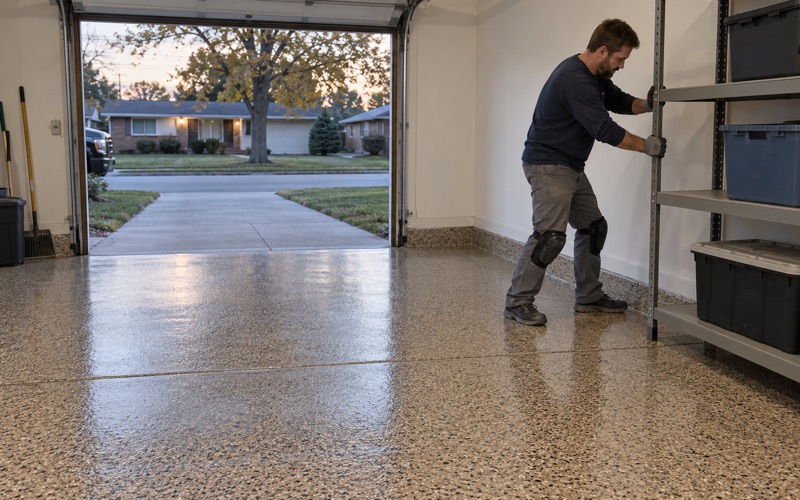
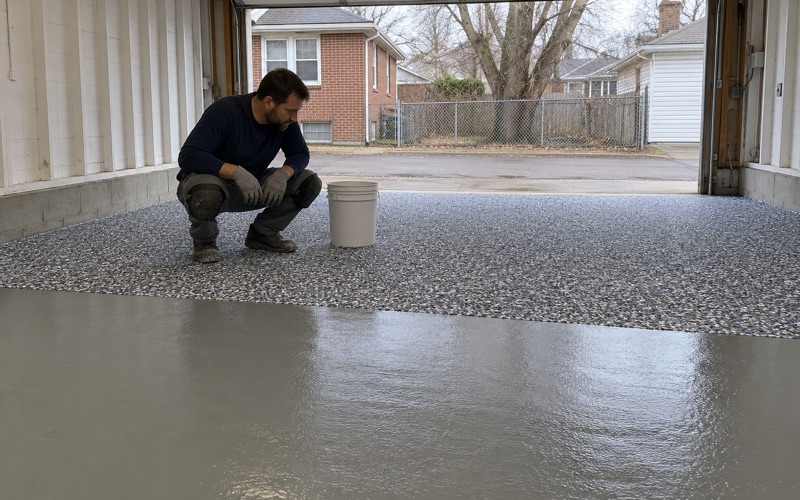
We treat the area in front of a garage refrigerator or freezer the way we treat a grocery case front: a vinyl flake or quartz broadcast with a topcoat that gives grip when wet. The rest of the floor can stay smoother for easier sweeping. Garage systems are also chosen to hold up to the brine and rock salt tires carry in from December to March.
A drip tray or mat under the appliance still matters, for the same reason spill stations matter in a store. A coating handles water on its surface; it does not dry a puddle that sits for days. Home jobs carry a written contract with the items Indiana’s Home Improvement Contracts Act requires, signed before any grinding starts.
Moisture, permits and coating limits before the work
About half of Lowell’s housing dates from 1990 or later, and more than a quarter predates 1970, so slab conditions vary widely from street to street. We test before pricing, using methods such as ASTM F1869 calcium chloride or ASTM F2170 relative humidity probes, and the proposal names the reading required. Cure timing follows slab temperature, and a cold unheated garage is told to wait.
Lowell sits outside the Chicago 2015 ozone nonattainment area, but Indiana’s statewide rule, 326 IAC 8-14, still caps floor coatings at 250 g/L for whoever applies them. Where a project needs a permit, the Town of Lowell Building Department at 501 East Main Street requires it before construction begins. We check that, and the town’s own contractor rules, before a job is booked.
- 20+ Years on Concrete
- Moisture Test in Every Scope
- Free Written Estimates