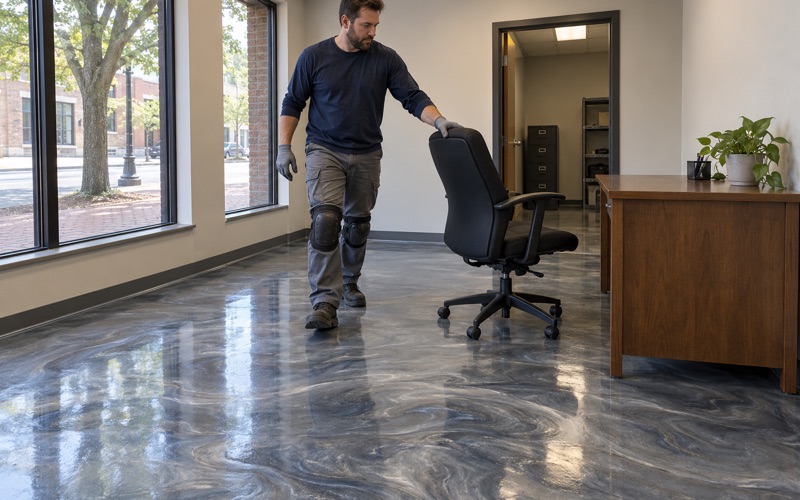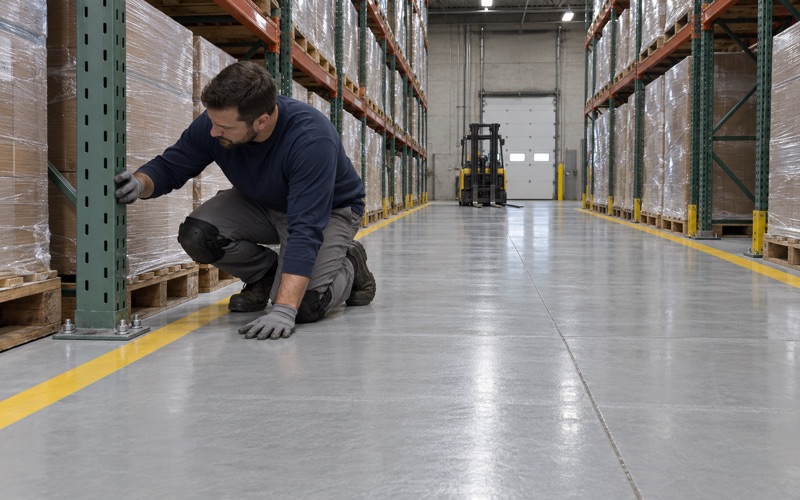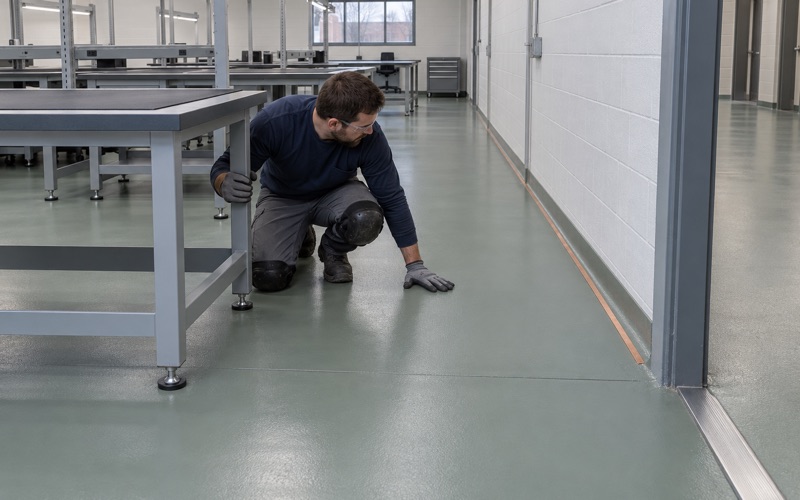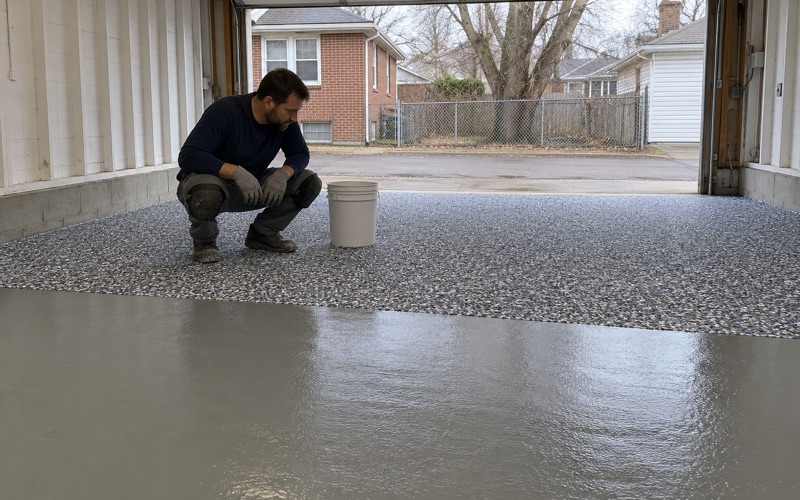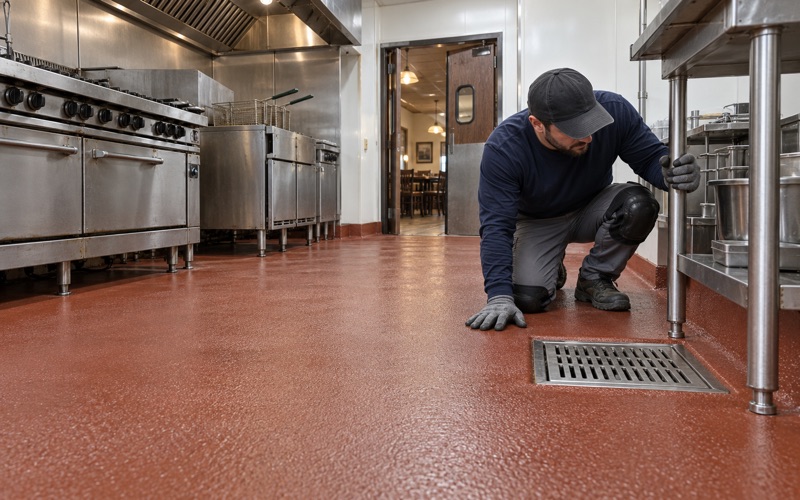
Hammond Epoxy Flooring has spent more than 20 years on epoxy flooring in Lyons and across the region, and most of the floors we coat here belong to working spaces: small shops, service rooms, storage areas and home garages. Our first question on those jobs is rarely about color. It is about what lands on the floor on a bad day and how it gets cleaned up.
One of the most common answers is the powder from a dry-chemical fire extinguisher. A discharged unit can coat a workbench, a machine and a large patch of floor in seconds, and the residue does not behave like ordinary dust once moisture finds it. How a floor holds up through that cleanup depends heavily on whether its surface is sealed or open.
This page walks through that cleanup the way the published guidance describes it, then explains how we build a coated floor so the job stays a surface job. We are a flooring contractor, not a fire safety advisor, so we point to the sources and let them speak for the safety side.
Every Lyons Business, Inspected Every Year
The Village of Lyons states on its fire prevention page that the fire department annually inspects each Lyons business, with the goal of identifying specific areas of concern and fire safety. That puts a trained set of eyes inside nearly every storefront, shop and service space in the village on a yearly cycle.
Who walks through the door
The village describes its fire personnel as certified by the Office of the State Fire Marshal at the Firefighter II level, with many advanced to Firefighter III. Those are the people conducting the yearly visit, and their page lists the fire department and village office at 4200 Lawndale Avenue.
We have no relationship with the department and play no part in its inspections. The village page also does not spell out its extinguisher rules, so we do not describe them here, and owners should ask the department directly about anything their own inspection covers.
The ABC extinguisher on the wall
In the shops and garages we work in, the extinguisher on the wall is very often a multipurpose ABC dry-chemical unit. Its extinguishing agent is monoammonium phosphate, a fine powder that is pushed out under pressure and spreads well past the fire it was aimed at.
That spread is the point when there is a fire. Afterward it means the powder has settled on tools, shelving, machine surfaces and every square foot of floor nearby, and much of it works into corners, joints and any crack or open pore it finds.
Why the cleanup becomes a floor job
University environmental health and safety sheets and restoration guidance agree that this residue turns corrosive to metal once it gets damp. They also agree it should be cleaned promptly rather than left to sit through a humid week or a mopping by someone who does not know what it is.
The largest single surface the powder lands on is almost always the floor. Whatever the floor is made of decides whether the cleanup ends with a rinse or leaves a residue working its way into the slab, and that is the part of the problem a flooring contractor can actually change. In a village where businesses are walked through every year, a floor that cleans up fully after a discharge is one less lingering mark of the event.
Looking for epoxy-flooring closer to Chesterton? See Chesterton Epoxy-Flooring.
Dry Powder First: Lifting Monoammonium Phosphate
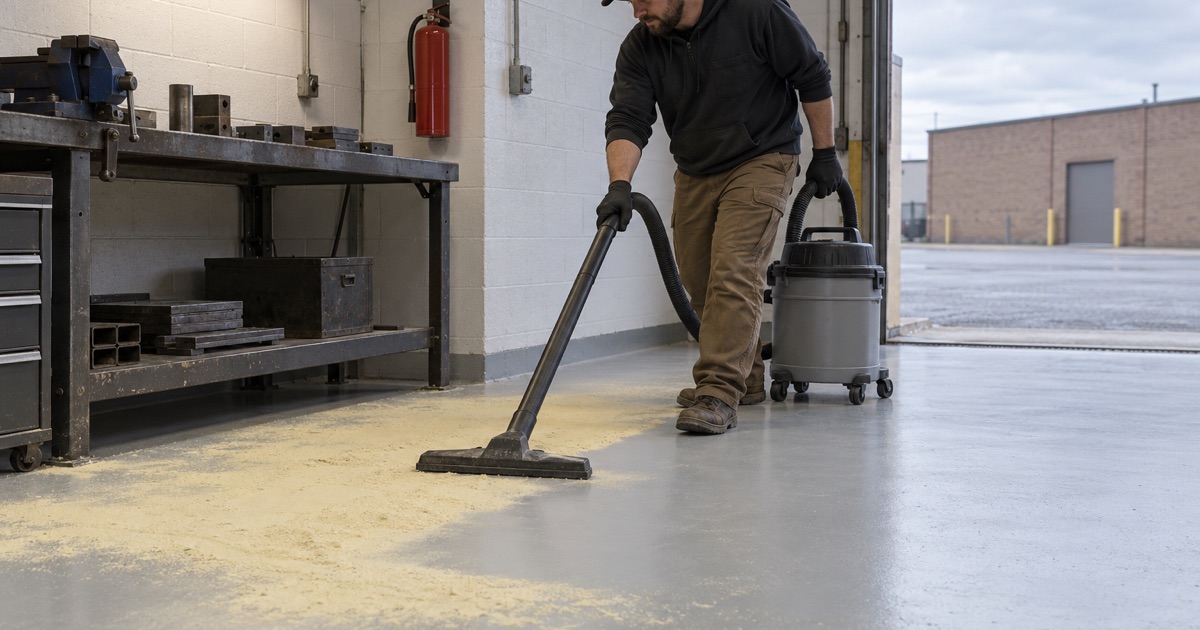
Every source we have read on this cleanup puts the same step at the front of the list: get the dry powder up before any water reaches it. Wetting the powder first turns a loose dust into a damp paste, and damp is the condition in which it starts to attack metal.
Why water comes last
A bucket and mop feel like the natural response to a mess on a shop floor. With monoammonium phosphate, that order spreads a corrosive slurry across a wider area, pushes it under base cabinets and machine feet, and drives it into any open surface it touches.
The guidance we follow is to treat the floor as dry until the bulk of the powder is gone. Doors and fans are managed so the dust is not blown around further, and the area is kept clear of foot traffic that would track it into the next room.
Hand pickup or a vacuum, where the sources split
The safety offices do not fully agree on how that dry pickup should happen. The University of Washington environmental health and safety office says not to vacuum monoammonium phosphate and to clean it up by hand. An Oregon university sheet instead says to use a HEPA vacuum to limit dust.
We do not pick a winner between them, and neither should a page like this one. Owners should follow the guidance their own insurer, safety office or restoration firm gives them, then hand us a floor that is ready for the wash.
Working around equipment
Powder that settles on and around machinery deserves the same care. The aim is to clear it from bases, rails and the floor right at the equipment before the wet stage, because those are the places where damp residue sits longest.
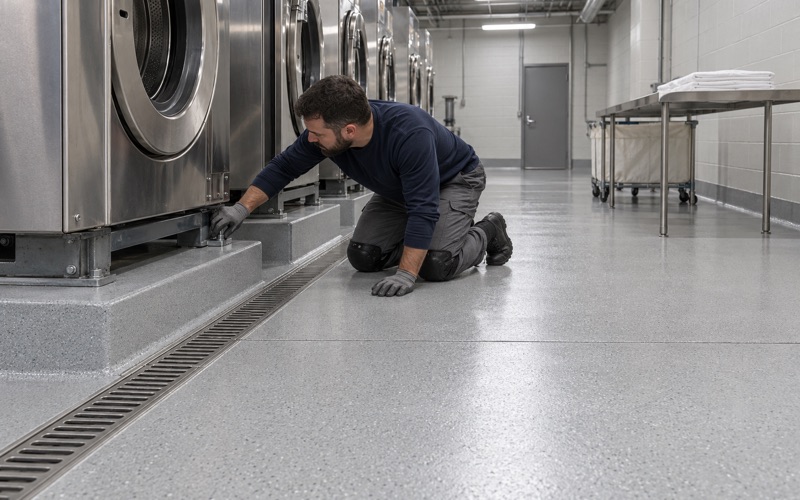
On a coated floor, this step is easier when the coating runs as a continuous surface up to the equipment pads rather than stopping short at a ragged edge. Bare strips and chipped edges are where the powder collects, so we detail them carefully at installation.
Baking Soda, Rinse and Dry: Cleaning Metal and Floor
Once the dry powder is up, the sources move to a neutralizing wash. Restoration and university guidance describe a dilute baking soda solution, about 1 cup to 3 gallons of water, followed by a clean rinse and a thorough dry.
None of that is complicated, but the order matters as much as the mix. The steps below follow the sequence the sources give, and they show where a coated floor makes each step shorter and where bare concrete makes it longer.
Metal surfaces before the floor
The guidance treats metal as the first priority because metal is what the damp residue harms. Tools, machine surfaces, racking and fixtures are wiped with the baking soda solution, rinsed and dried before attention shifts down to the slab.
That order also makes sense for the floor itself. Washing the metal sends drips and runoff downward, so the floor gets its own wash last and catches whatever came off the equipment above it, instead of being cleaned twice.
The neutralizing wash on a coated floor
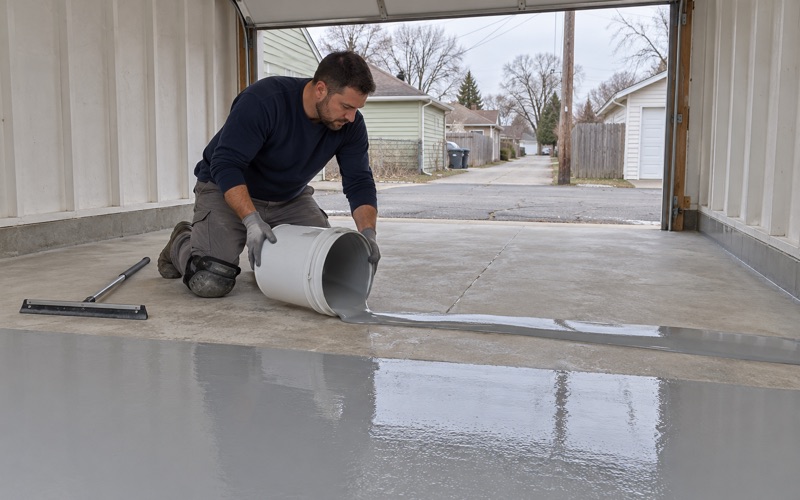
On a sealed resin floor, the wash is straightforward. The solution goes down, the residue loosens from a nonporous surface, and a squeegee or wet vacuum moves the dirty water to a collection point rather than into a joint or a storm inlet.
We size the texture of a coated floor with this in mind. Slip resistance comes from the broadcast media and the topcoat we specify, and we choose a profile that still gives grip when wet without being so coarse that residue packs into it during a wash.
Rinse, dry and look again
The sources close the sequence with a clean water rinse and complete drying. Leaving the floor wet after the wash simply gives any remaining residue the moisture it needs, so fans and dry mopping finish the job.
A final look at edges, cove lines and equipment pads tells an owner whether the cleanup reached everything. On a sound coating, those spots look the same as the open floor; on bare concrete, they are often where a stain or crust shows up later.
Why a Sealed Floor Rinses Clean and Bare Concrete Holds It
Plain concrete is porous, and that matters here. When the powder is wetted on bare concrete, the dissolved residue is carried down into the pores, where a rinse cannot reach it, and it can reappear as a bloom or stain as the slab dries.
That is why two shops can follow the same cleanup steps and end up with very different floors. The difference is not the effort that went into the wash. It is whether the surface underneath gave the residue a place to hide.
What a seamless surface changes
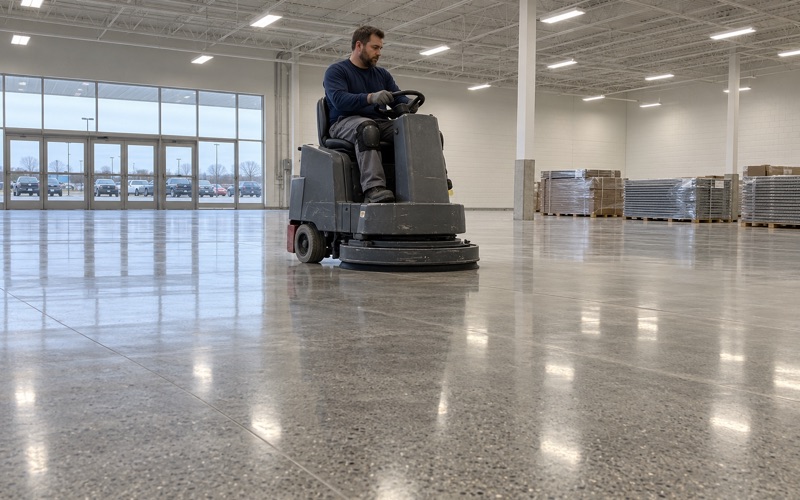
A sealed, seamless floor keeps the residue on top. The wash and rinse can move it off because there is nowhere for it to go, and the coating gives the cleanup a defined end point instead of a slab that keeps releasing it.
A coating is not a fire protection measure, and we never sell it as one. It is a cleanable surface, and the benefit we describe is about how the cleanup goes after an extinguisher has done its job, nothing more.
How we build a floor for that cleanup
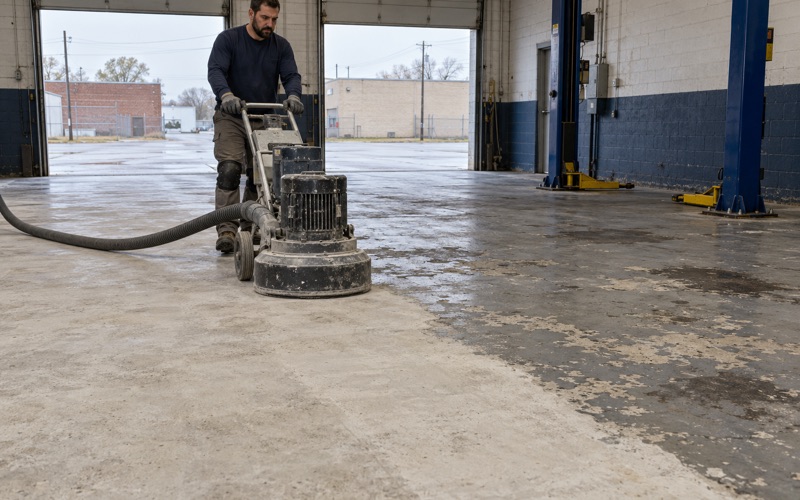
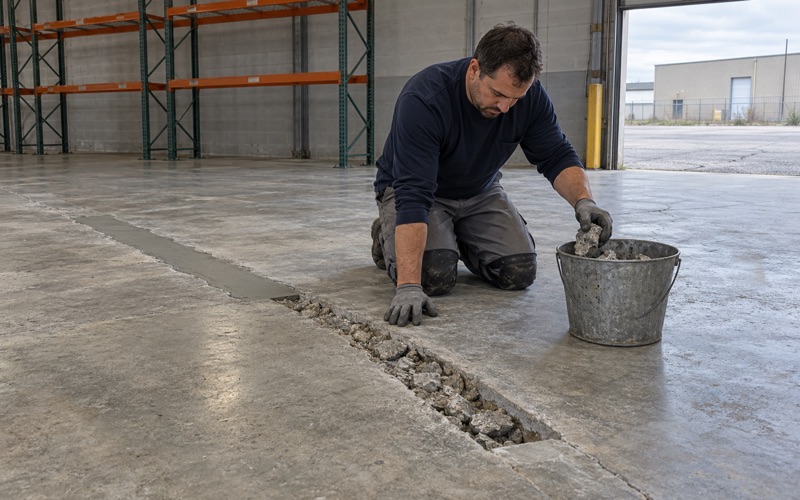
We open the slab by diamond grinding or shot blasting, never by acid etching, so the coating bonds to a measured profile, and the grinding dust is vacuumed at the machine. Cracks, spalls, old paint and patched areas are mapped before we price, and a slab that should be repaired first is called out first.
Each proposal names the product line, the coat count and the finished thickness so the installed floor can be checked against it. Moisture testing is written into the scope with the reading it must meet, and products are chosen inside the Illinois VOC limits for floor and industrial maintenance coatings.
Older slabs and the garage at home
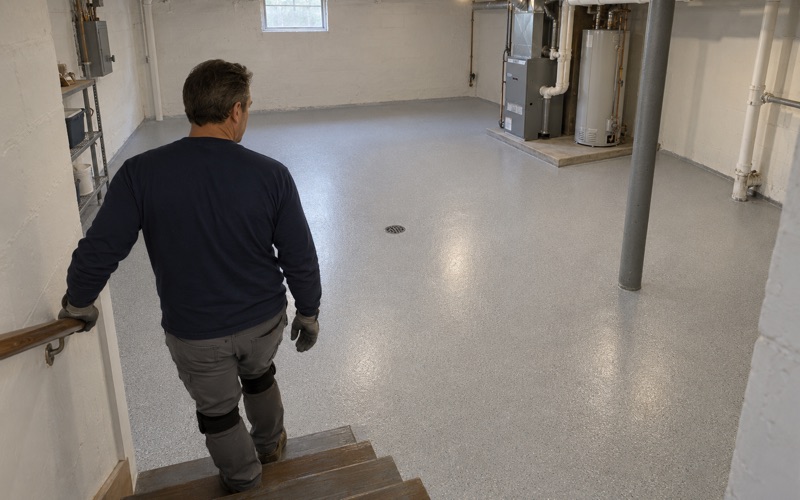
Lyons has added no housing units in the 2010s, and more than a quarter of its 4,390 units date from 1939 or earlier, so nearly every floor we see is an existing slab. Many carry old paint or a failed coating that has to come off before a new system can bond, and a few are better replaced than coated.
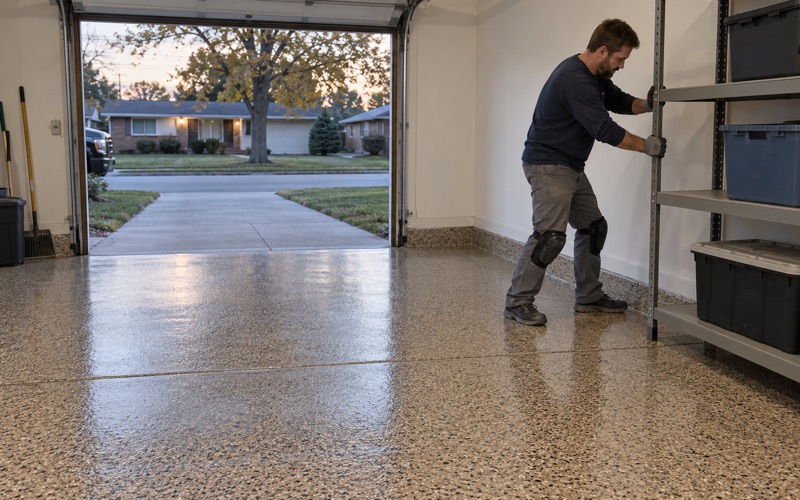
The same logic carries into a home garage, where an ABC extinguisher near the door is a common choice. The village issues its own contractor license application, so we check its current requirements before quoting, and we set cure timing by slab temperature and dew point rather than the calendar.
- 20+ Years on Concrete
- Moisture Test in Every Scope
- Free Written Estimates