Hammond Epoxy Flooring brings more than 20 years of coating work to epoxy flooring in Matteson, and this page is about one problem a floor can help solve when the work is done in the right order. That problem is a urine odor that returns every time the floor is mopped. Far more often than not, the source is in the floor itself rather than in the air.
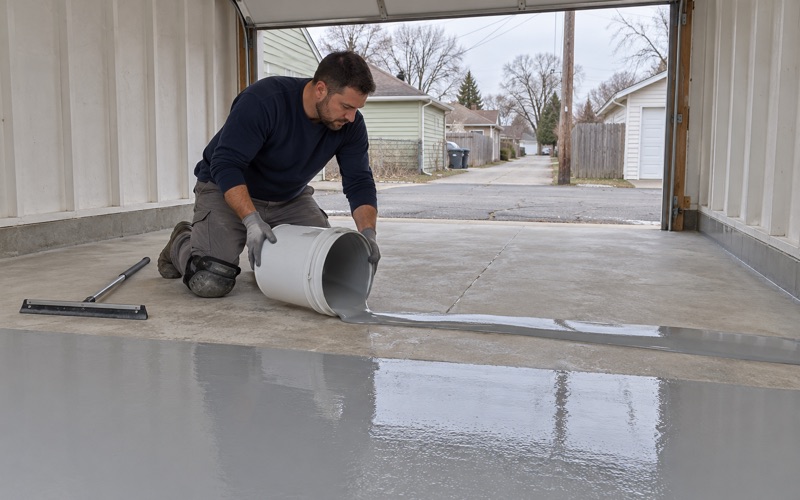
Our part of the fix starts with the slab. We open concrete by diamond grinding or shot blasting, never by acid etching, so the new system bonds to a measured profile instead of a guess. Moisture testing is written into the scope before the price is final, and the proposal names the test and the reading the slab has to meet.
The rest goes on paper too. Each proposal lists the product line, the coat count and the finished thickness, so the installed floor can be checked against it afterward. Cracks, spalls, old paint and patches are mapped before pricing, and we read the warranty exclusions aloud before anything is signed, beginning with moisture.
A 154-Bed Care Home and Illinois’ Rule Against Masking Odors
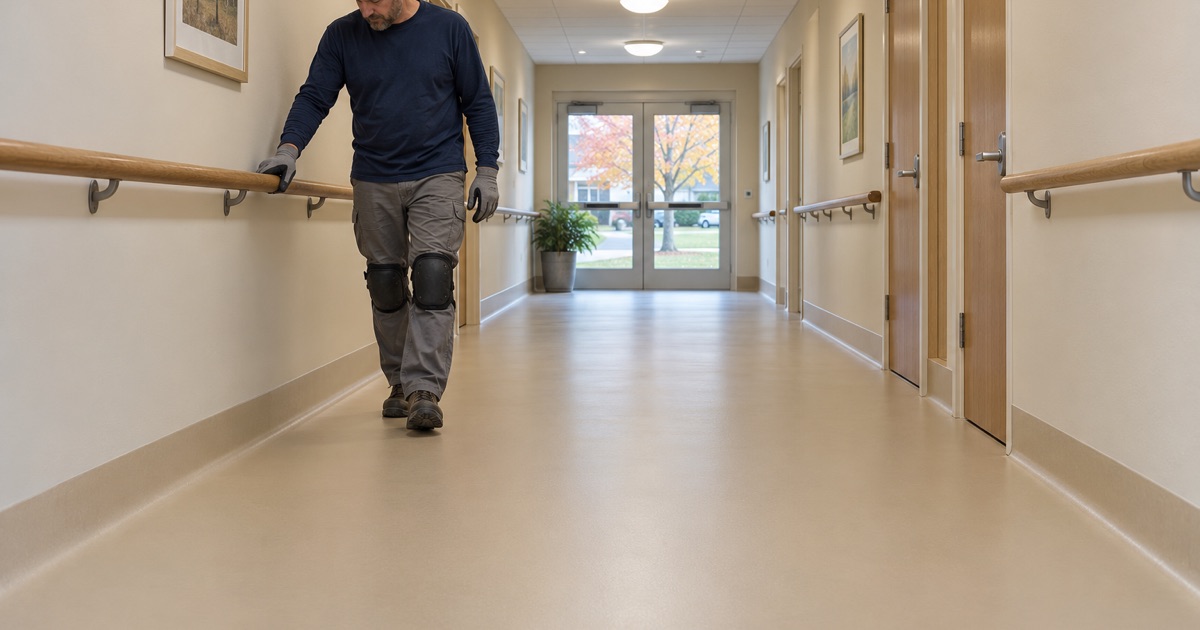
Generations at Applewood on Kostner Avenue
Matteson’s largest care home is Generations at Applewood, at 21020 Kostner Avenue. ProPublica’s Nursing Home Inspect data lists it with 154 certified beds and an average of about 128 residents a day, and it is affiliated with Generations Healthcare Network. Directories describe skilled nursing and rehabilitation there, with physical, occupational and speech therapy.
We name it to show the scale of the cleaning duty Illinois places on care homes, not because we have worked there or seen its floors. We have no relationship with the facility, and nothing on this page describes its housekeeping. What a building that size illustrates is how much resident-room and corridor floor a staff has to keep clean every single day.
What 77 Ill. Adm. Code 300.2220 Requires
The Skilled Nursing and Intermediate Care Facilities Code sets housekeeping duties in 77 Ill. Adm. Code 300.2220. Subsection (a)(3) tells staff to control odors by effective cleaning procedures and by the proper use of ventilation systems. Then it closes the easy exit: “Deodorants shall not be used to cover up persistent odors caused by unsanitary conditions or poor housekeeping practices.”
Read plainly, the rule treats a lingering smell as a sign that cleaning has not reached its source. The same section also asks for floors kept clean and as nonslip as possible, but it is the odor line that points straight at the floor. If the source sits somewhere a mop cannot reach, fragrance is not an answer the rule allows.
Looking for epoxy-flooring closer to Chicago Ridge? See Chicago Ridge Epoxy-Flooring.
Where a Urine Smell Actually Lives
Uric Acid Crystals in Grout and Tile Seams
Urine dries into residue, and part of that residue is uric acid in crystal form. A cleaning-product maker’s sell sheet describes the mechanism this way: uric acid crystals often remain trapped in porous surfaces and release a strong ammonia-like odor. It names grout as one of the porous surfaces that tend to trap urine odors.
Grout lines and tile seams are where a tiled floor is weakest against this. Each joint is a narrow, porous channel sitting slightly below the tile face, so liquid runs into it and residue settles there. A wet mop glides across the top of the tile while the joint quietly keeps whatever it has collected over the years.
Bare and Worn Concrete
Concrete behaves the same way on a larger scale. A slab is porous by nature, and once a sealer or an old paint film wears through in a traffic lane, spills soak into the open surface instead of sitting on top of it. Cracks, saw cuts and spalled patches add still more places for residue to gather below the reach of a cleaning pad.
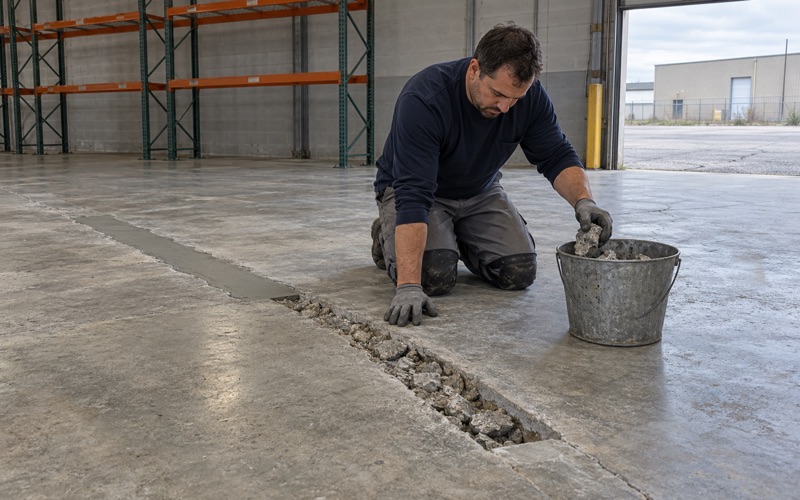
That is one reason we map every crack, spall, old paint layer and patch before we price a floor. Each of those spots is a likely reservoir, and each has to be opened, cleaned and repaired before a new system goes over it. A slab too far gone to save is called out as a repair or replacement job before any coating is quoted.
Why Mopping Brings It Back
The same sell sheet says humid conditions or wetting the surface can reactivate the odor. That explains a frustrating loop: the floor is mopped, the room smells stronger for a while, and then the smell fades only to return. Water reaches the crystals in the pores, and the ammonia smell rises back into the room with it.
The maker also says dilutable bathroom cleaners may not completely remove stubborn crystals, and that enzyme cleaners can be neutralized when an antibacterial or high- or low-pH product is used before or after them. Those are a manufacturer’s statements, not test results we can vouch for. The practical point holds either way: as long as a porous floor sits underneath, the cleaning keeps rewetting the problem.
Clean the Old Contamination Out, Then Remove the Pores
Treat the Slab Before Any Coating
A coating is not an odor treatment, and it does not take out contamination already in the concrete. If urine residue is left in the slab, the smell can come back through the new work, and a contaminated surface is a poor one to bond to. So the first stage is removal: old tile and grout come up, the affected concrete is treated and cleaned, and the slab is given time to dry.
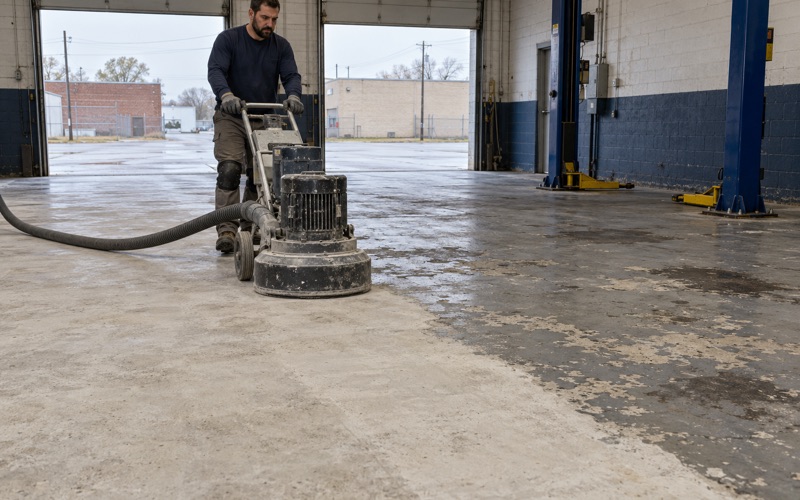
Then we open the surface by diamond grinding or shot blasting to a measured ICRI concrete surface profile. Grinding takes off the top layer where residue concentrates, and the dust is vacuumed at the machine instead of being washed toward a floor drain. We skip acid etching entirely, since it would put more liquid into a slab we are working to get clean and dry.
Test for Moisture Before the Price Is Final
A slab that has just been washed and treated holds water, and a coating laid over a damp slab is one of the failures most warranties leave out. Our proposal names the test, an ASTM F2170 in-situ relative humidity probe or an ASTM F1869 calcium chloride test, along with the reading the slab must meet. If the reading comes back high, a moisture-mitigation primer goes into the scope first.
On a floor with an odor history, that conversation carries more weight than usual, because the cleaning stage is wet work by design. Cure timing then follows slab temperature and the dew point spread at the surface, not the date on a schedule. A coating that cures properly is the only kind that stays continuous, and continuity is the whole point here.
A Seamless Floor With an Integral Cove Base
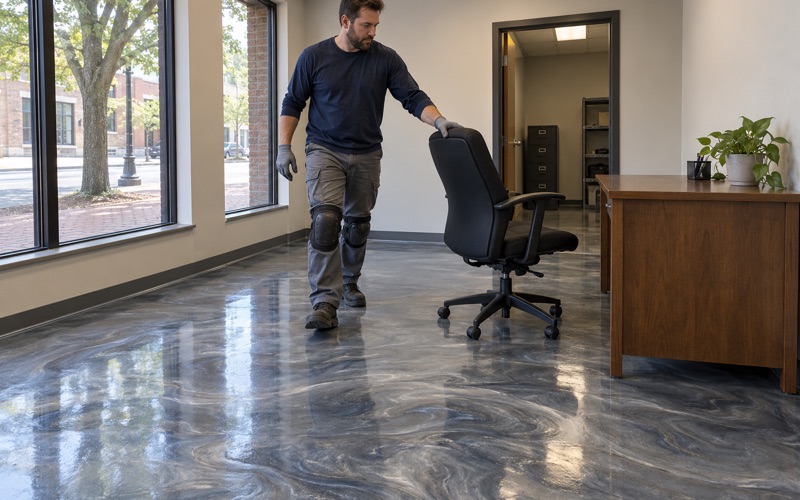
Once the slab is clean, dry and profiled, the job of the new floor is to give residue nowhere to go. A 100% solids epoxy system under a polyaspartic or urethane topcoat goes down as one continuous film, with no grout lines and no tile seams. Cracks and joints are filled and carried through the build instead of being left open.
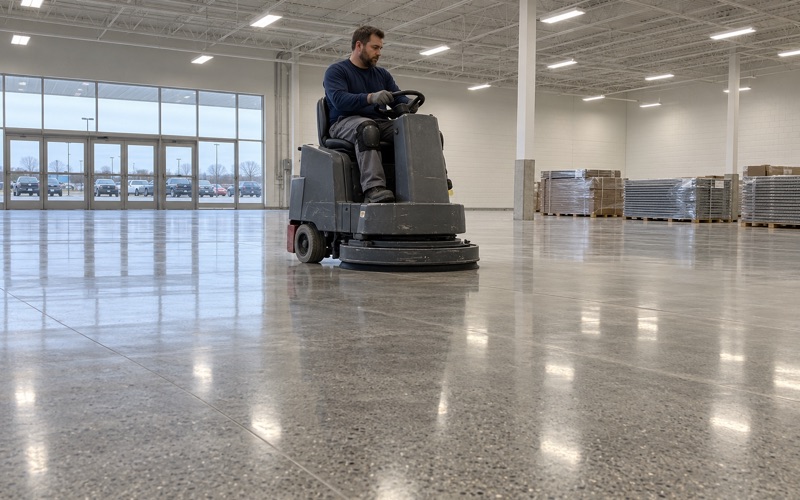
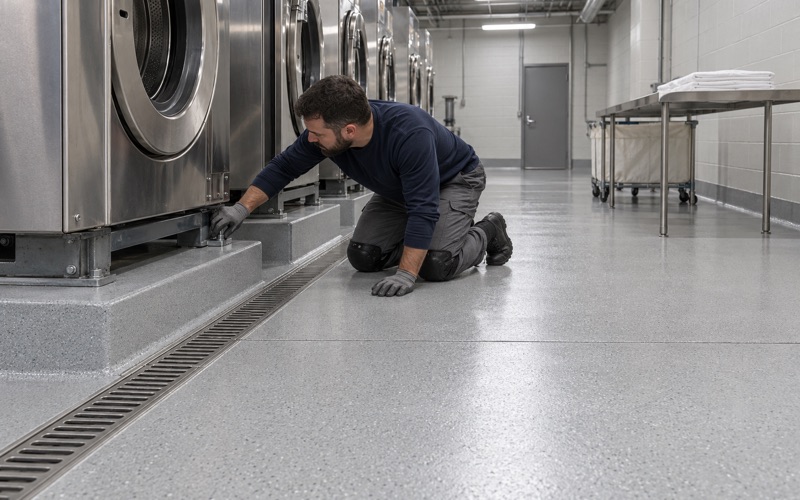
At the walls, an integral cove base runs the coating up the wall in a curve rather than stopping at a square corner. That corner is where mop water and spills tend to collect on many floors, and the cove gives a mop or auto-scrubber a surface it can reach completely. The finished thickness and coat count in the proposal are what you check the installed floor against.
What Changes for Housekeeping
A seamless floor does not treat odors by itself, and we will not sell one that way. What it changes is reach: when every inch is sealed and nonporous, routine cleaning gets to the whole surface, and there is no pore for new residue to settle into. That fits the way the Illinois rule frames the duty, as effective cleaning rather than masking.
Slip resistance still has to be specified, since the housekeeping section also asks for floors as nonslip as possible. We set it through the broadcast media and topcoat, such as a fine quartz aggregate, rather than promising it as a slogan. A rougher finish grips better but holds more soil, so the texture is chosen room by room with cleaning in mind.
Pet Accidents and Basement Odors in Matteson Homes
The Basement Where a Pet Had Accidents
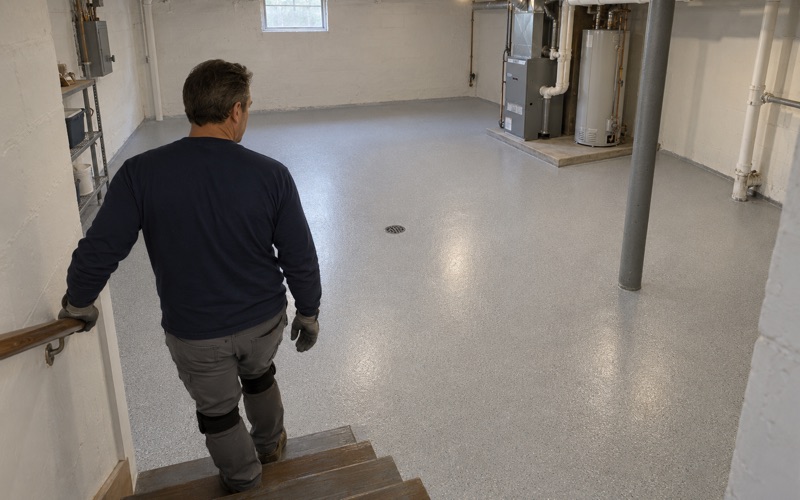
The same mechanism turns up in houses. A basement where a dog or cat has had accidents over the years can smell strongest on humid days or right after the floor is washed, which matches the rewetting effect the sell sheet describes. Bare concrete, or the grout of an old tile floor laid over it, is usually where that residue sits.
Our approach is the commercial sequence at house scale. The old covering comes up, the stained areas are treated and cleaned, and the slab is ground, tested for moisture and only then coated. Skipping the cleaning to save a day is how a homeowner ends up with a new floor and the same smell.
Garages and Matteson’s Newer Housing
Matteson’s housing is young by south-suburban standards. Census figures put 31.8 percent of housing units in the 2000 to 2009 build years and 45.2 percent at 2000 or later, and the village counts 806 owner-occupied attached homes alongside 4,514 detached ones. Where a pet spends its days in the garage, that slab can collect the same residue a basement does.
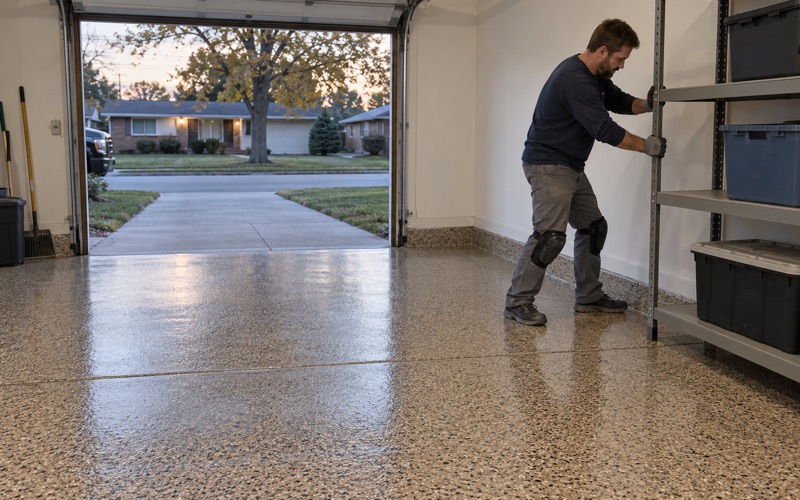
A garage floor gets the same treatment sequence with one addition: the system is chosen to stand up to the brine and rock salt that tires carry in from December to March. Cure timing matters even more out there. An unheated garage in a cold stretch is told to wait until slab temperature and dew point allow a proper cure.
Permits, Paperwork and the Village
Matteson’s Community Development department, through Building Services at 708-481-8313, licenses contractors, issues permits and performs inspections, and contractor registration runs through the village’s CitizenServe portal. The village’s building codes changed effective December 1, 2021. We confirm with Building Services whether a given floor job needs a permit, and we check its contractor rules before the job is booked.
The village lies entirely in Cook County, even though some 60443 mailing addresses may reach into Will County. Home jobs carry a written contract signed before any grinding starts, and our coatings are chosen inside Illinois’ VOC limits under 35 Ill. Adm. Code Part 223, which bind the applicator. A floor coating is never sold as waterproofing or as a cure for a damp basement.
- 20+ Years on Concrete
- Moisture Test in Every Scope
- Free Written Estimates