
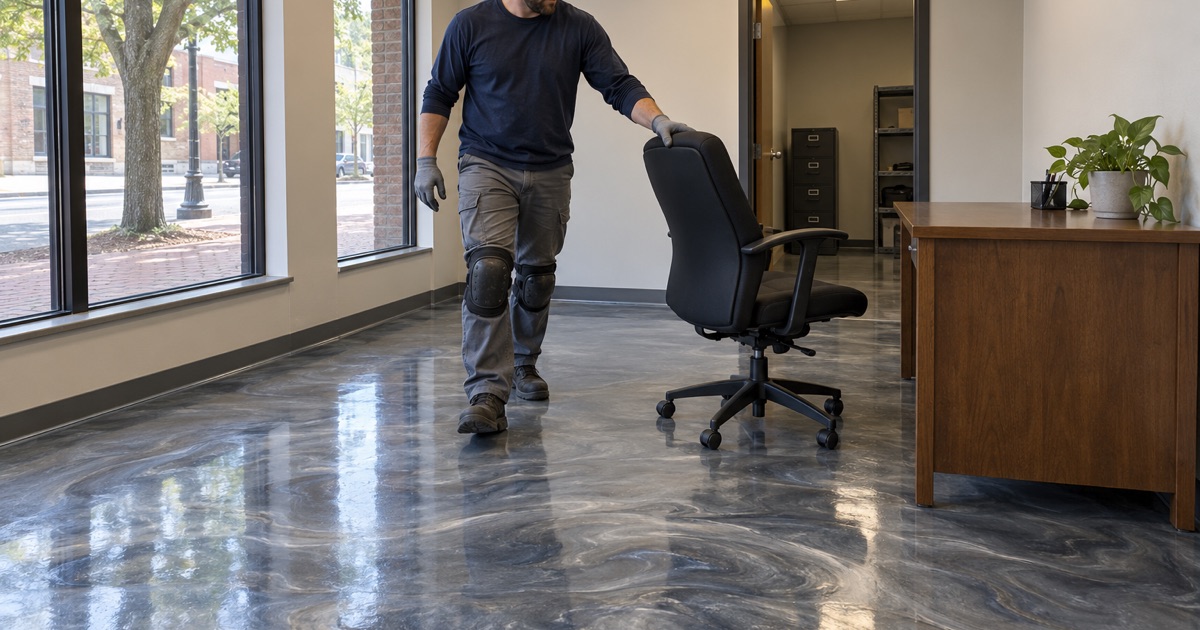
Hammond Epoxy Flooring installs metallic epoxy floors in Hammond, IN, serving surrounding cities including Griffith, Riverdale, Harvey, Dyer and Homewood. A metallic floor is the most hand-crafted system we lay: pigment moved through wet resin to create depth, veining and movement that no printed tile can match. After more than 20 years on concrete, we also know it is the least forgiving floor of a poorly prepared slab.
Metallic resin flows into every low spot and highlights every ridge, so flatness and preparation matter more here than anywhere. We diamond grind the slab, fill cracks and pits, map old repairs and test for moisture before the price is final. The proposal names the primer, the metallic system, the topcoat, the coat count and the finished thickness.
Metallic floors suit showrooms, lobbies, offices, finished basements, home bars and show garages. They are less suited to floors that take daily slush, heavy tools or forklift traffic, and we will tell you when a flake or quartz floor will serve better.
How a Metallic Epoxy Floor Is Built
A Flat, Ground Slab
The slab is diamond ground to open its surface and take down high spots. Because metallic resin is self-leveling and reflective, any dip collects pigment and any ridge stands out under light. Low areas are filled and ground smooth before any resin goes down.
Flatness cannot be added later by the coating. That is why we look at a slab in raking light during the walk-through and include any leveling work in the scope rather than finding it on install day.
Primer and Base Color
A primer seals the ground slab and gives the metallic coat a uniform surface to flow over. A tinted base coat often follows, because the base color shows through the metallic layer and sets the floor’s overall tone. Dark bases make metallic pigments glow; light bases give a softer pearl look.
On a slab with an elevated moisture reading, this is where a moisture-mitigation primer goes in. Metallic floors show blistering more than any other system, so we never skip that step when the test calls for it.
The Metallic Coat and Manipulation
The metallic layer is a clear or tinted 100% solids epoxy mixed with metallic or pearlescent pigment. It is poured and spread, then manipulated while wet with rollers, brushes, trowels or spray to create swirls, ripples or veining. Timing is critical, because the look locks in as the resin begins to gel.
The work needs a crew that moves fast and in step. A stall at the wrong moment leaves a visible seam or dull patch, which is why we size each section to what can be worked cleanly.
Metallic Floor Styles and Colors
Marble and Stone Effects
Two or three complementary colors worked together create veining that resembles marble or granite. White, gray and charcoal give a classic stone look; bronze and copper accents add warmth. These are popular for lobbies, home bars and showrooms where the floor is part of the design.
Veins can be drawn in deliberately with tools or allowed to form as the pigments move, and the balance between control and flow is what makes each floor unique.
Lava, Ocean and Cloud Looks
A more fluid manipulation creates large, rolling patterns that read like flowing water, lava or clouds. These looks hide minor dust and footprints better than tight marble veining and work well in larger open spaces.
The effect changes with viewing angle and lighting, so we always review samples under the lighting in your space rather than in a showroom.
Solid Metallic and Subtle Movement
Not every metallic floor needs dramatic swirls. A single-color metallic with gentle movement gives a modern, uniform shimmer that suits offices, retail and contemporary homes. It is also easier to touch up later than a multi-color design.
Subtle metallic is also the safest choice where furniture, shelving or rugs will cover much of the floor, since a bold pattern broken up by objects can look busy. A soft shimmer reads well whether the floor is open or furnished.
Where Metallic Epoxy Works Best
Showrooms, Lobbies and Offices
Commercial spaces that want a high-end look without stone or tile cost often choose metallic. The floor is seamless, easy to clean and reflects light. We phase work around business hours and use fast-cure topcoats where a space can only close briefly.
Entry areas in this region take winter slush, brine and grit. We plan walk-off mats and slip resistance at the door so the finish stays safe and keeps its shine through the season.
Finished Basements and Home Bars
A metallic floor turns a basement into a finished living or entertaining space. Because basements sit against damp ground, moisture testing is essential first, and a mitigation primer is used where the reading calls for it. The floor stops cleanly at sump lids and drains so they stay serviceable.
In many older Hammond basements, paint, mastic and patches have to be ground off first. Metallic resin will highlight any old repair left under it, so we rebuild them flush and smooth.
Show Garages and Hobby Spaces
For a heated show garage or a hobby shop, metallic makes a striking floor. We use a hard UV-stable topcoat and talk honestly about the tradeoffs: hot tires, brine and dropped tools show more on a smooth metallic surface than on a flake floor.
Where a garage takes a daily driver through a Lake County winter, many owners choose metallic for the shop side and a flake system for the parking side.
Getting a Metallic Floor Right
UV-Stable Topcoat
Epoxy ambers under sunlight, and on a metallic floor that changes the color you chose. We protect it with a polyaspartic or aliphatic polyurethane topcoat that holds its clarity in daylight and takes the abrasion of foot traffic. Gloss shows the depth best; satin hides scuffs better.
The topcoat is also the layer that gets renewed. When a busy floor starts to show wear years later, the topcoat can be abraded and recoated without touching the metallic layer beneath, so the design you paid for stays intact.
Temperature, Humidity and Dew Point
Metallic epoxy needs stable conditions during install and cure. A cold slab thickens the resin and changes how pigment moves, and a slab too close to the dew point can develop amine blush that clouds the finish. We measure slab temperature and dew point spread and reschedule rather than push through.
In an unheated space through a Northwest Indiana winter, that often means waiting for spring. In a heated building, we keep the heat steady for the install and the cure, because a thermostat set back overnight can change how the resin flows and sets.
Dust Control During Install
Any dust that lands on wet metallic resin shows in the cured floor. We grind with vacuums at the machine, clean the space thoroughly before the metallic coat, and close off the area while it cures to keep the finish clean.
The same care applies to the rest of the house or building. HVAC returns near the work area are covered, doors are sealed, and nobody walks through the space until the topcoat has set, so the finish you see on day one is free of footprints, lint and grit.
- 20+ Years on Concrete
- Moisture Test in Every Scope
- Free Written Estimates