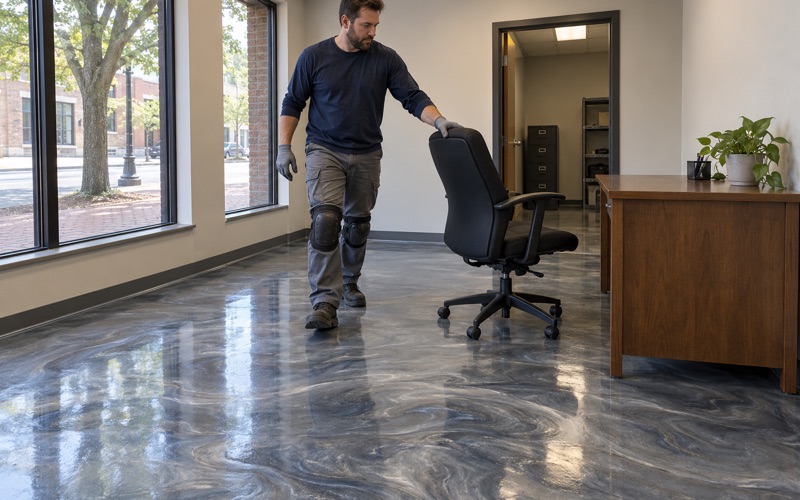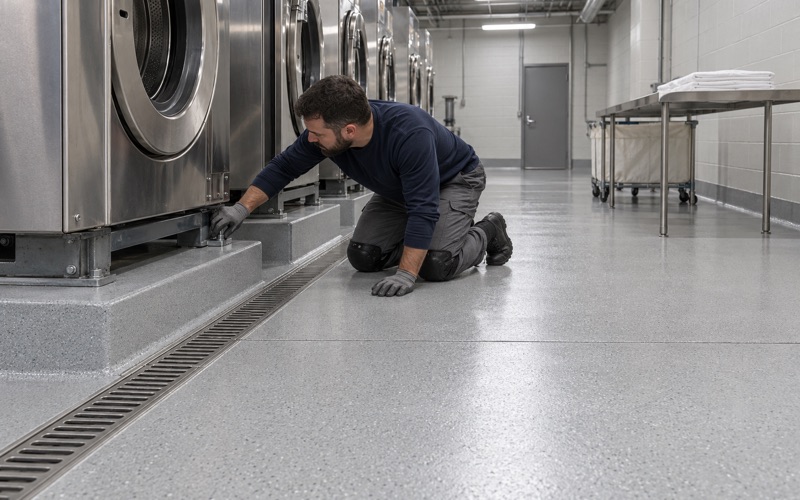
Hammond Epoxy Flooring approaches epoxy-flooring in Mokena with more than 20 years in the trade and one question that settles a surprising number of decisions: what happens when rubber meets the finish? Tires leave dark marks on most hard floors sooner or later. On some finishes those marks come off with a degreaser and a brush, and on others the fix takes part of the finish with it. Knowing which kind of floor you are buying is most of the choice.
That question separates a two-part coating from a one-part sealer. A cured epoxy or polyurethane is a tough film that rubber sits on, while a stubborn mark on an acrylic sealer is often lifted with a solvent that dissolves the sealer along with it. We explain that difference before a homeowner or a building manager picks a system, because it decides how the floor will be cleaned for years.
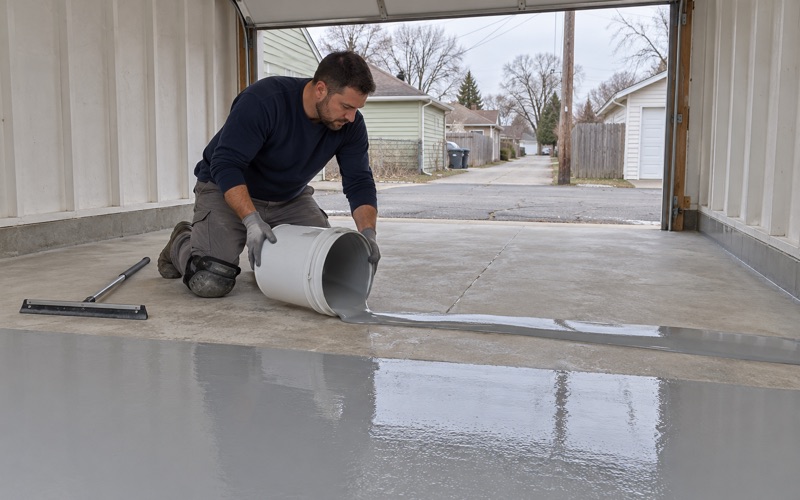
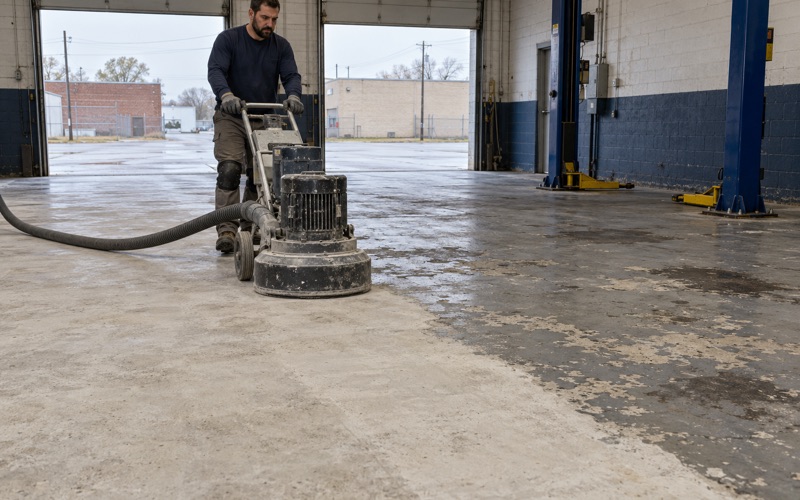
The work behind either choice starts the same way. The slab is opened by diamond grinding or shot blasting to a measured profile rather than etched with acid, and moisture testing is written into the scope along with the reading the concrete must meet. Every proposal names the product line, the coat count and the finished thickness, so the installed floor can be checked against the paper.
An Indoor Racetrack on Springlake Drive
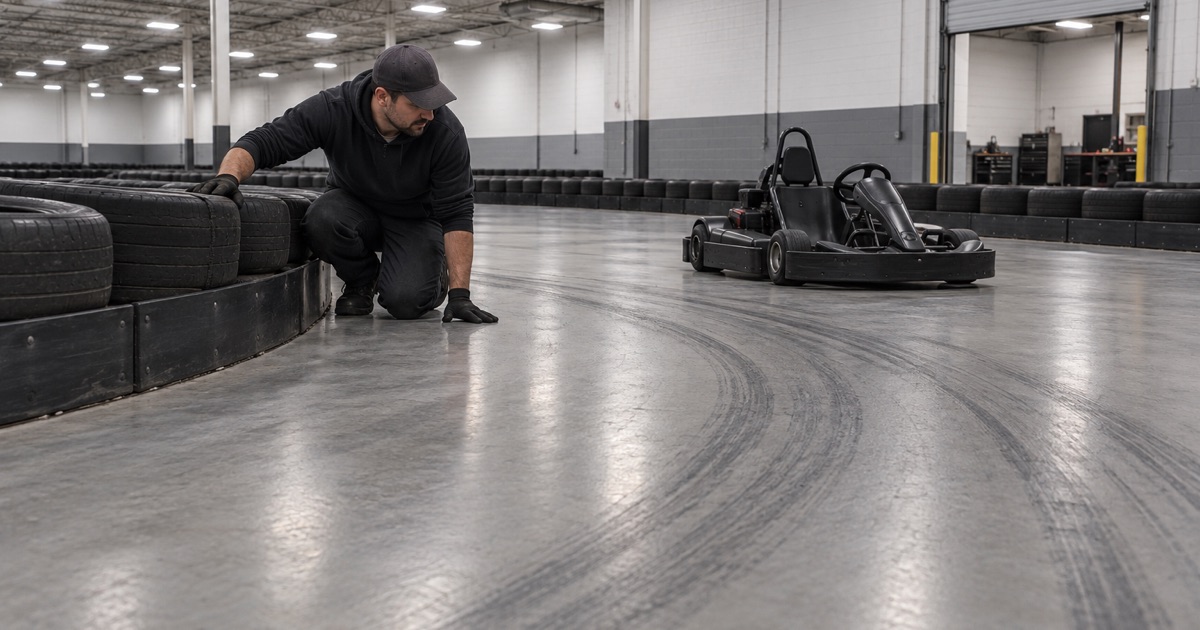
Two tracks under one roof
K1 Speed Mokena operates at 8580 Springlake Drive, near 88th Avenue and 191st Street, inside the village limits in Frankfort Township, Will County. Its own location page describes two indoor tracks, adult and junior karts that are 100-percent all-electric, and wheel-to-wheel racing at speeds approaching 45 mph. Mokena is a Will County village of 19,887 people at the 2020 census, a southwest suburb of Chicago.
The building opened in 2017 as Accelerate Indoor Speedway. Patch reported in September 2017 that it covered about 75,000 square feet with two grand prix-style tracks and 45 adult and 16 junior electric karts, which its general manager said were clean and emitted no fumes. We did not find when K1 Speed took over, and we have not seen its floor or its cleaning routine, because K1 Speed is not a customer of ours.
Solid and binding: what Illinois asks of a track
Go-kart tracks in Illinois fall under the amusement ride and attraction rules administered by the Illinois Department of Labor. Section 6000.302 of Title 56 of the Illinois Administrative Code covers outdoor and indoor concession go-karts, and its surface sentence is short: the track or course “shall be of a solid and binding material.” That sentence is the whole of the surface requirement.
The rule does not call for epoxy, urethane or any particular coating, and it does not endorse one. The same section asks for a barrier system anchored along the inner and outer edges, attendants who can see the entire course, charged fire extinguishers, and track lighting at every indoor operation. Whether K1 Speed’s karts are permitted under this section or under the separate rules for racing go-karts is something we did not check.
The everyday problem is rubber
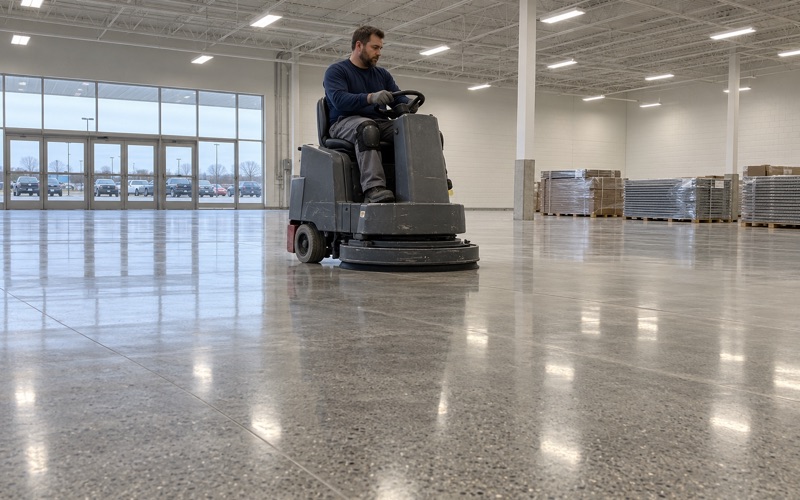
Once a floor is solid and binding, the question that shows up every day is the rubber the karts lay down. Tires shed a little of themselves where they brake, turn and accelerate, and those deposits build into dark lines along the racing line. On an indoor track the floor is the racing surface, so what those marks do to the finish is an operating question rather than a cosmetic one.
We do not know what finish K1 Speed’s track carries. One installer in Dubai describes applying a special epoxy paint to an indoor karting track to protect it from tire marks, scuffs, peels and cracks, and a resin flooring maker lists a karting track project in Hong Kong. Beyond examples like those, we found no independent data on indoor track grip by surface type.
Looking for epoxy-flooring closer to Lyons? See Epoxy-Flooring Services in Lyons.
Tire Marks on a Coating Versus a Sealer
Two kinds of finish
A two-part epoxy or polyurethane cures by chemical reaction into a hard film bonded to the ground concrete. A one-part acrylic sealer is a thinner layer that dries as its carrier leaves, and the right solvent can soften it again. That is why a sealer and a coating can look alike on the first day and behave very differently once rubber starts landing on them.
Sealers cost less and go down faster, and on a floor that sees little traffic that can be a fair trade. Where tires roll, turn and stop, the cost tends to show up later in how the floor has to be cleaned. We set the two options side by side in writing so the owner is choosing with the cleaning routine in view.
What one coating maker’s care guide says
Nutech Paint, an Australian coating maker, puts the split plainly in its care and maintenance sheet for floor coating systems. It says black tire marks can be difficult, particularly on acrylic concrete sealers, where the method is a reactivating solvent that dissolves the sealer so the sealer and the rubber stain come off together. The sealer is then applied again.
For polyurethane and epoxy surfaces, the same sheet says the coatings are generally easier to scrub and wash off, using a degreaser. That is one maker’s guidance for its own systems rather than a test result, but it follows the basic difference between the two finishes. The practical reading is simple: on a coating a mark is a cleaning job, and on a sealer it can mean a recoat.
Easier to clean is not the same as mark-free
No coating stops tire marks from appearing. A cured epoxy or polyurethane still collects rubber where wheels turn and brake, and a glossy topcoat can make a fresh mark easier to see. What the coating changes is how the mark leaves, not whether it arrives.
We say that plainly in the proposal, because a buyer who expects marks never to appear will be disappointed within a month. Slip resistance gets the same treatment, specified by the broadcast media and topcoat we use rather than promised as a slogan. A textured finish grips better and asks a little more of whoever cleans it, which is the next part of the conversation.
Cleaning a Track-Style Floor Without Stripping It
Degreaser, dwell time and a scrub
On a coated floor, the usual sequence is a degreaser or a cleaner made for rubber marks, time for it to work, then a scrub and a rinse. One trade cleaner sold for black marks from forklifts and similar wheeled equipment is marketed as removing them without damaging polymer coatings. Its directions call for a 1:1 dilution and at least 15 minutes of dwell before scrubbing and rinsing.
Those are one product’s directions, not a rule for every cleaner on the shelf. Stronger is not automatically better on a coated floor, and a solvent strong enough to lift rubber out of a sealer is the kind of product we would keep away from a topcoat until it has been tried. We leave the owner a short care note written for the exact system installed.
Test any cleaner on a hidden patch first
Both the Nutech care sheet and the forklift-mark cleaner’s directions say the same thing: try a new cleaner on a small, inconspicuous area first. In a garage that might be a corner behind the shelving, and on a larger floor a spot near a wall or under fixed equipment. A dull spot, softening or a color change in that patch is the warning that stops the job before it reaches the middle of the room.
We would rather an owner learn that from a square foot than from the whole floor. If a cleaner is not on our care note, the patch test is the step that makes it reasonable to try. Warranty exclusions are read out before the job is sold, starting with moisture, so the owner also knows which kinds of damage the paperwork will not cover.
Textured finishes take a broom first
A finish with quartz aggregate or other broadcast media in the topcoat holds more grit in its texture than a smooth gloss does. The Nutech sheet notes that anti-slip finished surfaces may need a stiff bristled broom before mopping. A mop on its own tends to glide over the high points and leave dirt in the low ones.
On a floor that carries rubber marks and grit together, the broom pass, the degreaser and the scrub work as a sequence rather than as alternatives. That routine takes a few extra minutes and keeps the texture doing its job. It holds the same on a commercial floor and a two-car garage, just at a different scale.
Tire Scuffs in a Mokena Garage
Where wheels turn at rest
A home garage is a small version of the track problem. When a driver turns the steering wheel while the car is standing still, the front tires scrub against the floor, and that twisting contact is where dark arcs tend to show up. Warm tires straight off the road add a second risk called hot tire pickup, where a weak or poorly bonded coating lifts with the tire.
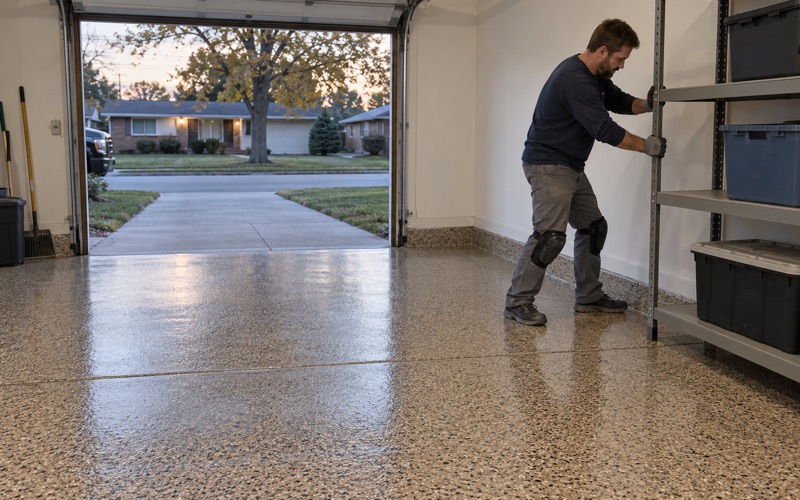
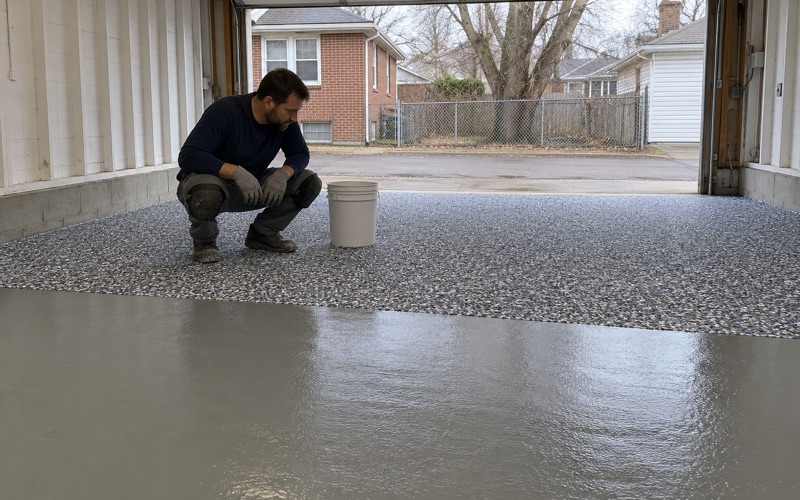
On a cured two-part coating those scuffs are a cleaning job, while on a one-part acrylic sealer they can mean dissolving and resealing the area. From December to March the same tires also carry in brine and rock salt, so the garage systems we suggest are picked to stand up to deicers as well as rubber. A 100% solids epoxy base with a polyaspartic topcoat and a vinyl flake broadcast is our usual starting point.
The slab under a 1990s or 2000s home
Census figures show 66.1 percent of the village’s housing units were built since 1990, and 30.3 percent in the 1990s alone. Among owner-occupied homes, 95.6 percent are single-family, 1,176 of them attached townhomes. For most owners here, the floor in question is a garage slab poured in the 1990s or 2000s.
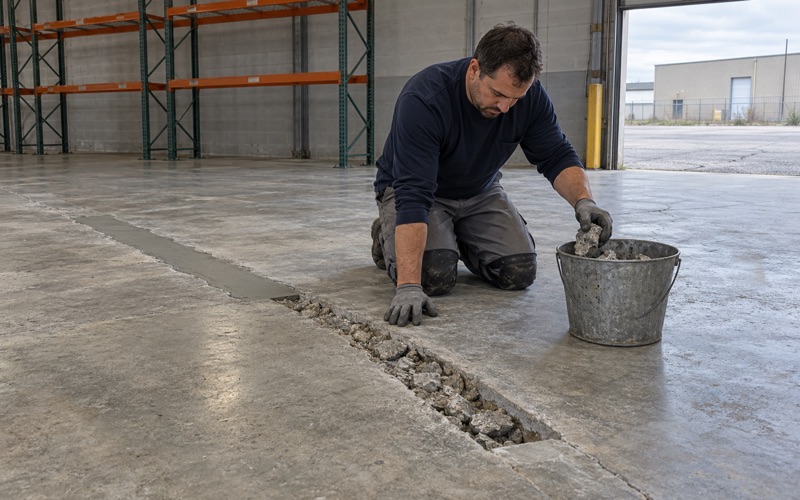
A slab that age has had decades of tires, salt and repairs, so we map cracks, spalls, old paint and patched areas before pricing, and a slab that should be repaired first is called out first. Moisture is tested to a named method, such as ASTM F1869 calcium chloride testing or ASTM F2170 relative humidity probes. Cure timing follows slab temperature and dew point, and a cold, unheated garage is told to wait.
Registering and asking the village
Contractors register with the Village of Mokena Community Development Department at 11004 Carpenter Street before working in the village. The registration calls for a $150 fee, general liability insurance of $500,000 each occurrence, workers’ compensation of $500,000 each occurrence and a $10,000 surety bond. Illinois licenses no general, flooring or coatings contractor, so the village registration is the paperwork that counts here.
The village’s permit list exempts finish work such as painting, tiling and carpeting, and floor coating is not named either way. For any project not listed, the village asks applicants to contact Community Development before starting, and we make that call rather than guess. Coatings are chosen inside the VOC limits of 35 Illinois Administrative Code Part 223, and home jobs carry a written contract signed before any grinding starts.
- 20+ Years on Concrete
- Moisture Test in Every Scope
- Free Written Estimates