Hammond Epoxy Flooring has put more than 20 years into epoxy flooring, and our work in Palos Heights starts with a question many coating crews skip: who will walk on this floor every day, and what will they see when they look down? For most garages the answer is a car and a busy household, and a speckled flake finish suits that fine. For some homes and buildings, that default finish is the wrong one.
This page is about one of those cases. Dementia-care guidance from the UK and Canada warns that speckled or patterned floors can be misread, so we plan resin floors for memory-care spaces, and for homes where a parent with dementia lives, differently from a standard garage. The chemistry stays the same, while the color, the sheen and the pattern change.
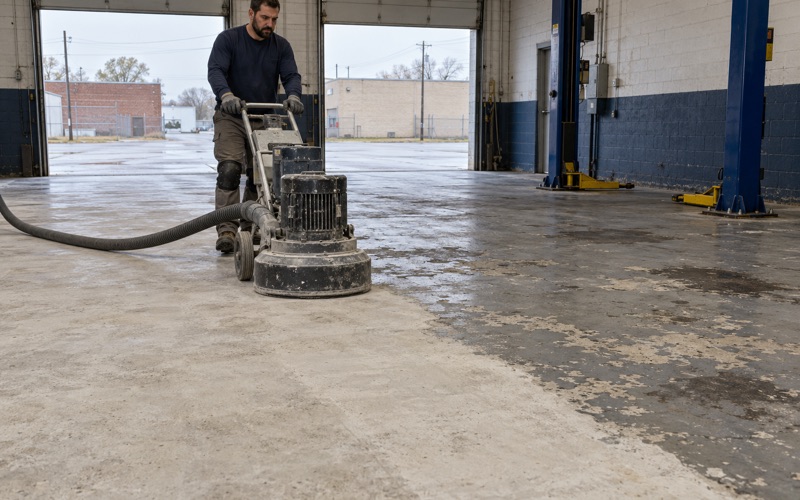
The preparation does not change with the finish. We open the slab by diamond grinding or shot blasting rather than acid etching, so the coating bonds to a measured profile. Every proposal names the product line, the coat count and the finished thickness, so the floor that goes down can be checked against the paper.
A Memory-Care Community on College Drive
Arden Courts at 7880 West College Drive
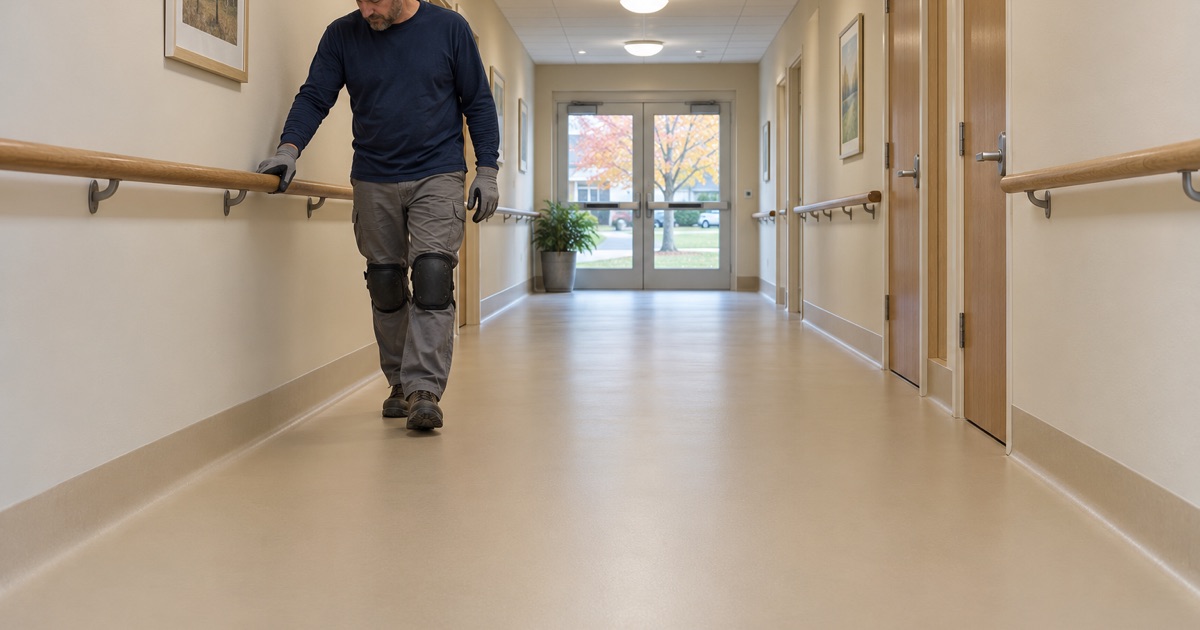
Arden Courts at Palos Heights, a ProMedica memory care community at 7880 West College Drive, serves residents living with dementia through an Alzheimer’s care program, with staff present around the clock. The address sits inside the city limits, in Palos Township. We mention it because it shows memory care is part of everyday life on College Drive.
We have no connection to Arden Courts and have not seen its floors, so nothing on this page describes them. What the building does is make a practical point concrete: a city with a memory-care community also has families nearby weighing the same questions at home. The guidance below was written for spaces where people living with dementia walk every day.
When a Pattern Looks Like Something to Pick Up
NHS England’s guidance for assessing dementia-friendly environments is direct about flooring: ‘Patterns can make it look as if there are things that need to be picked up.’ It asks that a floor ‘not have a pattern which is busy or big.’ It then sums up the whole goal in one line: ‘a good floor looks and acts like a floor - and nothing else.’
The Alzheimer Society of Canada makes the same point from a resource center it planned, noting that ‘speckled or patterned flooring can look like there is dirt on the floor.’ It adds that ‘misperceptions about the floor can cause confusion, fear, and even frustration.’ Both are guidance documents from the UK and Canada, not an Illinois or US code, and we treat them as design advice rather than a rule.
Shine That Reads as Something Else
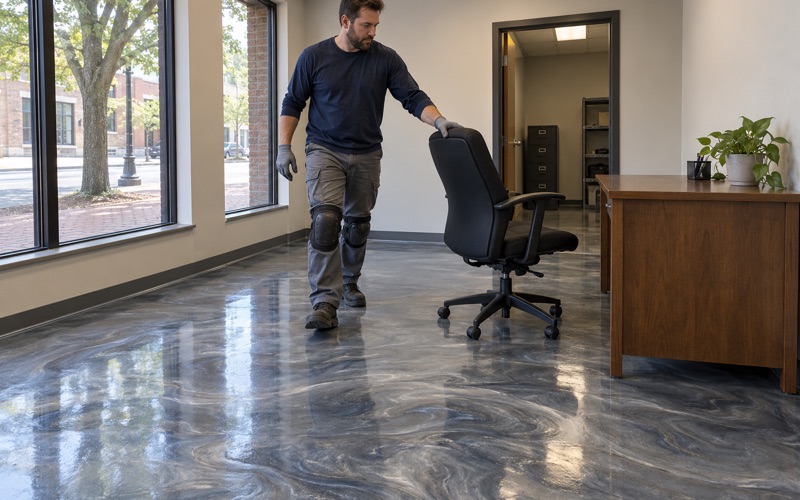
The NHS guidance also notes that ‘highly polished floors can look wet and slippery,’ and that shadows may be misread as a change in floor level. The Alzheimer Society of Canada likewise calls reflective or shiny flooring very confusing for people living with dementia. Gloss is a secondary concern here, but it travels with the pattern question because both give the eye something extra to sort out.
None of this means a floor treats anything. A coating does not reduce symptoms, change how dementia progresses or stop a fall, and we never sell it that way. What a finish can do is avoid adding a visual puzzle to a room, which is the narrow, practical job these guidance documents describe.
Looking for epoxy-flooring closer to Richton Park? See Epoxy-Flooring Services in Richton Park.
Why the Flake Broadcast Is the Wrong Default Here
What a Full Flake Broadcast Is
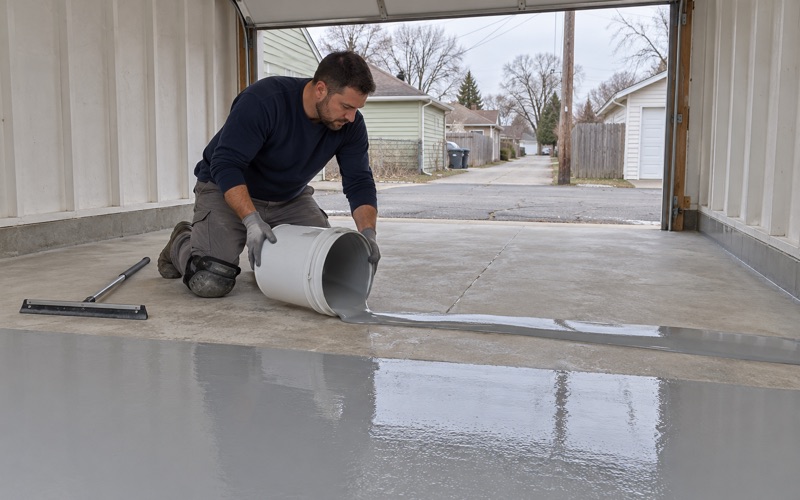
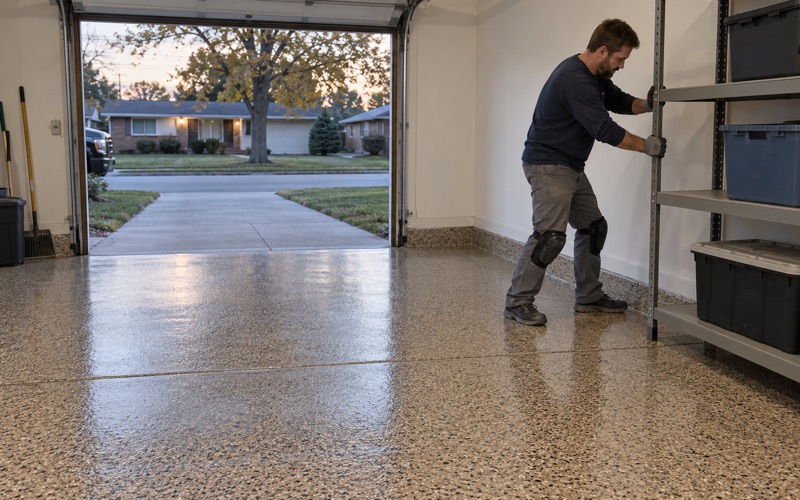
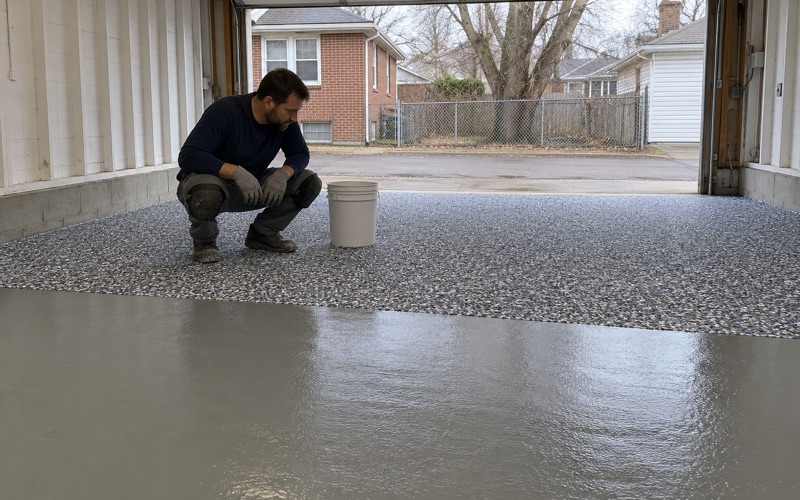
On most residential garage jobs, the decorative layer is a vinyl flake broadcast. Colored chips are thrown into a wet epoxy or polyurea base coat until the surface is covered, then scraped and sealed under a clear topcoat. It hides dust, tire marks and small slab flaws, which is why it became the standard garage look, and it leaves contrasting flecks across the entire floor.
That speckle is exactly what the guidance warns about. A flooring maker’s dementia guide, citing the University of Stirling, says flecks ‘may be seen as objects that can be picked up.’ Applying that to a garage flake floor is our own inference, but it is a short step: a flake floor is a speckled floor by design.
Fine, Low-Contrast Flake or None at All
For a memory-care space or a home where a parent with dementia lives, we price a solid color with no flake as the starting point. When an owner still wants some flake for the look, we keep the chip very fine and choose colors close to the base, so the floor reads as one tone from standing height. The difference shows in a sample board on the floor, not in a catalog photo.
We set those sample boards down in the room’s own light before anything is ordered. A blend that looks quiet under showroom lighting can look busy under one bare garage fixture or a row of basement tubes. The family, and whoever knows best how the person reads a room, makes that call with us.
Where Texture Comes From Without a Pattern
Flake gives a floor texture, and a solid floor still needs some. We get it from a fine aggregate, such as a fine quartz grit, mixed into or lightly broadcast into the topcoat, which gives the surface tooth without making a visible pattern. Slip resistance is specified by the media and topcoat named in the proposal, not promised as a slogan.
A fine aggregate in a matching-color topcoat is hard to see from standing height, and that is the point: texture you feel underfoot rather than a pattern you notice. The grit size and loading go into the written scope. That way the installed floor can be checked against what was agreed, not against a memory of a conversation.
Solid Color, Low Sheen, No Lines Across the Path
Choosing the Solid Color
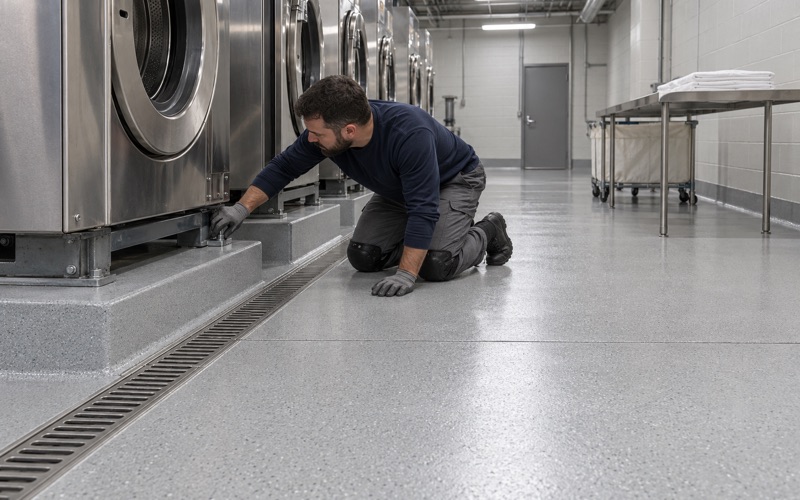
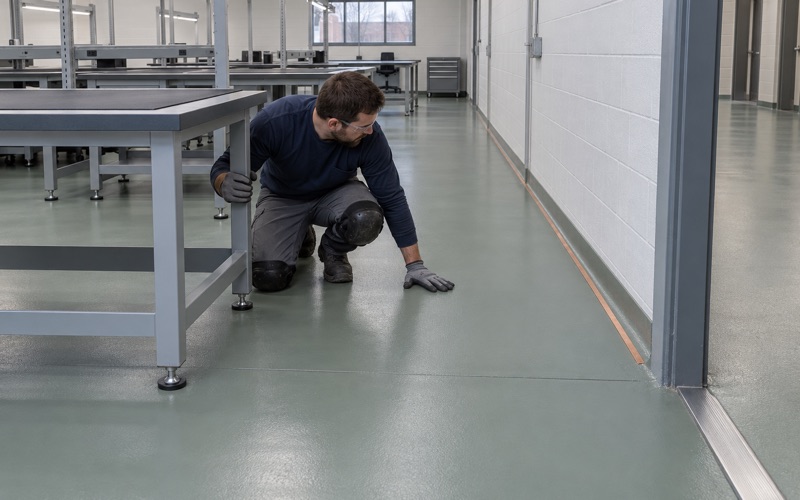
A solid-color resin floor still means choices. We look for a color that sets the floor apart from the walls and baseboard, so the edge of the room is easy to find, and keep it even across the whole walking area. A gray, tan or muted neutral usually does that, and we confirm it with a sample in the room itself.
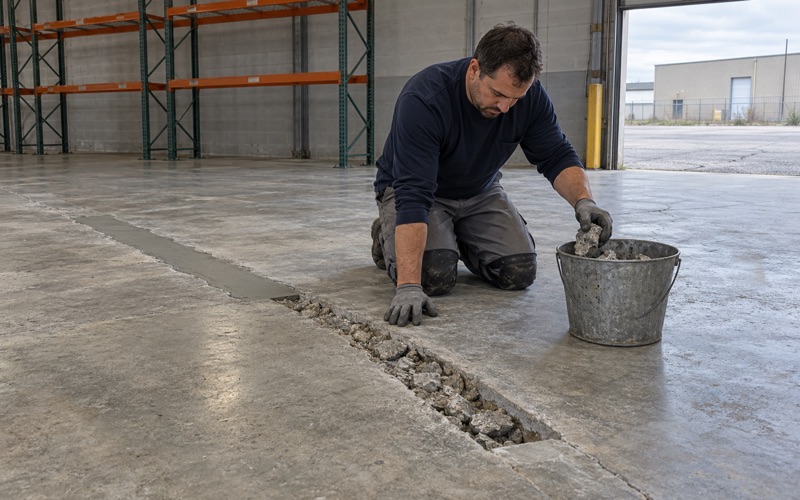
Solid color is also honest about the slab. Flake hides small flaws and a single-tone coat shows them, so repair work matters more on these jobs. We map cracks, spalls, old paint and patched areas before pricing, and when a slab should be repaired or replaced instead of coated, we say so first.
Low-Sheen Topcoats
A standard polyaspartic or urethane topcoat cures to a high gloss that shows off a flake floor. For these rooms we specify a satin or matte low-sheen topcoat instead, which cuts reflection from windows and overhead fixtures. It is a product choice made at quote time, not a buffing step afterward.
Low sheen has a care side too. A matte finish shows scuffs differently and wants the cleaner its manufacturer names, so that goes into the handoff. We also watch cure conditions, because amine blush on an epoxy coat that cured in cold, damp air can leave a cloudy film under any topcoat.
No Hard Color Lines Across the Walking Route
The NHS guidance also says a floor should not look like a step because of a sudden color change, and should not look like an obstacle because a line or pattern runs across it. That rules out the contrasting border, the painted parking line and the two-tone layout many garages and basements carry. Where a room needs a color change, we place it under a door or along a wall, not across the path a person walks.
Thresholds need the same thought. Where a coated garage meets a mudroom, or a basement meets a finished hallway, we work the transition so color and height read as continuous as the materials allow. Hazard striping belongs in plants and loading docks, not on the route between a car door and the kitchen.
Planning a Floor for a Parent With Dementia at Home
Garage, Basement or Mudroom
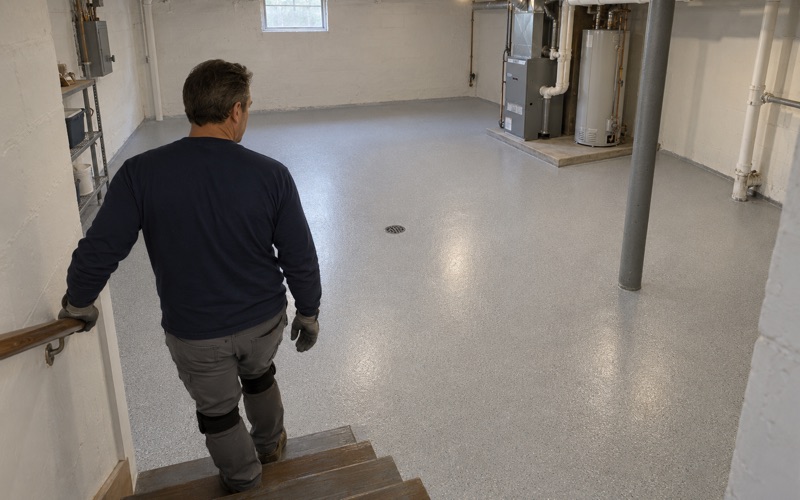
Most of these jobs are in a house rather than a care building: a garage that becomes the daily entrance, a basement turned into a living suite, or a mudroom off the drive. In Palos Heights, owners occupy 93.4 percent of homes, so the decision usually rests with the family. We ask who will use the room, at what time of day, and what the person finds hard right now.
Basements bring moisture into the plan. Before we price a below-grade floor, the scope names a test such as ASTM F2170 in-situ relative humidity probes or ASTM F1869 calcium chloride testing, along with the reading the slab must meet. A floor coating is not waterproofing or flood protection, and we never sell it as either.
Townhouses and Newer Slabs
Single-family attached homes make up 22 percent of the city’s housing, 1,020 of them owner-occupied, so many garage floors sit inside an association’s rules as well as the owner’s choice. We ask owners to check those rules before we schedule. If the association reviews finishes, we supply the product data and color sample it asks for.
The city also reports teardown-and-replacement permits for existing houses and new construction on vacant lots, so a share of slabs here are new pours. New concrete has to dry before it takes a coating, and cure timing follows slab temperature and dew point rather than the calendar. A cold, unheated garage is told to wait.
Permits, Contracts and the Proposal
The City of Palos Heights Building Department, at 7607 West College Drive, takes contractor registration in person or by mail only and does not accept emailed registrations. Permits are picked up in person as well. When a job calls for one, we plan for that trip instead of assuming an online filing.
Every home job is set out in a signed written contract before any grinding begins, with the Illinois Home Repair and Remodeling Act in mind. Our coatings fall within the VOC limits of 35 Ill. Adm. Code Part 223, and grinding dust is vacuumed at the machine rather than washed toward a floor drain. We read the warranty exclusions aloud before the job is sold, starting with moisture.
- 20+ Years on Concrete
- Moisture Test in Every Scope
- Free Written Estimates