Hammond Epoxy Flooring has been doing epoxy-flooring in Summit and the surrounding area for more than 20 years, and on every job here the first thing we read is the label on the can. Illinois decides where a coating may go by the category its maker printed on it, not by the resin inside. That makes product selection part of the scope, settled on paper before a single pass of the grinder.
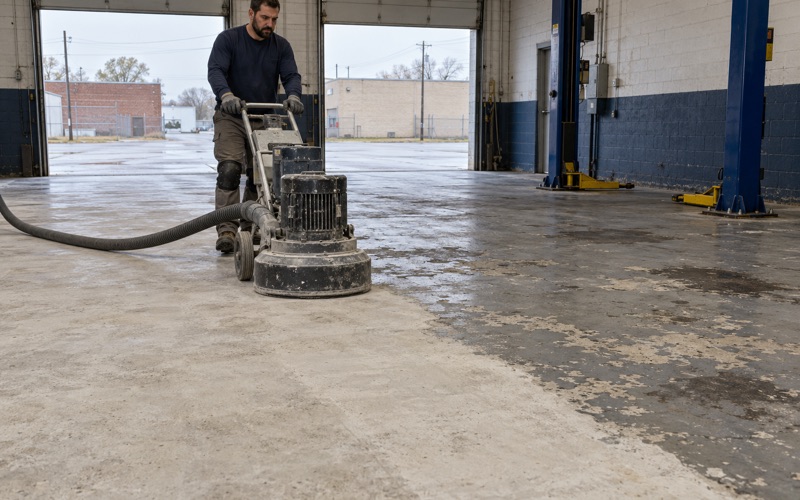
A garage, a basement and a working shop floor each ask something different of a coating, and the answer starts with the slab itself. We open the concrete by diamond grinding or shot blasting to a measured profile, never with acid, so the coating has something real to grip. The moisture test is written into the scope before the price is final, and the proposal names that test and the reading the slab has to meet.
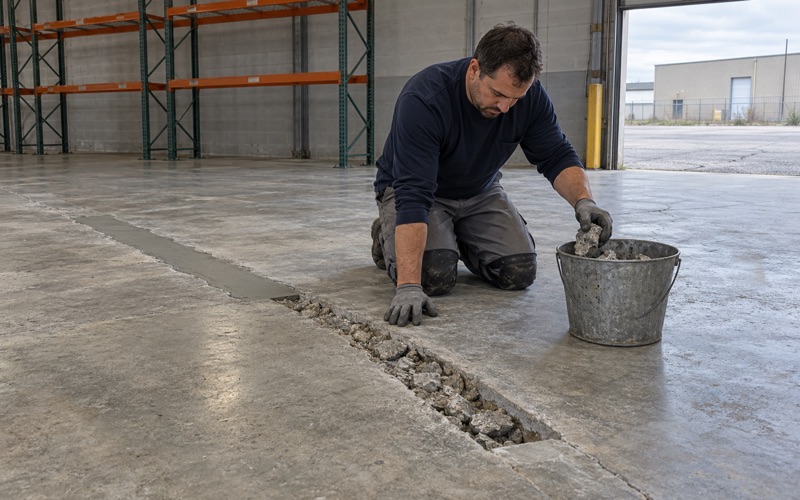
You also get the product line, the number of coats and the finished thickness in writing, so the floor we leave behind can be checked against the paper you signed. Cracks, spalls, old paint and patched areas are mapped before pricing, and a slab that ought to be repaired or replaced is called out first. The sections below show how the labeled category shapes each of those choices on a Summit floor.
A Coatings Maker on West 59th Street
Waterborne and solvent-borne lines in the village
Summit is not only a place where coatings get applied; it is also a place where they get made. Williams-Hayward Protective Coatings lists its plant at 7425 West 59th Street, and its own website sorts its products into waterborne coatings and solvent-borne coatings. The EPA’s ECHO database files the business under paints and allied products, at that address and at 7400 West Archer Avenue.
A supplier directory describes the company as a maker of coatings for the rail, OEM and maintenance industries, with waterbased and zero-VOC lines among its offerings. We have no relationship with the company, and we have not read whether it makes a floor product or what its labels say. What its catalog does show plainly is the split every coating buyer in Illinois is working inside.
Illinois sorts by the label, not the chemistry
Illinois regulates architectural and industrial maintenance coatings under Part 223 of the state’s Administrative Code, and the rule sorts products into categories, each with its own limit on volatile organic compounds. The category comes from how a product is labeled and formulated. Two products built on the same resin chemistry can sit in different categories, and two very different chemistries can share one.
That is why the word epoxy, on its own, settles nothing about where a product belongs. A two-part epoxy can be sold as a floor coating, as an industrial maintenance primer, or as something else entirely, depending on how it was made and labeled. On a Summit job we read the category first and the marketing copy last.
The rule binds whoever applies it
A VOC limit is not only the manufacturer’s concern. The Illinois rule reaches the applicator as well, so the contractor who opens the can and rolls it onto a floor answers for choosing a product whose category fits the work. We pick coatings inside the Illinois limits for both the floor and industrial maintenance categories, and the choice is ours to explain and defend on every proposal.
Looking for epoxy-flooring closer to Mokena? See Epoxy-Flooring in Mokena.
Floor Coating Versus Industrial Maintenance Coating
What a floor coating is under the state rule
Illinois defines a floor coating as an opaque coating labeled and formulated for application to flooring, including decks, porches, steps and other horizontal surfaces that may be subjected to foot traffic. Its VOC limit is 250 grams per liter. The definition turns on two things together, the label and the formulation, so a product has to be made for floors and say so on the container.
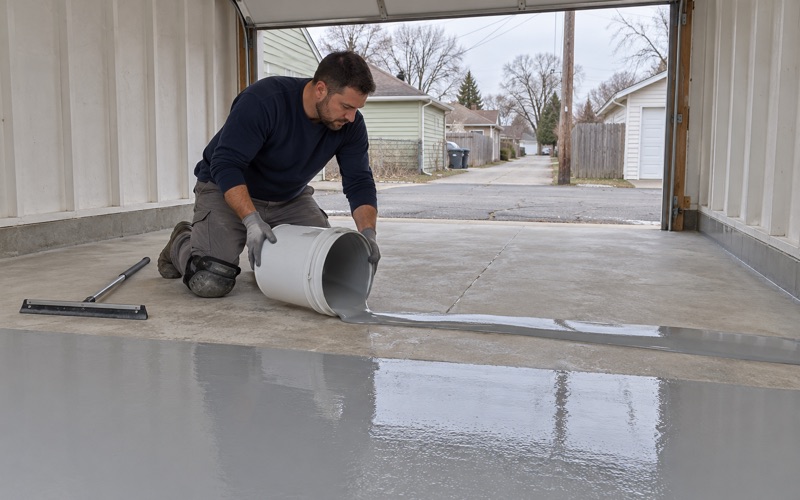
Most of what a homeowner would call a garage floor coating should land in this category. A 100% solids epoxy base coat is formulated with little or no solvent, and many polyaspartic topcoats are sold in low-VOC versions as well. Even so, we confirm the category printed on each container instead of assuming that a chemistry earns it.
What earns the industrial maintenance label
An industrial maintenance coating is a high-performance architectural coating, primers, sealers and topcoats included, formulated for surfaces exposed to extreme conditions and labeled that way. The listed conditions are immersion in water or chemicals, corrosive agents, repeated temperatures above 250 degrees Fahrenheit, and heavy abrasion. Its limit is higher, at 340 grams per liter.
The extra room exists because those service conditions are harsh, not because the category is a premium version of a floor product. A product carrying that label was formulated with a specific kind of exposure in mind. If a floor will never see that exposure, reaching for the higher-VOC category adds solvent without adding anything the job actually needs.
Where the two categories meet on one floor
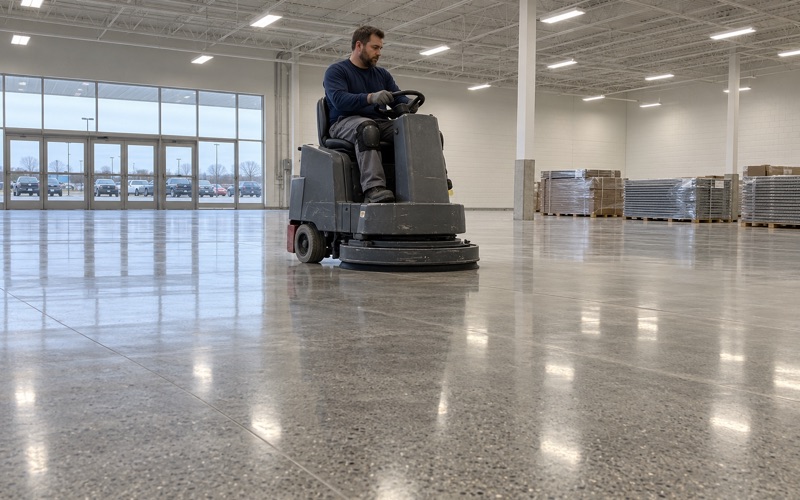
Plenty of floors in an industrial village are mixed. A plant aisle may carry only foot and cart traffic, while a wash bay or a chemical storage area a few yards away sits under standing liquid for hours. We read the actual exposure on each part of the floor and match the labeled category to it, rather than spreading the strongest-sounding product everywhere.
That reading goes into the proposal area by area. Where a zone truly calls for an industrial maintenance product, we say which zone and why, and the rest of the floor gets a product labeled for floors. Phasing those areas around shifts, with overnight and weekend windows when a space cannot close, keeps a working building running while each section cures.
Reading the Category and the Data Sheet Before a Summit Job
Category first, then the sheet
The category tells us whether a product may go on a given floor; the technical data sheet tells us whether it will work there. We read the sheet for the minimum slab and air temperature, the recoat window, the film thickness per coat and the moisture limit the maker sets for the concrete. A product that passes the category test can still fail the data sheet test.
Cure timing then follows the slab, not the calendar. We go by slab temperature and the dew point spread at the surface, and an unheated garage in a cold stretch is told plainly to wait. Rushing a cure past what the sheet allows is how amine blush and a soft, easily marked topcoat turn up a few weeks later.
What the ground under Summit adds
The village’s 2024 hazard mitigation annex says the majority of Summit lies in the floodplain of the Des Plaines River, and it notes that sewer and rainwater are combined into one sewer. Village officials said that system was overburdened in July 2023 and again on July 25, 2025, when one resident reported three feet of water in his basement.
A slab in that setting is tested before it is coated, not after the coating lifts. We use ASTM F2170 in-situ relative humidity probes or ASTM F1869 calcium chloride testing, and we compare the reading against the limit printed on the product’s data sheet. If the slab reads high, a moisture-mitigation primer goes into the scope, or the job waits until the concrete allows it.
What goes into the written proposal
Every Summit proposal names the product line, its labeled category, the coat count and the finished thickness. It also states the moisture test and the reading the slab must meet, so the installed floor can be checked against what you signed. Warranty exclusions are read out before the job is sold, beginning with moisture, because it is the failure most coating warranties leave out.
Grinding dust is collected by a vacuum at the machine rather than washed toward a floor drain. In a village whose sewer carries both wastewater and rainwater, that matters for more than tidiness. Slip resistance is specified by the broadcast media and the topcoat, such as quartz aggregate in a wet area, rather than promised as a slogan.
What the Rule Means for a Homeowner Buying a Garage Coating
Reading a store-bought kit
A homeowner rolling out a kit in their own garage is the applicator, too. The simplest check is the category on the label: a garage product should be labeled as a floor coating and sit under the 250 grams per liter limit. If the container reads as an industrial maintenance coating instead, it was formulated for harsher service than a parked car and a workbench.
Then read the data sheet before the box is opened. Look for the minimum temperature, the pot life once the two parts are mixed, and how the maker wants the concrete prepared. Some kits suggest an acid etch, and we would rather see the slab ground, because a measured profile is what a coating actually grips.
Waterborne, solvent-borne and zero-VOC are not categories
Waterborne, solvent-borne and zero-VOC describe how a product is formulated, not what it is labeled for. A waterborne product can still be labeled for heavy industrial service, and a solvent-borne one can be labeled as a floor coating within its limit. The use category is the line the state draws, and it is the one worth reading first.
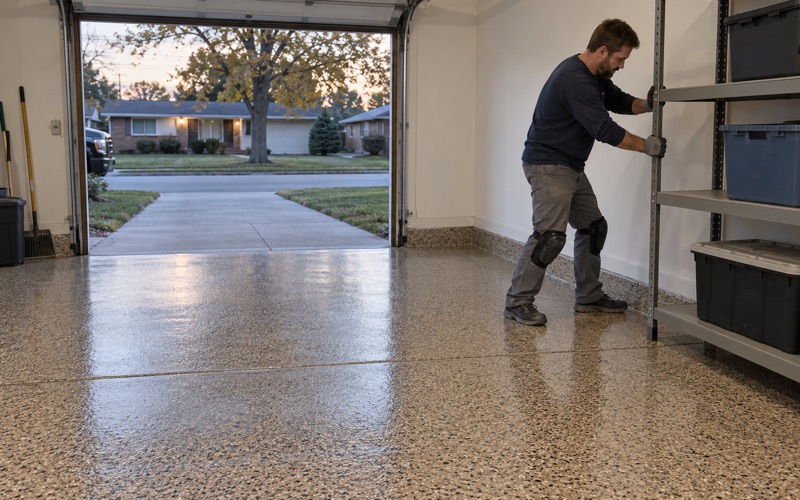
For a Summit garage, the use that matters most is winter. Brine and rock salt ride in on tires from December to March, so we choose garage systems for that exposure and for resistance to hot tire pickup. A vinyl flake broadcast under a clear topcoat also hides some of what the season tracks in between cleanings.
What a floor coating will not do
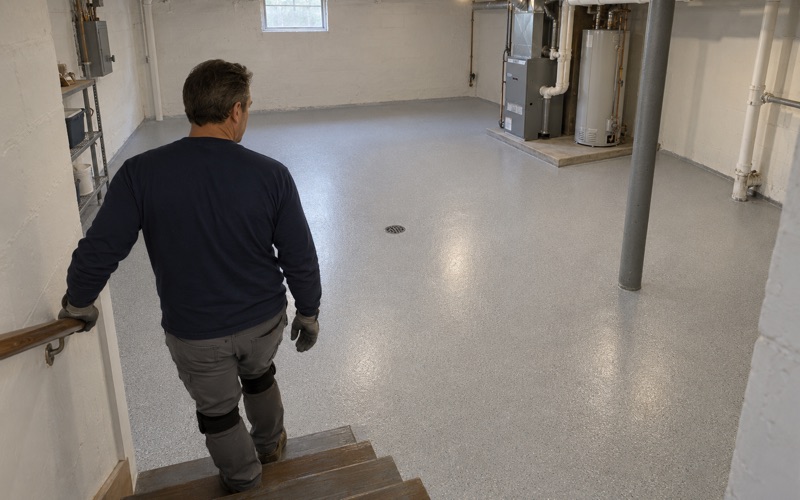
A coating is a wear surface, not a barrier against the water that has reached Summit basements in recent summers. We never sell one as waterproofing, flood protection or radon reduction. If a floor drain backs up, a seamless coated floor is easier to clean afterward, and that is the honest limit of the claim.
When a slab is too wet, too cracked or too contaminated to hold a coating, we say so before pricing. Sometimes the right first step is a repair, a moisture-mitigation primer, or a question to the Village of Summit Building and Public Works department on West 59th Street. The coating comes after that, chosen by what its label says it is for.
- 20+ Years on Concrete
- Moisture Test in Every Scope
- Free Written Estimates