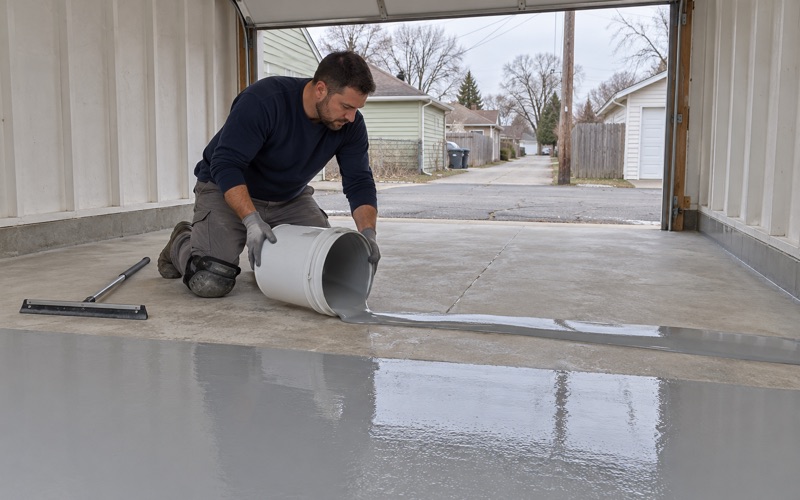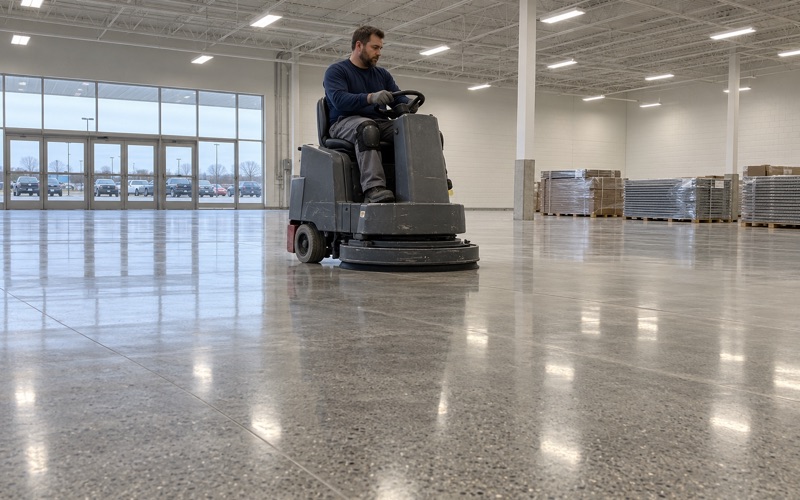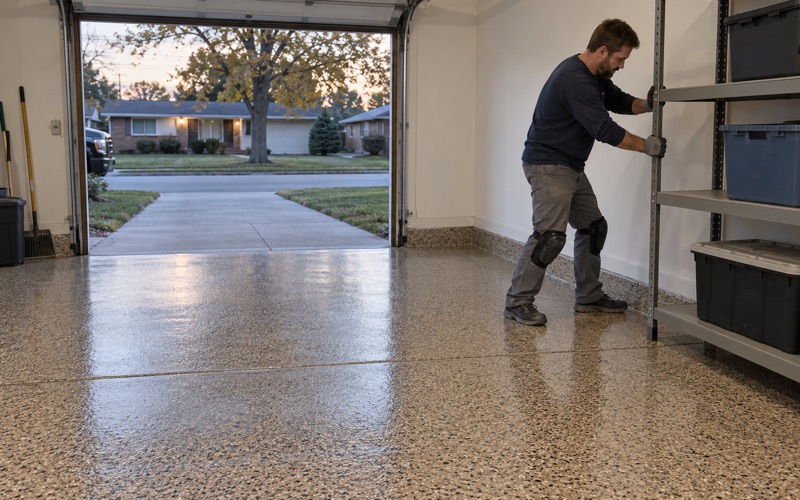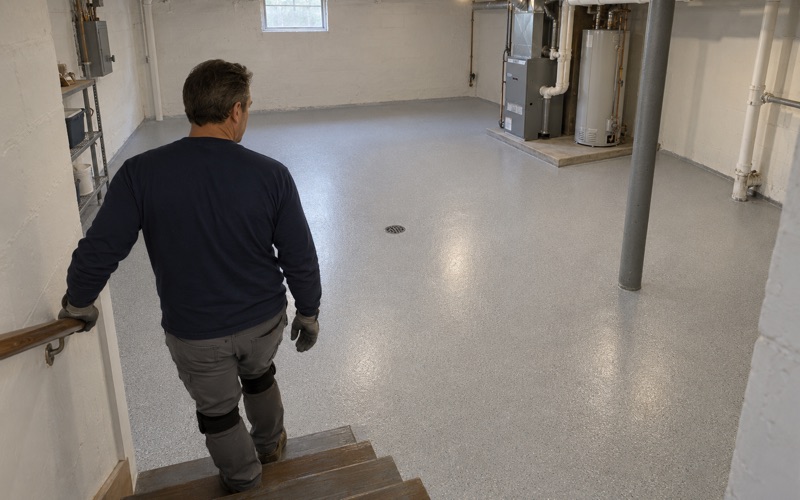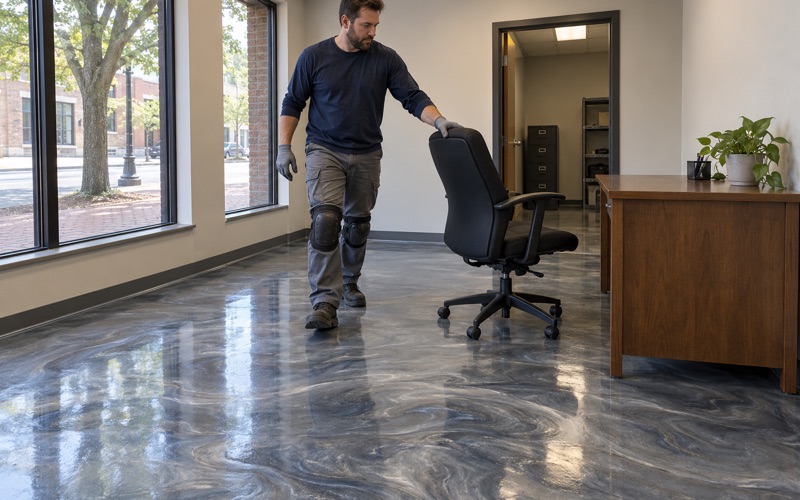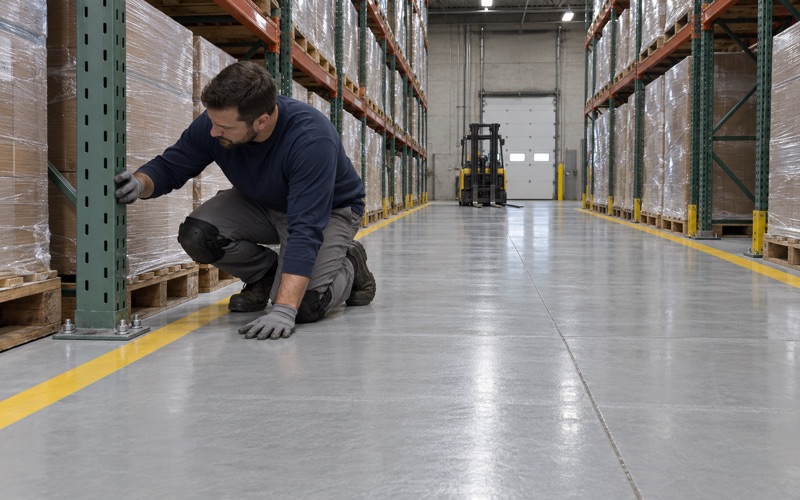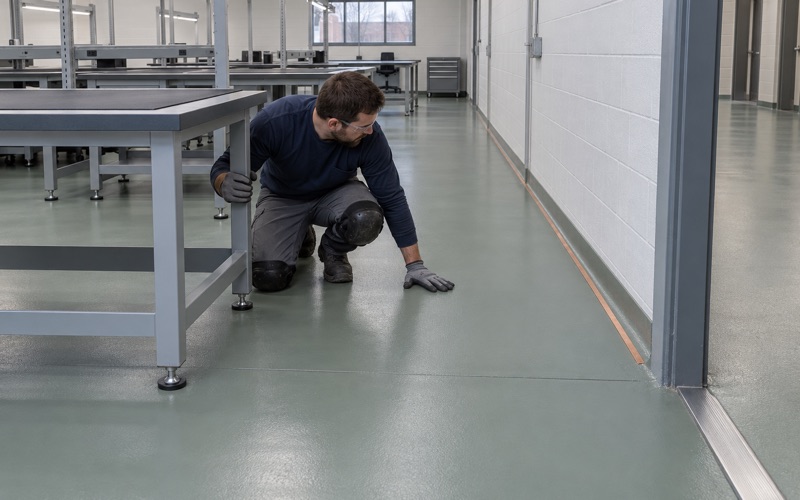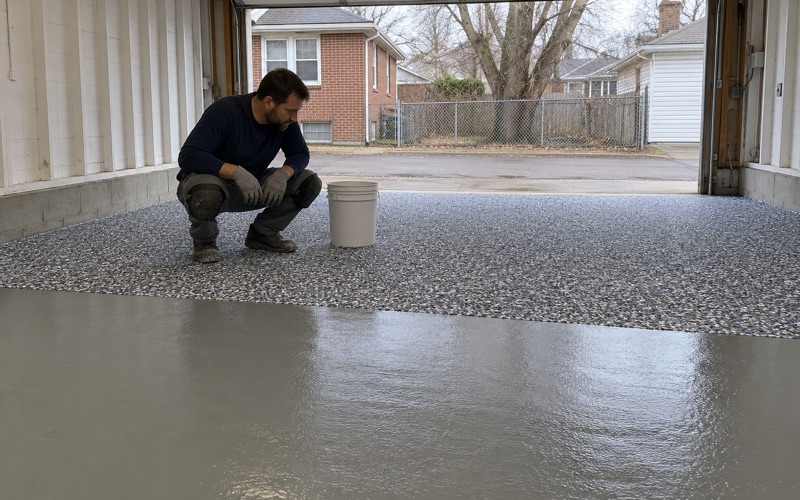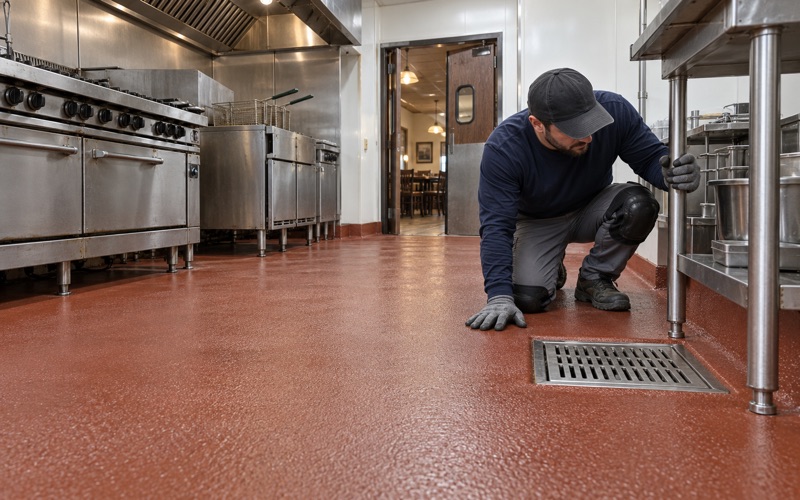
Hammond Epoxy Flooring brings more than 20 years of work to epoxy-flooring in Worth, and a floor that takes cooking oil is a job we plan differently from an ordinary garage. Frying oil is not only a stain problem. It can react with bare concrete, so the floor around a fryer has to be closed, sealed and seamless before the first basket drops.
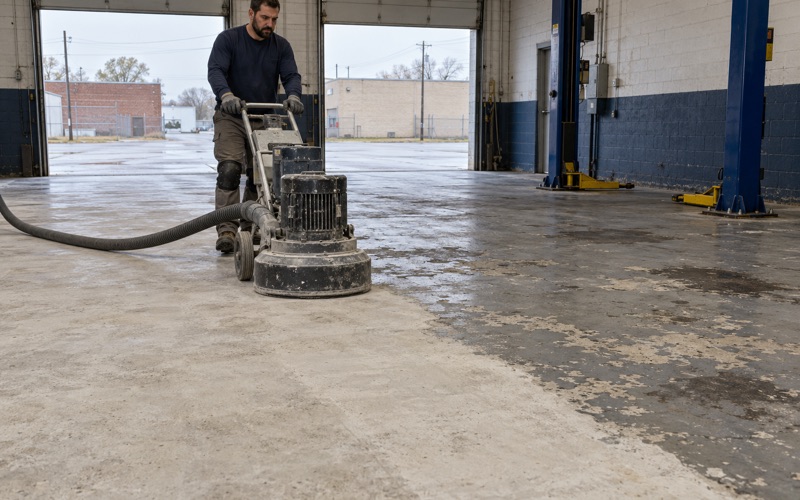
We open every slab by diamond grinding or shot blasting, never acid etching, so the coating bonds to a measured ICRI surface profile instead of a guess. Before a price is final, we map cracks, spalls, old paint and patched areas, and we tell you plainly when a section should be repaired or replaced first. In a kitchen, that map matters more than anywhere else, because open joints are exactly where cooking fat goes.
Every proposal we write names the product line, the number of coats and the finished thickness, so the installed floor can be checked against the paper. Moisture testing is part of the scope, with the test and the passing reading spelled out before you sign. We also go through the warranty exclusions before the job is sold, starting with moisture, the failure most coating warranties leave out.
Friday Fish Fries at the Legion on Depot Street
Marrs-Meyer American Legion Post 991 sits on Depot Street, right across from the Metra station, and its own page says the public is always welcome. A Patch roundup of south-suburban Lenten fish fries lists the post serving on Fridays during Lent, from February 20 through April 3. That is a long run of Friday frying in a hall kitchen, and it makes a useful example of what oil asks of a floor.
What a Friday Fry Line Puts on the Floor
We have not seen the post’s kitchen, and nothing on this page describes its floor or suggests it is a customer of ours. What we can describe is the pattern a crowded fish fry tends to follow anywhere. Oil, fish batter and breading drop and get tracked around the fryers, the spot where baskets land and the walk to the oil-disposal container.
Most of that gets wiped up the same night. The part that does not ends up where a mop reaches poorly: the seam under a fryer base, a crack running beneath a prep table, the grout lines of an old tile floor. Those are the places where cooking fat does its slowest and least visible damage.
A Busy Season, Then Quiet Months
A hall kitchen that runs hard for a few weeks a year and lightly the rest of the time is easy to overlook. Oil that settles into a crack during Lent is still there in summer, and nobody looks at that corner until the next fish fry starts. We would rather close those openings before a busy season than find them after it.
Looking for epoxy-flooring closer to Cedar Lake? See Epoxy-Flooring in Cedar Lake.
Cooking Oil Does More Than Stain Concrete
Most people think of spilled oil as a cleaning issue, a dark patch that never quite comes out. With cooking fats, the bigger concern is chemical. The oils and fats used for frying can react with the cement that holds concrete together, which is why we keep them off bare concrete wherever we can.
Saponification in Plain Terms
Cement paste is alkaline and rich in calcium compounds. When fats and oils sit against it, the alkali and the fat can react in a process called saponification, the same basic chemistry that turns fat into soap. A Japan Concrete Institute paper describes cement-based materials swelling and breaking apart by chemical expansion through that reaction.
The products of the reaction take up room inside the paste, and micro-cracks start where they form. Those cracks give more oil a path inward, so on a slab that stays wet with fat the damage can feed itself. A sealed surface interrupts that cycle by keeping the fat on top, where it can be cleaned off.
What 60 Days in Oil Did to Concrete in the Lab
Researchers at RUDN University soaked concrete and cement-sand samples in corn, olive and palm oil at 16 to 24 degrees Celsius. After 60 days, compressive strength had fallen by an average of 61.2 percent, and the university’s release says that in 90 days of contact with oil, concrete collapses. The mechanism they gave was calcium compounds in the cement reacting with the oils to form fatty-acid products.
That was a full laboratory immersion, not a kitchen floor. A hall kitchen sees drips and smears, not samples sitting submerged for two months, so the figure is not a rate for any floor in Worth. We use it for what it does show: cooking fat and bare cement do not belong in contact, and the time to stop that contact is before it starts.
Joints, Cracks and Grout Lines Are the Way In
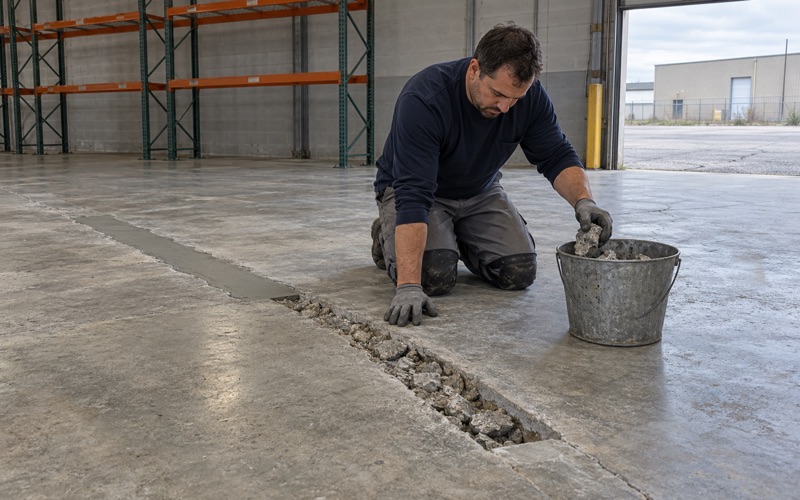
On a sound slab with an intact coating, oil sits on the surface. Trouble starts at the openings, such as a control joint that was never filled, a hairline crack, a chipped edge beside a drain or cement grout between old tiles. Fat finds those openings first, and once it is inside, no degreaser fully pulls it back out.
That is why our pre-pricing map carries so much weight in a kitchen. We mark every crack, spall and joint, and the scope states how each one will be closed, whether with a filler, a patch or a repaired section. A coating rolled over open joints only moves the problem a few feet.
Fryers, Baskets and the Path to the Grease Bin
Oil does not land evenly across a kitchen. It concentrates in a few predictable zones, and planning a floor around those zones works better than treating the whole room as one surface. The layout of the fryers, the draining station and the exit route tells us where the system has to work hardest.
Drip Zones at the Fryers and the Basket Landing
The heaviest film tends to sit in front of the fryers, where baskets come up dripping, and at the landing where cooked fish is tipped out to drain. Breading and batter dust collect there too and turn into a paste when they meet oil. Those zones want the most durable build in the system and a seamless surface with nowhere for that paste to pack in.
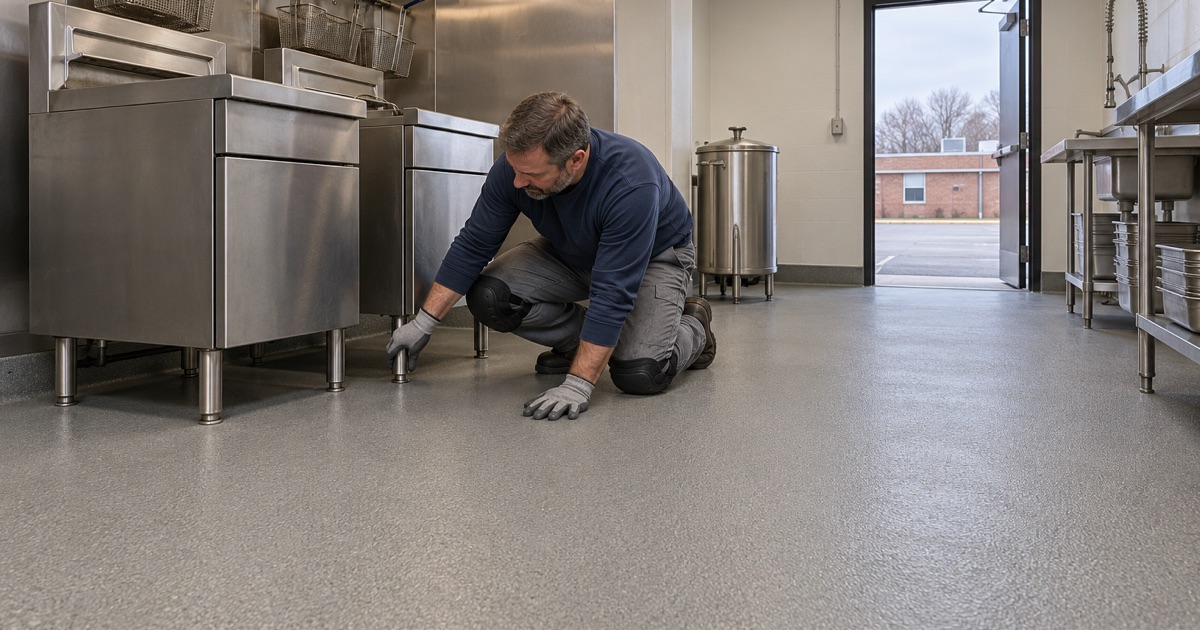
For the body of a floor like this we generally look at 100% solids epoxy, with urethane cement as the option where hot-water washdown and temperature swings are part of the routine. The proposal names which system goes where, the coat count and the finished thickness. That way there is no guessing later about what was installed in front of the fryers.
Texture That Grips When the Floor Is Oily
A smooth, glossy floor with a film of oil on it is slippery. We specify slip resistance by the broadcast media and the topcoat, typically a quartz aggregate broadcast locked in by the finish coat, rather than promising grip as a slogan. The texture has to be coarse enough to hold underfoot and fine enough that a deck brush still reaches the bottom of it.
Cleaning matters as much as texture. A degreaser that lifts the film and is then rinsed or picked up removes the oil, while a mop pushed through it with plain water mostly spreads a thinner layer across a wider area. We go over a cleaning routine with whoever runs the kitchen, since the wrong chemistry can dull a topcoat or leave it slick.
A Lidded Caddy and a Clean Route to the Grease Container
Used fryer oil has to leave the kitchen somehow, and the route it takes often shows on the floor. Carrying spent oil in a lidded caddy rather than an open pot keeps sloshes off the path to the grease container. That route, and any threshold it crosses, deserves the same sealed, textured finish as the fryer line.
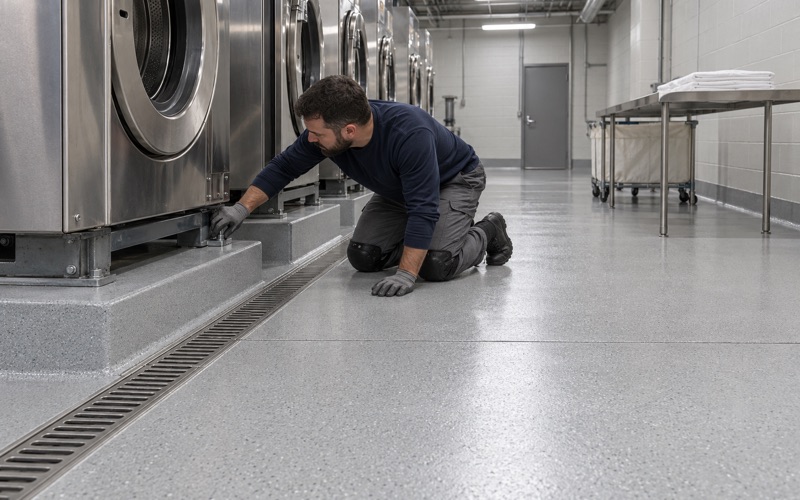
Where the path meets old tile or a doorway, we detail the edge of the new coating so it does not leave a lip that catches a cart wheel. Floor drains and grease interceptors are worth a look on the same visit. A drain body sitting low in a cracked slab is one more place for oil to collect.
Deep Fryers and Cooking Oil in a Worth Garage or Basement
Home cooks who run a turkey fryer, a fish fryer or a canning setup in a garage or basement face the same chemistry on a smaller scale. Oil that soaks into bare concrete stays there, and the stain is the visible part of it. A sealed corner where the fryer lives is a modest job that heads off a lasting one.
Older Slabs Need a Closer Look First
Census housing figures put about three-quarters of Worth’s homes in the 1950 through 1979 building years. That makes most garage and basement floors here retrofits over a slab roughly 45 to 75 years old. Slabs of that age commonly carry old paint, patches and cracks that have to be handled before any coating goes down.
On those slabs, moisture testing comes first. Depending on the floor, we may use an ASTM F2170 in-situ relative humidity probe or an ASTM F1869 calcium chloride test, and the proposal names which one and the reading the slab must meet. If it falls short, we talk about a moisture-mitigation primer or about waiting, rather than coating over the problem.
Seal the Corner Where the Fryer Lives
For a garage fryer corner, the plan is a kitchen in miniature: grind, fill every crack and joint, and lay a sealed, seamless coat with a texture that holds when oily. A vinyl flake broadcast suits the rest of a garage, and we can tighten the texture near the fryer so a spill is easy to squeegee up.
Cure timing follows slab temperature and dew point rather than the calendar. An unheated garage in a cold month is told to wait, since a coating cured too cold can develop amine blush and lose bond. A frying season is not worth a floor that starts peeling by summer.
Shared Garages, Village Licensing and Who Signs
Worth has a sizable apartment and condominium layer, including 1,060 units in buildings of 10 to 19 units, and 340 of those are owner-occupied. A shared garage, storage room or laundry floor in one of those buildings is decided by the association or the owner, not the unit occupant. We confirm who signs before we quote.
Worth requires contractors working in the village to register for $110, carry a certificate of insurance naming the village and post a $10,000 surety bond. The building department’s permit list names remodeling projects but not flooring either way, so we ask before starting rather than assume. Every home job also gets a written contract, signed before any grinding begins.
- 20+ Years on Concrete
- Moisture Test in Every Scope
- Free Written Estimates